
• Welcome to Photrio!
    Registration is fast and free. Join today to unlock search, see fewer ads, and access all forum features.
    Click here to sign up

Selenium toner and shadow areas

A long time ago...

A
A long time ago...

  • 0
  • 0
  • 31
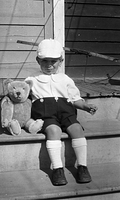
Boy and teddy, 1920's.jpg

A
Boy and teddy, 1920's.jpg

  • 2
  • 2
  • 45

Recent Classifieds

Forum statistics

Threads
201,202
Messages
2,820,407
Members
100,582
Latest member
v1photos
Recent bookmarks
0

Colin Corneau

Member
Allowing Ads
Joined
Nov 20, 2007
Messages
2,365
Location
Winnipeg MB Canada
Format
35mm RF
Spent the weekend trying my first go with selenium toner.

I mixed Ilford/Harman's selenium toner 1:10, and toned a few prints I'd made on Ilford's Warmtone VC fibre base paper.

I was pleased, for the most part. While I know a greater dilution will have a more subtle effect on the print, I was most curious about the effect on the print's dark areas.

They didn't quite block up, but the print got noticeably darker. My question: is it wiser to print slightly lighter, or less contrast, if one knows they'll be selenium toning later on?

Many thanks
 

Vaughn

Subscriber
Allowing Ads
Joined
Dec 13, 2006
Messages
10,275
Location
Humboldt Co.
Format
Large Format
I suppose it is a matter of why one is toning.

Just for archival purposes, one uses a much more dilute toner -- which results in little or no change in density or color. No reason to print differently.

Toning for color change -- usually higher dilution, which can cause an appearent rise in contrast with the shadows darkening slightly (highlight values remain the same). Might want to print with slightly less contrast -- not over-all density (that is, lighter), so that the highlights stay the way one wants them. Printing lighter might lose the delicate highlights one wants.

Vaughn
 
OP
OP
Colin Corneau

Colin Corneau

Member
Allowing Ads
Joined
Nov 20, 2007
Messages
2,365
Location
Winnipeg MB Canada
Format
35mm RF
Yes, the shadows definitely went darker, even losing some detail slightly.

I'd like a subtle tone shift, and archival quality remains regardless of dilution used (or so I've read).
 

Chuck_P

Member
Allowing Ads
Joined
Feb 2, 2004
Messages
2,369
Location
Kentucky
Format
4x5 Format
I think the degree of deepening of the shadows is pretty variable with different papers. I've only selenium toned with Ilford MGIV FB and I don't feel the need to change my desired contrast, but with a different paper, I may find otherwise.
 

Bruce Osgood

Membership Council
Member
Allowing Ads
Joined
Sep 9, 2002
Messages
2,642
Location
Brooklyn, N.Y.
Format
Multi Format
A factor you may wish to consider is Dry Down. Some papers do not require this consideration and I don't know if yours is one of them. But a print will dry to a darker tone overall than is anticipated when looking at the wet print. IF your paper is subject to dry down and you haven't taken that into consideration then you will get an even darker print after toning. This is not to say the blacks will lose seperation but they will not look well defined.

Les McLean has a lot of info on dry down in his book and there probably is a lot here if you do a search.
 
OP
OP
Colin Corneau

Colin Corneau

Member
Allowing Ads
Joined
Nov 20, 2007
Messages
2,365
Location
Winnipeg MB Canada
Format
35mm RF
Thanks for the headsup, Bruce.

I did wait until papers dried, in both cases, before making a judgement. I also had several identically printed versions of each to go by, too.

Sounds like more experiments with dilution ratios are in order.
 

Bruce Osgood

Membership Council
Member
Allowing Ads
Joined
Sep 9, 2002
Messages
2,642
Location
Brooklyn, N.Y.
Format
Multi Format
Thanks for the headsup, Bruce.

I did wait until papers dried, in both cases, before making a judgement. I also had several identically printed versions of each to go by, too.

Sounds like more experiments with dilution ratios are in order.

And temperature. Also a source of inconsistency.
 

AlanC

Member
Allowing Ads
Joined
Feb 23, 2004
Messages
348
Location
North Yorksh
Colin,

Ilford Warmtone fibre (glossy) is my favourite paper. I always selenium tone it, to enrich the print's appearance, using Harman selenium toner at 1+3. As you have discovered this does darken the shadows. Two ways you can deal with this are:

1. Selenium tone as part of of the process, not as an add-on afterwards. When my print comes out of the fixer I wash it for 1 minute, then soak it in hypo clear for 1 min. then selenium tone it. If the shadows go too dark I can then easily do another print. I sometimes do this with test strips too.

2. Aim to first get an untoned print that looks good in the shadows and highlights when judged wet. For the final print knock 10% off the exposure time. This will take care of dry down in the highlights. The shadows will also look lighter but will darken down to what they were (or a little darker) when you selenium tone the print.

I watch the print like a hawk when it is in the selenium toner, and transfer it to water as soon as I see a colour change -or indeed any change- start to occur. I like prints with just a hint of colour change.
As far as the colour is concerned I find that if I develop in Neutol WA I get a coolish brown/purple, and if I develop in Harman Warmtone I get a warmer colour. I prefer the latter, but others may not.

When you get used to this paper and how it changes in selenium you will find that you won't need to do step 2 so rigorously. The whole process will become intuitive and easy to control.
Hope this helps.

Alan Clark
 

Tom Stanworth

Member
Allowing Ads
Joined
Sep 4, 2003
Messages
2,021
Format
Multi Format
I use a super bright little spot when selenium toning and see the color and density change very early. If doing important stuff I make 3-4 prints of everything and place one print in water next to the toner under the same light so I can see the change in the toning print. I usually print slightly lower in contrast with most papers when selenium toning. some, like Oriental Seagul gain LOADS of density including highlights, when well toned. Others, Like MGIV tone very slowly and once done more closely the resemble the original with deeper blacks and more richness. Ilford Wt is somewhere in between, despite being WT. Forte papers go nuts if you are not careful!
 
OP
OP
Colin Corneau

Colin Corneau

Member
Allowing Ads
Joined
Nov 20, 2007
Messages
2,365
Location
Winnipeg MB Canada
Format
35mm RF
Great advice, all. Alan, I like your approach and will try it next time I'm in the darkroom.

I've done a lot of prints already for this exhibition, but can easily do more if need be and at least I have lots of prints to experiment with!
 

smieglitz

Member
Allowing Ads
Joined
Oct 18, 2002
Messages
1,950
Location
Climax, Michigan
Format
Large Format
..Forte papers go nuts if you are not careful!

I concur. I just experimented with some Forte Classic MG and it really reacts well in toners. And, very quickly too. The first print got away from me in KRST 1+6. The stuff reminds me of old Portiga Rapid. And the cream base is sweet and reminiscent of Kodak Ektalure. The Natural surface is akin to old Luminos textured papers.

Yesterday I printed the same image in: Thiocarbamide-Sepia at various bleach times and AB toner dilutions; Thiocarbamide-Gold; Thiocarbamide Sepia then Thiocarbamide-Gold; Selenium (KRST); Selenium then Thiocarbamide-Gold; and Thiocarbamide Gold then Selenium. Wonderful variations in effect. I'll scan the results and post to the technical gallery when I get a chance.

AFA the original question, I usually print with slightly lower contrast when planning to selenium tone. I give slightly more exposure if I will use a toner that incorporates a ferricyanide bleach. I much prefer warm-tone papers as they react in selenium to change color to a greater degree than cold-tone papers.
 
OP
OP
Colin Corneau

Colin Corneau

Member
Allowing Ads
Joined
Nov 20, 2007
Messages
2,365
Location
Winnipeg MB Canada
Format
35mm RF
Me too. I have both but so far have only used the Harman brand.
 

vic vic

Member
Allowing Ads
Joined
May 23, 2008
Messages
166
Location
israel
Format
Multi Format
i dont know the ilford brand selenium, but a strong delution indeed changes the print appearance quite dramatically. ilford MGW paper for example goes to strong purple-red-brown tones with cold/sterile look ... at least with kodak and fotospeed seleniums.

im refering to fotospeed and kodak seleniums that are very similar, almost seem to be identical actually in practice
a much more deluted selenium will have far less dramatic effect both on color and on contrast. 1+20 to 1+30 delutions for 1 to 3 minutes give some sparkle to the print... the tones seem to be more differentiated in all tonal values. personally, i dont make any special adjustments in printing. i just make the archival toning and the dry print looks and feels almost identical to the wiped and not fully dried print without archival toning... true too all papers, normal, warmtones, but especially true that the sparkle of the toned dried paper is maintained in its "look" with matt and semi-matt papers (otherwise, usually matt and semi matt papers loose the luminosity when dry)
 
Photrio.com contains affiliate links to products. We may receive a commission for purchases made through these links.
To read our full affiliate disclosure statement please click Here.

PHOTRIO PARTNERS EQUALLY FUNDING OUR COMMUNITY:


Ilford ADOX Freestyle Photographic Stearman Press Weldon Color Lab Blue Moon Camera & Machine
Top Bottom
