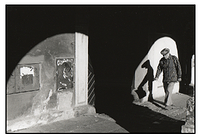
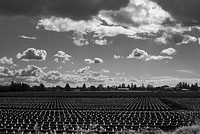
Rodinal gives, for the most part a fairly long and straight curve, which means very even tonality. Shadow detail is slightly compressed so you will see a distinct toe. If you develop longer in Rodinal, pretty much the whole curve adds density at the same rate, and it's very powerful so it'll keep doing that for a long time. But straight line, unless you slow down agitation a bit (to 3 minute or 5 minute agitation intervals), in which case you can force a curve with a shoulder and somewhat compressed highlights.
HC-110 gives an upswept curve as well as a toe. To me, effective film speed (shadow detail) is very similar between HC-110 and Rodinal.
The upswept curve means very good separation the higher up towards the highlights you get. But be careful, if you develop for too long you will easily go beyond the printable range and get highlights that block up. In normal negatives this also means that if you bring down highlights to printable levels, by using a lower contrast paper or paper filter, mid-tones can seem a bit dark. This is good for some subject matter, and not so much for other kinds.
Both developers can give very pleasing results, and lots of people do just that all the time. They are different in tonality, however, as described above, where Rodinal catches more of the highlights, but with less separation than HC-110, but has better separation in the mid-tones, and shadow detail is about equal. In my opinion, Rodinal is better for medium to high contrast lighting, and HC-110 better for low contrast lighting.
Less important, to me, is that Rodinal gives a sharp, but beautiful grain, whereas HC-110 looks a bit less distinct. Rodinal gives sharper edges. HC-110 gives slightly finer grain.
- Thomas