
• Welcome to Photrio!
    Registration is fast and free. Join today to unlock search, see fewer ads, and access all forum features.
    Click here to sign up

rodinal does not like continuous agitation

Inconsequential

H
Inconsequential

  • 0
  • 0
  • 13
Emi on Fomapan 400

A
Emi on Fomapan 400

  • 5
  • 3
  • 79

Recent Classifieds

Forum statistics

Threads
201,797
Messages
2,830,359
Members
100,957
Latest member
Tante Greet
Recent bookmarks
1

stawastawa

Member
Allowing Ads
Joined
Jan 12, 2014
Messages
101
Location
Portland, OR
Format
Medium Format
so i hear... tell me and show me more!

can any one say and show an example of why rodinal does not like continuous agitation? does it not like continuous agitation at all concentrations (eg would 1:20 be ok but 1:200 not good)
 
Joined
Sep 10, 2002
Messages
3,675
Location
Eugene, Oregon
Format
4x5 Format
I think a lot of people use Rodinal as a compensating developer, i.e., at very high dilutions with reduced agitation, etc. Continuous agitation basically makes any compensation impossible; there is no chance for the developer to exhaust in the highlights and still keep working in the shadows. This, of course, happens with any developer; it's just that most developers get used in a non-compensating manner. Using HC-110 dilute and with reduced agitation is worlds apart from using it in a rotary processor with continuous agitation too. Anyone who depends on the compensating effects of any developer by using higher dilutions and/or reduced agitation is likely not going to like the results from continuous agitation.

[Edit] As Michael points out below, Rodinal should work just fine as a non-compensating developer with continuous agitation and the right developing time.

Best,

Doremus
 
Last edited:

Harry Stevens

Member
Allowing Ads
Joined
Dec 18, 2014
Messages
424
Location
East Midland
Format
Multi Format
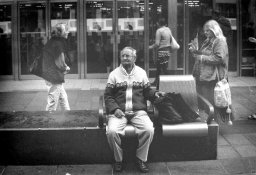
Here is a rough picture I took when testing a camera out and the results of blown highlights I believe caused by over agitation by me using Rodinal 1+50 mix/ I am not a chemist or any kind of expert on developers but I do remember giving it a good shake every minute.:smile:

Look at the ladys bag and the peoples trousers it effected the highlights in the entire roll..........Put the sunglasses on folks.:smile:
 

Attachments

  • Fred.jpg
    Fred.jpg
    116.1 KB · Views: 717

Paul Howell

Subscriber
Allowing Ads
Joined
Dec 23, 2004
Messages
10,100
Location
Scottsdale Az
Format
Multi Format
I use Adox version of Rodinal 1:50 develop Foma 200 and 100 in a Unicolor film drum, have not had any issues with blown highlights. Are you using the posted times for development or are reducing development time to compensate for the bright highlights?
 

Leigh B

Member
Allowing Ads
Joined
Jan 17, 2011
Messages
2,059
Location
Maryland, USA
Format
Multi Format
Rodinal should be fine with continuous agitation if development time is adjusted accordingly.
It seems you don't understand the concept of a compensating developer.

Doremus explained it correctly in post #2.

Compensation works by allowing the developing agent to be exhausted in areas of high density, so development stops in those areas before it stops in the mid-tone areas. This can prevent highlights from blocking up and losing detail. Compensation can only happen when the developer is still, i.e. not moving.

Rodinal likes gentle infrequent agition if maximum compensation is desired.

- Leigh
 

Neal

Subscriber
Allowing Ads
Joined
Dec 3, 2004
Messages
2,028
Location
Chicago, West Suburbs
Format
Multi Format
Dear Nicholas,

I did a quick scan of an example using Rodinal and Fuji Acros at box speed. I think my homemade drive unit turns a few rpm faster than a Jobo but that has never been a problem. The attempt was to obtain as full a histogram as my feeble scanning skills would allow. No attempt to enhance the image was made. The image was scanned in 16bit gray using at about 2800dpi using a Minolta Dimage scan dual III and VueScan. The histogram is from Paint Shop Pro Photo XI and was recorded from the image before resizing for the post.

AcrosRodinal.jpg

Good luck,

Neal Wydra
 

darkroommike

Subscriber
Allowing Ads
Joined
Mar 22, 2007
Messages
1,738
Location
Iowa
Format
Multi Format
It seems you don't understand the concept of a compensating developer.

Doremus explained it correctly in post #2.

Compensation works by allowing the developing agent to be exhausted in areas of high density, so development stops in those areas before it stops in the mid-tone areas. This can prevent highlights from blocking up and losing detail. Compensation can only happen when the developer is still, i.e. not moving.

Rodinal likes gentle infrequent agition if maximum compensation is desired.

- Leigh
OP said nothing about compensation, that accounts for the diversity of replies.
 

David Lyga

Member
Allowing Ads
Joined
Nov 25, 2007
Messages
3,445
Location
Philadelphia
Format
35mm
Here is a rough picture I took when testing a camera out and the results of blown highlights I believe caused by over agitation by me using Rodinal 1+50 mix/ I am not a chemist or any kind of expert on developers but I do remember giving it a good shake every minute.:smile:

Look at the ladys bag and the peoples trousers it effected the highlights in the entire roll..........Put the sunglasses on folks.:smile:

I have a suspicion that this was due to UNDER agitation, with the highlights running out of steam too soon. Perhaps once per minute was not enough frequency.- David Lyga
 

Leigh B

Member
Allowing Ads
Joined
Jan 17, 2011
Messages
2,059
Location
Maryland, USA
Format
Multi Format
OP said nothing about compensation, that accounts for the diversity of replies.
The OP asked WHY Rodinal does not like continuous agitation.

Compensation is the reason WHY Rodinal does not like continuous agitation.
If agitated continuously, it works like any other developer, with perhaps slightly enhanced edge effects.

- Leigh
 

Leigh B

Member
Allowing Ads
Joined
Jan 17, 2011
Messages
2,059
Location
Maryland, USA
Format
Multi Format
I have a suspicion that this was due to UNDER agitation, with the highlights running out of steam too soon. Perhaps once per minute was not enough frequency.- David Lyga
That's exactly the way it's designed to work.

That's after all the definition of a compensating developer and how that effect is achieved.

- Leigh
 

Leigh B

Member
Allowing Ads
Joined
Jan 17, 2011
Messages
2,059
Location
Maryland, USA
Format
Multi Format
Even with no agitation, it doesn't display compensating action.
It depends on the dilution, obviously.

It certainly has exhibited compensating action at 1:100 over the 50+ years that I've used it.

- Leigh
 

Lachlan Young

Member
Allowing Ads
Joined
Dec 2, 2005
Messages
5,082
Location
Glasgow
Format
Multi Format
It depends on the dilution, obviously.

It certainly has exhibited compensating action at 1:100 over the 50+ years that I've used it.

- Leigh

What films, EI's and development times? Any records of SBR's?

Given that after ~20mins dev time 1+100 Rodinal is not doing very much at all, the contrasts reported in the US Agfa datasheet make for interesting reading - a 'gamma infinity' development at 1+100 will give a CI in the low 0.5s on quite a number of films - which would happily give the misleading impression of 'compensation' without making other scenes look overly flat.

The same datasheet also goes some way to explaining the nonsense about stand developing successfully pushing certain films - developing to effective gamma infinity at 1+100 with a final CI in the mid 0.6s would count as a 2-stop push by Kodak's standards. That the 'official' effective EI's come nowhere close to the stand-developing fetishists' fevered claims is quite amusing...
 

piu58

Member
Allowing Ads
Joined
May 29, 2006
Messages
1,545
Location
Leipzig, Germany
Format
Medium Format
> If agitated continuously, it works like any other developer, with perhaps slightly enhanced edge effects.

The edge effects are mostly based on diffusion in the layer, not in the fluid. I use Rodinal with continuous agitation for decades, with excellent result. They are less film which don't harmonize with Rodinal.
 
Joined
Sep 10, 2002
Messages
3,675
Location
Eugene, Oregon
Format
4x5 Format
I understand it. Rodinal isn't a compensating developer. Even with no agitation, it doesn't display compensating action.

Michael,

I'm curious now. My answer in post #2 above was not based on personal experience (I haven't ever used Rodinal), rather all the reports I've read over the years on using Rodinal very dilute and with minimum agitation. That would point to a compensating effect as far as I can tell. My experience with HC-110, PMK and other developers is that higher dilutions and agitation at longer intervals gives a decided compensating effect.

So, would you mind elaborating a bit for me? I would think that just about any developer used diluted enough and with an agitation scheme that allowed the developer to exhaust in the highlights before the next agitation would exhibit some compensating action. What is it that prevents Rodinal from doing this?

TIA,

Doremus
 
Joined
Sep 10, 2002
Messages
3,675
Location
Eugene, Oregon
Format
4x5 Format
Michael,

Thanks for your taking time to address my question. I'll have to re-visit my ideas about compensation and quit reiterating what I've read and heard without better corroboration. I hope I haven't muddied the waters too much...

Best,

Doremus
 

Leigh B

Member
Allowing Ads
Joined
Jan 17, 2011
Messages
2,059
Location
Maryland, USA
Format
Multi Format
I hope I haven't muddied the waters too much...
Hi Doremus,

I always respect your opinions. You know that.

The problem we face in this and many other discussions is one of technique.

Put 100 photographers in a room and you'll have 200 different techniques being espoused.
And all of them could well be valid.

The differences in results we're discussing here are slight.
They can vary depending on an almost infinite selection of methods and materials.

- Leigh
 

bence8810

Member
Allowing Ads
Joined
Oct 18, 2015
Messages
377
Location
Tokyo
Format
Multi Format
Hello all,

Lots of answers and I also agree with the above "Put 100 photographers....."

I use Rodinal as my only developer and love the output.
Shooting Eastman 5222 I do the following:

@400 (1stop push) 1:50 11minutes
@1600 (3 stop push) 1:25 13minutes

I agitate for 30 seconds continuously and then every minute starting the 1st minute mark I invert 3 times and than a firm tap on the kitchen counter. This worked great for me - high contrast (specially at 1600) but that's what I like. Lots of grain too.

I once tried on a roll I shot at 400 to agitate 5 times every 30 seconds and I got way blown highlights (which I also liked but never repeated).

Good luck with whatever way you use Rodinal!
Ben
 
Last edited:
OP
OP
stawastawa

stawastawa

Member
Allowing Ads
Joined
Jan 12, 2014
Messages
101
Location
Portland, OR
Format
Medium Format
Thank you ben, Harry, Neal (looks like you got your film dialed in nicely for your scanner!) and others.
Thank you Leigh and Michael and Doremus.

Sounds like I will keep continuous agitation methods as a consideration. My personal purpose was to decide if I should stick to high dilution minimal agitation development schemes. The few notes about bigger grain might be one reason I would avoid over-agitation but not really enough experience posted here to say.

Public purpose was to hopefully clear rather than muddy the waters about rodinal's potential.
Maybe I will convert this into a poll somehow...

~nicholas
 

Alan Johnson

Subscriber
Allowing Ads
Joined
Nov 16, 2004
Messages
3,374
See "Controls in Black and White Photography" by Dr R Henry.
On p30 he details his method of continuous rotary agitation.
On p240 he shows that with continuous agitation he still gets an acutance effect using Beutler developer.
On p227 he gives a little data on the acutance with Beutler and Rodinal.
Conventional consideration is that with continuous agitation the acutance effect is the result of diffusion within the emulsion.
More acutance is obtained with less agitation as diffusion through the liquid layer next to the emulsion comes into play.
 

Gerald C Koch

Member
Allowing Ads
Joined
Jul 12, 2010
Messages
8,131
Location
Southern USA
Format
Multi Format
The rate of development and fixation are dependent on diffusion. Therefore there is a point where increased and or more robust agitation has little or no effect. So there is really no reason for continuous agitation. Indeed the use of constant agitation cause very serious problems.
 
OP
OP
stawastawa

stawastawa

Member
Allowing Ads
Joined
Jan 12, 2014
Messages
101
Location
Portland, OR
Format
Medium Format
The rate of development and fixation are dependent on diffusion. Therefore there is a point where increased and or more robust agitation has little or no effect. So there is really no reason for continuous agitation. Indeed the use of constant agitation cause very serious problems.
What are these "very serious problems" ? can you provide image examples?
 

M Carter

Member
Allowing Ads
Joined
Jan 23, 2013
Messages
2,149
Location
Dallas, TX
Format
Medium Format
I'm only a couple years in with Rodinal, but I keep coming back to it. If you really test and learn the stuff, it's remarkably flexible. You can control contrast via dilution or time (I've not tested more agitation, I do a gentle "wine glass swirl" for 5 seconds every :60). Using higher dilutions to open highlights does give me less in the low-mids, but somehow I like that look overall better - something about the curve I suppose. I've tested with higher dilutions to match the highlight rendering of more time, and found there's definitely more grain with 1:25 vs. 1:50 - but it's not remarkably more, but apparent (I enlarged a 35mm neg to 16x20 and printed a small area of my test patch from several dilutions/times - so not "it felt like more grain to me", but that the grain is more visibly prevalent).
 
Photrio.com contains affiliate links to products. We may receive a commission for purchases made through these links.
To read our full affiliate disclosure statement please click Here.

PHOTRIO PARTNERS EQUALLY FUNDING OUR COMMUNITY:


Ilford ADOX Freestyle Photographic Stearman Press Weldon Color Lab Blue Moon Camera & Machine
Top Bottom