

• Welcome to Photrio!
    Registration is fast and free. Join today to unlock search, see fewer ads, and access all forum features.
    Click here to sign up

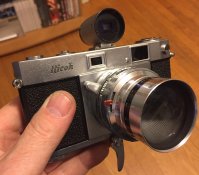
Ricoh 500; unfroze lens helicoil and stuck shutter.

Toby's Bar

H
Toby's Bar

  • Tel
  • Apr 25, 2026
  • 0
  • 0
  • 16
Barber

A
Barber

  • 0
  • 0
  • 34

Recent Classifieds

Forum statistics

Threads
203,486
Messages
2,855,474
Members
101,866
Latest member
Afadjato
Recent bookmarks
0

Kino

Subscriber
Allowing Ads
Joined
Jan 20, 2006
Messages
8,183
Location
Orange, Virginia
Format
Multi Format
Snowy day, so I undertook the resurrection of one of my Ricoh 500 rangefinders by freeing the helicoil with acetone and then cleaning the shutter with naptha until the blades snapped shut again. I should buy stock in cotton swabs...

IMG_2351.jpg
 
You should buy a tombstone which states, with emphasis:

"Here Lies a Pragmatic Bloke who Defied, Rather than Deified, the Wasteful, Excess Lubricant that Japan is Forever Guilty of Imposing Upon the Helicoids of Us Poor Mortals"

(You might be charged a bit extra for all that verbal engraver-cutting into the stone.) - David Lyga
 
Last edited:
You should buy a tombstone which states, with emphasis:

"Here Lies a Pragmatic Bloke who Defied, Rather than Deified, the Wasteful, Excess Lubricant that Japan is Forever Guilty of Imposing Upon the Helicoids of Us Poor Mortals"

(You might be charged a bit extra for all that verbal engraver-cutting into the stone.) - David Lyga

True!

I would really like to know what formulas Japanese and German manufacturers used for Helicoil grease!

I can often get both varieties out with naphtha, but sometime have to resort to acetone, which can be anxiety inducing...

Typically, grease in the 1930's through 1940's Japanese cameras (unsure of German) turns into a jadeite-looking solid, while the grease in both Japanese and German post-WWII cameras is very dark green and tar-like.

Just about the time I think I am getting pretty good at bringing these cameras back to life, one brings me back to earth with some mind-bending problem. I really don't know how half of these cameras ever got manufactured; the parts are so tiny and fiddly...
 
And the light seals? Are you trying to get away with a cheap CLA? :wink:

Thanks for reminding me! I'll have another look. Tend to forget the light seals when so many other problems are self evident!
 
True!

I would really like to know what formulas Japanese and German manufacturers used for Helicoil grease!
.

For years and years I have used a very modest dab of Vaseline and have never had problems. Why the Japanese and Germans had to use so much remains a mystery. However, I will state that Nikon, alone and to their collective credit, used this grease very sparingly. But the majority are truly guilty of causing aperture blades to freeze-up when the grease gets hot (like in a glove compartment in the summer). - David Lyga
 
I am now using Super Lube (very sparingly) on my helicoils and other moving parts and minuscule amounts of watch oil on the escapements. So far, no problems. In 50 years... who knows?
 
The helical on mine is nice and smooth. I wonder if it was serviced at some point in its life.
 
The helical on mine is nice and smooth. I wonder if it was serviced at some point in its life.

I have two 500's; one was frozen, the other is fine and I have no indication that either was serviced prior to my taking possession. Could be servicing. or it could be storage conditions or it could be factory variations on the helicoil lube used; who knows?
 
How do you find the proper starting point when re-assembling the focus? Is there a general rule that needs to be followed? I have a stiff focusing Hassie 80mm that I wish was smoother.
 
How do you find the proper starting point when re-assembling the focus?
I would put a mark/drop of paint on the end of the shaft and the frame it threads into and count the number of turns it takes to unscrew it along with the distance from the end of the barrel to the plate f the plate is removable. The rule is likely the specs of the end result of the installation. A machinist scribe and a scribe mark may be better than paint. Felt tip markers marks come off with cleaning chemicals.
 
How do you find the proper starting point when re-assembling the focus? Is there a general rule that needs to be followed? I have a stiff focusing Hassie 80mm that I wish was smoother.

I hope you haven't already disassembled the lens before you asked this question!

While I cannot answer this directly, there are a multitude of video tutorials on various types of lenses being re-lubed on YouTube and the general principals are all the same.

The job is not for the faint of heart; you have to take very careful notes on disassembly and make reference scribes on the lens barrels at various points and get them back in place EXACTLY.

I would not recommend you start on this lens. Get a junker and practice first...
 
It should read "Here Lies An Armature Camera Repair Technician That Succumbed to Cleaning Fluids Fumes".

At least I don't use perchlorethylene at home; only at work...
 
How do you find the proper starting point when re-assembling the focus? Is there a general rule that needs to be followed? I have a stiff focusing Hassie 80mm that I wish was smoother.
With some lenses you do not have to be so precise with the starting point, as infinity focus can still be achieved within certain bounds. I certainly do not know about the Hasselblad lens but you could mark both areas with a tiny indentation on the aluminum or brass. NOTE:There are TWO sets of threads for most lenses: the one that the female portion of the helicoid which fits INTO the narrow threads and the male portion which fits into the actual helicoid. The narrow threads usually allow only ONE point per revolution. The thick threads usually allow several points per revolution. - - David Lyga
 
Last edited:
Shutterfinger's got it right re: marking the thing. Scribe marks are the best way to do it. There's also the importance of marking it where the
helical separates. It can be a pretty frustrating experience seating the helicals without marks
 
It gets interesting when you have to restore a pair of geared, interlocked TLR lenses; the objective and the taking lens.

I restored a Crystar TLR (think early Ricohflex) that had the heilicoils frozen with that petrified "green snot" lube.

Getting these lenses to sync was quite the test of my patience.
 
Photrio.com contains affiliate links to products. We may receive a commission for purchases made through these links.
To read our full affiliate disclosure statement please click Here.

PHOTRIO PARTNERS EQUALLY FUNDING OUR COMMUNITY:



Ilford ADOX Freestyle Photographic Stearman Press Weldon Color Lab Blue Moon Camera & Machine
Top Bottom