

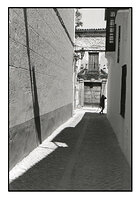
Kodak's DK-60a was my first film developer, in my teenage darkroom in eastern Canada, circa 1961 to about 1965. If my memories serve me accurately, the processing times with 120 Verichrome Pan were about 7 minutes at 20C/68F. The results were, as I recall, quite okay. I had a Yashica D TLR and a cheap Japanese meter and I shot weddings and often printed to 8x10 for albums and gift photos. No-one complained. Last year I finally dug up some of my old negatives and reprinted, again to 8x10. Sharp as anything. Almost no grain. I generally overexposed everything by up to half a stop back then, so contrast was good.
By 1963 I had acquired an old Kodak darkroom scale and weights and found a supplier of raw chemicals, and I was mixing my own DK-60a. A year or so later I read an article by the late Ron Spillman on two bath film development and then for a few years I used the Leica two bath for my roll films,perhaps wrongly as I now believe it was only for 35mm films. But again, with okay results.
In the late '60s I switched to D-76 and I have never looked back. I had a brief romance with Rodinal in the '70s and then with Agfa Rodinal Special in the '80s. My Rod Spec negs mostly print OK. Most of what I souped in Rodinal I now consider to be unprintable. Sad, but that's life. My mistake.
This said, now for largely nostalgic reasons I want to try DK-60a again, after half a century. Does anyone in APUG-land still use it? Someone I knew once referred to it as Kodak's original version of HC-110, which seemed, well, improbable to me. HC-110 I believe is (was, in Australia) an entirely different product, much more flexible and variable than DK-60a.
D-76 still serves me well, but I wonder what DK-60a would do with the TMax emulsions or with Fuji Acros.
I'm curious to find answers to the following questions -
Are there any advantages at all to using DK-60a in this modern age?
Are there any films more suited to this developer than others? Older emulsions, I would think. Efke (sadly now discontinued, tho I still have about 30 rolls) or maybe Fomapan?
Can DK-60a be modified in mixing from raw chemicals, to better suit modern emulsions?
I did fail chemistry in high school, hence the last question.
All your good advice about DK-60a will be greatly appreciated, and certainly enjoyed.
By 1963 I had acquired an old Kodak darkroom scale and weights and found a supplier of raw chemicals, and I was mixing my own DK-60a. A year or so later I read an article by the late Ron Spillman on two bath film development and then for a few years I used the Leica two bath for my roll films,perhaps wrongly as I now believe it was only for 35mm films. But again, with okay results.
In the late '60s I switched to D-76 and I have never looked back. I had a brief romance with Rodinal in the '70s and then with Agfa Rodinal Special in the '80s. My Rod Spec negs mostly print OK. Most of what I souped in Rodinal I now consider to be unprintable. Sad, but that's life. My mistake.
This said, now for largely nostalgic reasons I want to try DK-60a again, after half a century. Does anyone in APUG-land still use it? Someone I knew once referred to it as Kodak's original version of HC-110, which seemed, well, improbable to me. HC-110 I believe is (was, in Australia) an entirely different product, much more flexible and variable than DK-60a.
D-76 still serves me well, but I wonder what DK-60a would do with the TMax emulsions or with Fuji Acros.
I'm curious to find answers to the following questions -
Are there any advantages at all to using DK-60a in this modern age?
Are there any films more suited to this developer than others? Older emulsions, I would think. Efke (sadly now discontinued, tho I still have about 30 rolls) or maybe Fomapan?
Can DK-60a be modified in mixing from raw chemicals, to better suit modern emulsions?
I did fail chemistry in high school, hence the last question.
All your good advice about DK-60a will be greatly appreciated, and certainly enjoyed.


