• Welcome to Photrio!
    Registration is fast and free. Join today to unlock search, see fewer ads, and access all forum features.
    Click here to sign up

reversal processing

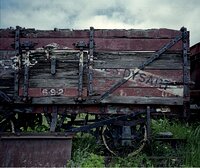
A coal wagon

A
A coal wagon

  • 5
  • 3
  • 57
Morning Birdie

D
Morning Birdie

  • 1
  • 2
  • 44

Forum statistics

Threads
203,143
Messages
2,850,488
Members
101,694
Latest member
Pip Shepley
Recent bookmarks
0
I don't know of any method using ordinary film, but there are special films and papers that produce a positive image (often with high fog levels) using ordinary processing.
 
I don't know of any method using ordinary film, but there are special films and papers that produce a positive image (often with high fog levels) using ordinary processing.

Graphic arts materials, there were some direct postive films and papers for lithography and halftone production. They were high contrast materials processed in the regular litho developers. As far as I know about them they were pre exposed to the solarizing point so any more exposure resulted in a loss of density, or some chemical equivalent. Maybe PE knows something about how they did it.
 
As has been said no, but EFKE make a Direct positive paper Freesyle sell it. Kodak made a Direct reversal coping film it had an SO number, I still have some in the UK, it's developed in a normal print dev and gives full tones.

I guess I have over 30 different B&W reversal formulae and they all use a bleach. Some bleaches are worse (more hazardous) than others, but they include Bichromate/Permanganate/Persulphate/Quinone.

There are various formulae in the articles section.

Ian
 
Agfa too has such copying film on offer.
 
I am trying to process a new microfilm from agfa ( ecopos 305 ). what kind of developer should I use ? the same first developer from the full reversal processing can be used as developer with the convencional fixer or I have to use a new kind of developer ?

tks
 
Back in the early 1960's Dr Arne Arenberg & Leon Witten introduced the "The Arneleon System" for Reversal processing, this used 5 stock solutions allowing the first developer to be varied for different films. There were far greater differences between films in the 60's, thin emulsions like ADox KB14 (Now known as Adox/EFKE KB 25), and Pan F behaved quite differently to thicker emulsions, and particularly the very heavy coatings of Kodak Royal X.

Perhaps the most important feature is that Hydroquinone in the first developer is used to control the contrast of the final positive, it's the B&W Reversal processing equivalent of Dr Beers famous Variable Contrast print developer.

For a High Contrast films like Pan F the system used a Soft working Metol only developer, so you might have to use a similar approach to tame the contrast of a copying film.

Ian

 
Photrio.com contains affiliate links to products. We may receive a commission for purchases made through these links.
To read our full affiliate disclosure statement please click Here.

PHOTRIO PARTNERS EQUALLY FUNDING OUR COMMUNITY:


Ilford ADOX Freestyle Photographic Stearman Press Weldon Color Lab Blue Moon Camera & Machine
Top Bottom