• Welcome to Photrio!
    Registration is fast and free. Join today to unlock search, see fewer ads, and access all forum features.
    Click here to sign up

Restoration of rare cameras

Afternoon Calm

D
Afternoon Calm

  • 3
  • 0
  • 51
Toby's Bar

H
Toby's Bar

  • Tel
  • Apr 25, 2026
  • 1
  • 0
  • 68

Recent Classifieds

Forum statistics

Threads
203,501
Messages
2,855,633
Members
101,871
Latest member
bluefox
Recent bookmarks
2

Dwayne Martin

Member
Allowing Ads
Joined
Mar 23, 2014
Messages
269
Location
SW Florida
Format
4x5 Format
Hi gang, does anyone here think that a very carefully replacement of a leatherette with original materials will harm the value of the camera? In this case the camera is a C. Tiranti Summa Report.
Thanks
Dwayne
 
Good question. I suppose it depends on the condition of the working components and bright trim. Do you have the necessary skills to do this in a professional manner? Best wishes,
 
I think you need to invert the question: will replacement improve the value. But first, define value - money or historical artifact value.
 
If the camera is for your own personal satisfaction, you can do whatever you want with it. If you intend to sell it, pass it on as-is so the ultimate buyer has those same options.
 
You'll likely get very different answers from: archivists, investors, collectors, and users. :smile:
 
Thanks everyone for the advice. For anyone interested, I don't plan to sell the camera, atleast not anytime soon. The leather is in pretty bad shape, peeling and missing altogether in some areas..... I haven't made up my mind for sure yet but I think I'd like to replace the leather. Seems hard to believe that this would be worse than the current condition.
D
 
well f it were mine.... id put all new leather but you really have to use some skill doing it. it cant look like meatball surgery.
 
Having right now a similar question, to myself, I should want to give you leave to replace the worn cover.
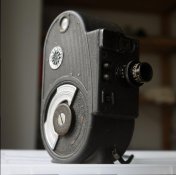
Here’s a camera that was sold at the thousands, without a leatherette. Screw feet are visible.
No leather.JPG
Shall I apply a cover?
 
if you watch programs like antiques roadshow &c they always say " don't even dust it, we like the old dust, its called "patina" "
if you look at restorations that are done well, whether it is a house, a book or piece of furniture, they always " replace in-kind"
meaning with the same materials and type of workmanship. i don't know what sort of leatherette was used to skin your camera
the old box cameras and their cases ( cary boxes ) were often covered in "fine morrocan leather" ...
since this is for your own enjoyment and not to sell to the german auction house next month, i'd cover it with whatever you want.
i'd remove the old leather clean the camera's box and find a covering you like and cover it with that. not sure what to glue it with
contact cement? rabbit hide glue ? rubber cement ? or something "reversible" ..
nice camera btw ! i'd never heard of or seen somethng like that i'm sure it will be a blast to use !
 
If you do decide on applying new leather, have a look at CameraLeather.com.

They offer several different types of leather, imitation leather and leatherette in self-adhesive sheets that you can cut yourself. The adhesive works well.

They are a breeze to deal with.
 
If the camera is for your own personal satisfaction, you can do whatever you want with it. If you intend to sell it, pass it on as-is so the ultimate buyer has those same options.

I would say the same.
However the OP hinted at a third alternative: getting his rare camera insured.
 
from a collector's POV, yes. the price will depreciate.

from a camera user's POV, no. it may even be a plus since you already shouldered a potential cost for him to change the vulcanite or whatever it is.
 
Having right now a similar question, to myself, I should want to give you leave to replace the worn cover.
Here’s a camera that was sold at the thousands, without a leatherette. Screw feet are visible.
View attachment 178828
Shall I apply a cover?

Certainly NOT! That is a Bell & Howell and all that I have seen were never covered with leather either 16mm, which I think yours, is or 8mm. That would not be restoring, rather it would be ruining the looks of it as it came from the factory.........Regards!
 
Certainly NOT! That is a Bell & Howell and all that I have seen were never covered with leather either 16mm, which I think yours, is or 8mm. That would not be restoring, rather it would be ruining the looks of it as it came from the factory.........Regards!

+1000
 
Certainly NOT! That is a Bell & Howell and all that I have seen were never covered with leather either 16mm, which I think yours, is or 8mm. That would not be restoring, rather it would be ruining the looks of it as it came from the factory.

Funny, I know that it’s a Bell & Howell, I can tell you exactly which model: Bell & Howell Filmo 8 134-E. Model E has the rear bearings removable but without oil bores. I also know that they were all sold like this, I only thought it could be an interesting idea to cover those screw feet the first time. Has nobody ever wondered about them? Bell & Howell Co. seems to still have a nimbus to them, that’s interesting, too. An early company to install extensive outsourcing, one must know that the little company wasn’t able to manufacture the famous perforator in 1908. It was simply bought. Bell & Howell couldn’t do the casting of the 1910 printer, neither of the main parts of the 2709 camera, nor of the 1918 pedestal splicer. The list is long and B. & H. depended still more on third parties with everything optical. Many parts, if not all, were made by others.

The story of the first wooden housing cameras destroyed by mildew and termites in Africa is a debunked myth. The motive for producing an all-metal camera is quite different. But I’m drifting off.

I have repaired and restored a number of Filmo 8s. Of course do I leave them the way they are. The outer appearance isn’t that important anyway. The valuable things are deep inside. By the way, B. & H. had offered a renovation of cameras back in 1942. That cost $7.50, $112.15 as of today, and consisted of extraction of the works, a fresh lacquering of the main frame, and reassembly. Filmo 8s were available in black and dark brown until December 1953 when fawn metallic and dubonnet was introduced.
 
Photrio.com contains affiliate links to products. We may receive a commission for purchases made through these links.
To read our full affiliate disclosure statement please click Here.

PHOTRIO PARTNERS EQUALLY FUNDING OUR COMMUNITY:



Ilford ADOX Freestyle Photographic Stearman Press Weldon Color Lab Blue Moon Camera & Machine
Top Bottom