
• Welcome to Photrio!
    Registration is fast and free. Join today to unlock search, see fewer ads, and access all forum features.
    Click here to sign up

Replicate this Photo, How many stop higher for ASA setting and How to D76 Development ?

Recent Classifieds

Forum statistics

Threads
202,920
Messages
2,847,560
Members
101,535
Latest member
photomorg
Recent bookmarks
2

Mustafa Umut Sarac

Member
Allowing Ads
Joined
Oct 29, 2006
Messages
4,952
Location
İstanbul
Format
35mm
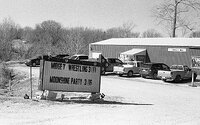
Hello there, This photo is taken in a normal day at 1:30 PM with diaphgram blade blocked olympus xa2 and developed by a professional with secret developer. As you see , its so much dark but highlights are clean white.
Film is Ilford FP4.

Now I have Canon EOS 1000 with EF 35-80mm lens , FOMA 100 ASA Film and D76 Developer and Epson Scanner. I will put ASA setting higher to replicate this dark image but how many stop should I go higher and how to develop the film ?

This is a Grocery.

grocery olympus xa2.jpg
 
The real trick is to find a place where you have two sources of light, one behind bare trees and a second source directed to the scene but not flooding. Maybe late afternoon/sun behind trees and a car/headlights on the fruit stand.

Set ASA normal and overdevelop.

I would use D-76 1:1 for 17 minutes to get increased contrast like this.
 
The real trick is to find a place where you have two sources of light, one behind bare trees and a second source directed to the scene but not flooding. Maybe late afternoon/sun behind trees and a car/headlights on the fruit stand.

Set ASA normal and overdevelop.

I would use D-76 1:1 for 17 minutes to get increased contrast like this.

Dear Bill , Thank you for your answer. That is great. Does overdevelopment increase the grain ?
 
It will increase grain to develop more, but not dramatically. The first photo looks like there might be a street light because the ground is not stark black.
 
It will increase grain to develop more, but not dramatically. The first photo looks like there might be a street light because the ground is not stark black.

Bill, Foma 100 ASA film has 8 minutes development time and are you quite sure 17 minutes goes to pure black and whites when there are some mid tones or is it a photoshop curves trick that I am after ? Or together ? I saw 17 minutes is N+3 development and does it enough to do the trick ?
 
I will put ASA setting higher to replicate this dark image but how many stop should I go higher and how to develop the film ?

There are several ways to get to a similar point.
1: Underexpose using the camera meter and without changing the ISO setting from what the film is officially intended for. So keep the ISO at 100, but take a meter reading (evaluative or partial, depending on what you prefer) and dial in exposure compensation of around 2 stops underexposure (i.e. 2 stops faster shutter speed than the meter reading suggests).
2: Underexpose by setting the ISO to a higher number; I would pick something like 400 for this rather dramatic underexposure.
3: Correctly expose the film, and decide later on in digital post processing or darkroom printing where the black point should be.

I would personally go for #3 because this is the most flexible and if you end up liking the image better with some more shadow detail, it will still be in the negative.

Btw, @Bill Burk is right in pointing out that the real 'magic' in this photograph is probably not its exposure; it's the light and the atmosphere of the scene. Technique is a side-show; 95% of photography is seeing, not metering, development etc.
 
Push the film to get strong contrast and blocked shadows.

Lots of burning in the darkroom to get every dark parts as dark as you want them.

Split toning sepia/selenium to get the highlights to glow, as well as that brown-pinkish hue.

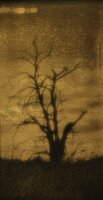
That would be how I would try it. I don't think what you see comes from film ASA-setting and development alone, but with a lot of darkroom work. The glow and washed-out textures of the highlights — especially apparent in the second photo — tells me bleach was propably used.
 
Is OP asking for an entirely analogue solution? His mentioning of Epson scanner suggests that he'll scan the negative and not necessarily make an enlargement. If that's the case, then expose, develop and scan normally. Get the desired effect in post.
 
Is OP asking for an entirely analogue solution? His mentioning of Epson scanner suggests that he'll scan the negative and not necessarily make an enlargement. If that's the case, then expose, develop and scan normally. Get the desired effect in post.

In terms of how the originator achieved this effect, aren't we all overlooking "the secret" developer" that Mustafa mentions?🙂

pentaxuser
 
I don’t recall the exact settings since it has been many years since I did this. But if you can take double exposures with your camera you might like this technique. With the camera on a sturdy tripod take the first exposure while there is still some light at probably half the metered time and then the second exposure after dark when the lights are on for the other half. Develop normal.
Someone familiar with this technique can explain in more detail as I did this last about fifty years ago but did get nice results.
 
Bill, Foma 100 ASA film has 8 minutes development time and are you quite sure 17 minutes goes to pure black and whites when there are some mid tones or is it a photoshop curves trick that I am after ? Or together ? I saw 17 minutes is N+3 development and does it enough to do the trick ?

I would specify 20C, and with D-76 1:1 the normal time for Foma 100 at 100 rating is 10 minutes. I'm proposing that to get this twilight scene having streetlight and car headlight illumination to look bright, you may develop longer than normal. The 'push' time to 200 is 14 minutes which is so close to my normal 13:30 for 'everything' that I don't think that will be enough. So I would offer 17 minutes to re-create that look. Expose as if for 100 even if that means using a tripod and giving a full second
 
I see this as a correct exposure and normal development for the light.
 
If the second photo is from the same source, it's underexposed and the secret developer is lith.
 
  • Don_ih
  • Don_ih
  • Deleted
  • Reason: Reconsidered.
I'm pretty sure we're looking at a scan from a negative.

I got things backwards but not that. I know it's a negative scan. Normal exposure plus reduced lith development (lith mixed for litho film) could give that look - underexposure plus lith development will give actually blank film.
 
Other way around; blocked closed, development not pulled. Just underexposed by 2 stops or so. Maybe 3.

I was thinking of the high contrast B&W work of William Klein where he over exposed his negatives to get bright but controlled highlights and deep black shadows. He certainly didn't underexpose his negatives.
 
Photrio.com contains affiliate links to products. We may receive a commission for purchases made through these links.
To read our full affiliate disclosure statement please click Here.

PHOTRIO PARTNERS EQUALLY FUNDING OUR COMMUNITY:


Ilford ADOX Freestyle Photographic Stearman Press Weldon Color Lab Blue Moon Camera & Machine
Top Bottom
