• Welcome to Photrio!
    Registration is fast and free. Join today to unlock search, see fewer ads, and access all forum features.
    Click here to sign up

Reciprocity Failure

Tractor & Tulips

A
Tractor & Tulips

  • 1
  • 1
  • 34
Tree with Big Shadows

Tree with Big Shadows

  • 3
  • 0
  • 82

Forum statistics

Threads
203,458
Messages
2,855,079
Members
101,853
Latest member
DJFOX
Recent bookmarks
0

mporter012

Member
Allowing Ads
Joined
Nov 25, 2012
Messages
383
Location
Fort Collins, Colorado
Format
Analog
A question about reciprocity failure. If you use an in-camera ttl light meter, does the camera give you the proper exposure regardless after 1 second? I don't entirely understand...

Thanks -
 
A question about reciprocity failure. If you use an in-camera ttl light meter, does the camera give you the proper exposure regardless after 1 second? I don't entirely understand...

Thanks -

No, reciprocity failure is a deviation from expected behavior of the emulsion, I can't see how the camera could deal with it. Unless perhaps it was a super smart camera that could have it's exposure system programmed to compensate for a particular film, as not all films behave the same way. Given the current status of film cameras in the market, that feature wouldn't seem likely to appear.
 
At a very basic level, the film loses sensitivity after it's maximum exposure has been reached, manifesting as poor contrast, colour shift/cast and other anomalies. You can see reciprocity failure in action if you use, for example, Provia 100F (slide film) for star trails. Set the camera up, trigger the shutter and lock it open for say 6 hours. This exposure time is way, way beyond the film's design intent for correct exposure over a given range. What happens over that long period of time is that the colour shifts to a strong magenta (with Velvia, it is a strong green) and gains contrast. Provia 100F, along with Velvia (used correctly) is a beautiful film with no casts whatsoever. It's what happens when you make very long exposures how the film's design breaks down. It's often exploited by traditional arts students in the street / documentary photography oeuvre.

You can hedge against reciprocity failure by providing additional exposure, but at some stage RF will still creep in. There is no camera that corrects for reciprocity because it is a characteristic of film, not one that a camera has control over (but to some degree, the photographer does, for the same statement above, by providing additional exposure and corrections). RF is a journey of discovery and is well worth experimenting with when you have selected a film you like and which you will use quite often, getting to know how it behaves beyond it's limits is one of the more interesting investigations you can do.
 
Eastman Kodak USED to include Reciprocity Failure charts in the leaflet that was packaged with every "Professional" film they sold. Sure took a lot of experimenting out of it. Who wants to experiment, re-inventing the wheel? I certainly do not. I do not know if EK still does this. Right now, EK is on a heart-lung machine. So I fear all this knowledge is forever lost.
 
Two things. Reciprocity information is available in data sheets as pdf documents. Has been since Nelson lost an eye.
You don't need to experiment if you expose film well within it's intended limits; outside those limits though you do need to understand what the film's individual response will be like and formulate a strategy for dealing with it as necessary.
 
I'm with Gary on this one; you will need to experiment in order to know what to expect.

Exposure is only part of the Reciprocity equation (B&W). A degree of processing compensation is often needed to compensate for the change in contrast.

Like Gary wrote, colour shifts also can be expected with colour films in long exposures.
 
Nothing replaces doing it yourself but the Pinhole Assist app comes close. They have reciprocity failure charts included for a number of common emulsions and it will do the calculation for you based on light levels and your camera settings.
 
No, reciprocity failure is different from film to film, so a light meter cannot know how to adjust for that. Some films don't need any adjustment up to a minute or longer, and some need adjustment after just a second.

Basically, you find the datasheet on the film you're using, and that will tell you what sort of correction it needs. If it requires 1 stop of correction, just keep your shutter open for twice as long, if it needs 2 stops, then it's 4 times as long, 3 stops, 8 times as long etc. You double the amount of exposure for each stop.

Generally I find that you can be pretty lax though, if you're doing long exposures, it's likely at night, and overexposure matters less, i.e. a black sky is a black sky, but during the day a blue sky will turn white with overexposure.

Trial and error is the order of the day really.
 
OK. So if my light meter reads f/8 at 2s, this will be inaccurate then and I need to use one of these charts? Dammit, there goes a ton of long exposures down the drain!
 
OK. So if my light meter reads f/8 at 2s, this will be inaccurate then and I need to use one of these charts? Dammit, there goes a ton of long exposures down the drain!

At two seconds measured exposure you could still be within acceptable exposure latitude of most films - for a technically perfect negative. If you shoot HP5+ for example, it may be that you needed 2.5 seconds, and that's not going to make an enormous difference in your negatives. If you were measuring for 30 seconds and needed 70 seconds according to the chart, then you're more in trouble.

But keep in mind that just because a negative isn't technically perfect doesn't necessarily mean it will not yield a good print!
So process your film and learn from your experience, just like everybody else has had to do. If you don't use a multitude of films it's only a matter of time until you know how to compensate for reciprocity failure. We all learn some of our lessons the hard way.
 
OK. So if my light meter reads f/8 at 2s, this will be inaccurate then and I need to use one of these charts? Dammit, there goes a ton of long exposures down the drain!

If it's Fuji Acros you'll be fine; some others, not so much. In my (limited) experience, the lighting conditions that lead to super long exposures often have a wide range of scene brightness, and the exposure is essentially selecting what part of the range to display. As such, I almost always "get something," it just may not be quite the way I visualized it.

Having just come off Worldwide Pinhole Photography Day and having accidentally exposed a sheet of ISO 100 film as though it were paper at ISO 6, I've had recent experience! :blink: (In that case, reciprocity failure worked in my favor.)
 
hello
i'm doing some long exposure photos with ektar 100 4"5", like 1h exposure....i didnt understand very well the procedure to find the reciprocity failure. anyone can help me?
 
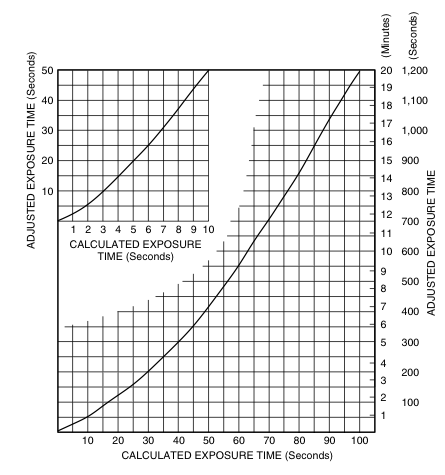
Look up the datasheet for the film and they will usually provide a reciprocity chart such as this one (I'm pretty sure this is for Tri-X 400)

picture-8.png


Now meter your scene. Lets say your meter says you need to expose your film for 5 seconds. Well take your finger and place it on the number 5 (on the "Calculated Exposure Time" axis. Now move your finger up until you hit the curve. See where your finger is in reference to the vertical axis now (Adjusted Exposure Time).

So for example:

10 second exposure on your meter = you really need to expose for ~50 seconds
20 second exposure on your meter = you really need to expose for ~2 minutes


The problem is that with Ektar 100 there is no chart on the datasheet. Usually when I shoot Ektar at long exposures, this is what I used (found somewhere on the internet). You can curve fit these points to interpolate reciprocity for an hour long exposure.

Calculated Exposure Time = Adjusted Exposure Time
1 sec = 1 sec
2 sec = 2 sec
4 sec = 4 sec
8 sec = 8 sec
16 sec = 20 sec
32 sec = 40 sec
64 sec = 115 sec
2m 18s = 4m 16 s
4m 16s = 9m 23s
 
Photrio.com contains affiliate links to products. We may receive a commission for purchases made through these links.
To read our full affiliate disclosure statement please click Here.

PHOTRIO PARTNERS EQUALLY FUNDING OUR COMMUNITY:



Ilford ADOX Freestyle Photographic Stearman Press Weldon Color Lab Blue Moon Camera & Machine
Top Bottom