• Welcome to Photrio!
    Registration is fast and free. Join today to unlock search, see fewer ads, and access all forum features.
    Click here to sign up

Reciprocity Failure Correction - Gadget Gainer's Formula from '05 - EFKE PL100M?

Chose vue

A
Chose vue

  • 0
  • 0
  • 15
Chose vue

A
Chose vue

  • 0
  • 0
  • 19

Recent Classifieds

Forum statistics

Threads
202,106
Messages
2,835,186
Members
101,116
Latest member
Jai DuVal
Recent bookmarks
0

holmburgers

Member
Allowing Ads
Joined
Aug 13, 2009
Messages
4,439
Location
Vienna, Austria
Format
Multi Format
Hi all,

In my quest for the proper reciprocity failure compensations for EFKE PL100M I've come up nearly empty handed. I did however come across (there was a url link here which no longer exists) from nearly 7 years ago that seems incredibly useful for any film.

The formula is Log(tc) = log(tc,1) + 1.62 log(tm), where tc,1 is the correction at 1 second indicated time.

gainer said:
Due to the fact that the factor 1.62 works for these different films of different manufacturers, it is my opinion that it will work for any current emulsion to acceptable accuracy. That is to say that I expect it to be within the spread among readings of indicated exposure made by a number of proficient photographers of the same scene. If this is the case, all one needs to know is the reciprocity correction to one indicated exposure to find the correction for any other indicated exposure.

Given the emboldened statement, I'm wondering if anyone can come up with a reasonable number to apply to Efke PL100M?

gainer said:
The factor 1.62 is accurate for all the films tested which were 400TX (0.169), TMY (0.061), TMX (0.069), HP5+ (0.101) and 100 Delta (0.046). The numbers in parentheses are the values of tc,1.

Or, if all that is required to come up with the right coefficient for a given film is based off 1 or 2 tests then I'd be more than glad to do it myself. The thing is, I need a bit of help understanding the formula and how to apply it; like where does that coefficient come from exactly?

gainer said:
To convert that equation to one that can be solved quickly on a TI-30 pocket calculator...

tr = tc,1*(tm^1.62) + tm

tm = exposure time indicated by the meter
tc = amount to be added to indicated time
tc,1 = correction to be applied to a 1 second tm
tr = exposure time adjusted for reciprocity failure
__________________________________________

I've basically reposted the information here because it seems like a useful tool, and one that is perhaps forgotten(?)
 
OP
OP
holmburgers

holmburgers

Member
Allowing Ads
Joined
Aug 13, 2009
Messages
4,439
Location
Vienna, Austria
Format
Multi Format
Well, is this formula not derived from Bond's testing?
 

cougstar

Member
Allowing Ads
Joined
Feb 27, 2007
Messages
43
Location
California
Format
Large Format
I've used the Reciprocity Chart for Bergger 200. Seems to work good. I found this on Michael Smith's Azo Forum a few years ago.
Dead Link Removed

Meter Exposure Given (All times in seconds)

1sec = 2sec
2sec = 5sec
4sec = 15sec
8sec = 35sec
10sec = 50sec
20sec = 120sec
30sec = 195sec
40sec = 300sec
50sec = 405sec
60sec = 525sec
70sec = 600sec
80sec = 825sec
90sec = 1005sec
100sec = 1200sec
 

Lee L

Member
Joined
Nov 17, 2004
Messages
3,287
Format
Multi Format
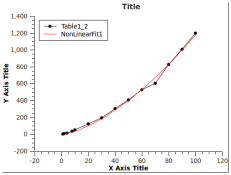
Using the data for Bergger 200 supplied by Ted from the Azo forum, I ran a regression with the Gainer formula using SciDAVis.

The coefficient should be around 0.6177. So the new exposure time with reciprocity compensation in seconds should be:

corrected time = 0.6177 * metered time ^ 1.62 + metered time

The attached chart shows the data in black (which appears a bit 'ragged', as one should probably expect), and the calculated fit in red.

Lee
 

Attachments

  • Bergger200reciprocity.png
    Bergger200reciprocity.png
    558 KB · Views: 153
Last edited by a moderator:
OP
OP
holmburgers

holmburgers

Member
Allowing Ads
Joined
Aug 13, 2009
Messages
4,439
Location
Vienna, Austria
Format
Multi Format
This is great! Lee, it's nice to see you are still a whiz with this formula, just as you were 6 years ago! I had hesitated to follow the Bergger 200 times because in my search I saw somewhere a dissenting comment regarding those times. But as they say, 'good enough for jazz'.

Michael, indeed that seems to be the beauty of this formula; that one only needs the coefficient.

Now, I'm having a bit of trouble with the math here, to be honest... putting metered times into Lee's formula is getting me values that don't match the above Bergger times given by Ted. Are there some parantheses, or some order of operations I'm missing? And the time spit out should be the time, not the time to add, right?

:pinch:
 

Lee L

Member
Joined
Nov 17, 2004
Messages
3,287
Format
Multi Format
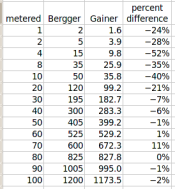
I'd have to look at what you're doing more directly to comment on order of operations, but if you know the concept and apply it, you may be getting 'correct' numbers without realizing it. I'll attach a screenshot of a spreadsheet with metered times, Bergger data from the Azo forum, calculated exposure times with the Gainer formula and the coefficient I derived, and then the percentage difference between the Gainer and Bergger times. If you look at the adjustments given in the Bergger data for metered times below 30 seconds, you'll find that it's not a very smooth set of numbers, the 'ragged' stuff I referred to before.

However, even though there are differences between the proposed Bergger data and the derived Gainer formula, you can look at the last column and see that the Gainer formula differs by -0.5 stops at 4 seconds metered time, most of the time it agrees with the Bergger data to better than +/- 0.3 stops. I'd guess that the original work to generate the Bergger 'data' wasn't done with tolerances as tight as the supplied numbers might suggest.

Lee
 

Attachments

  • Screenshot-7.png
    Screenshot-7.png
    13.4 KB · Views: 232
OP
OP
holmburgers

holmburgers

Member
Allowing Ads
Joined
Aug 13, 2009
Messages
4,439
Location
Vienna, Austria
Format
Multi Format
Thanks Lee, that confirms that I was doing the math correctly, but indeed, I was thrown off by the discrepancies. I'll be using the data you generated and I'll report back if it works well or not.
 

Lee L

Member
Joined
Nov 17, 2004
Messages
3,287
Format
Multi Format
Patrick Gainer established his reciprocity formula based on data from this article:
http://www.phototechmag.com/index.php/archive/reciprocity/

Ilford hasn't changed it's reciprocity data for HP-5 for decades, but the film has changed. Here's a quote from Bond's article concerning HP5+.

Ilford curve outdated, too?
In publications dated September 2002 (sent to me in January 2003), Ilford still had a single old curve for correcting reciprocity departure for HP-5+ and 100 Delta. I found the behavior of these films to be quite different from the curve, and also different from one another.

You'd likely do much better with Bond's recommendations for reciprocity adjustment for HP5+ than with the data sheet from Ilford.

Lee
 
Photrio.com contains affiliate links to products. We may receive a commission for purchases made through these links.
To read our full affiliate disclosure statement please click Here.

PHOTRIO PARTNERS EQUALLY FUNDING OUR COMMUNITY:


Ilford ADOX Freestyle Photographic Stearman Press Weldon Color Lab Blue Moon Camera & Machine
Top Bottom