
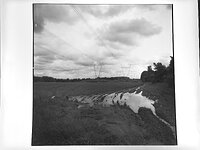
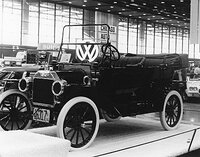
I often see what appears to be typewritten text on photo postcards (the one I'm recalling was circa 1907). Text appears white on the card. Does anyone know how these were printed? I assume you would roll up something clear in a typewriter and put that over the negative when contact printing, but... if so... I'm wondering what clear material they were using. A piece of film stock?
-
Welcome to Photrio!Registration is fast and free. Join today to unlock search, see fewer ads, and access all forum features.Click here to sign up
You are using an out of date browser. It may not display this or other websites correctly.
You should upgrade or use an alternative browser.
You should upgrade or use an alternative browser.
Real Photo Postcard Text
-
A
- Thread starter bud007
- Start date
Recent Classifieds
-
For Sale Zone VI 5x7 Enlarger
- Started by oficinouno
-
For Sale Antique Darkroom Red Safe Lights _ Electric Lamps
- Started by Manual Camera
-
For Sale Antique contact printing frames, Kodak and others, several sizes
- Started by Manual Camera
-
For Sale Transposing Frames for stereo photography ("châssis alterneur"), several sizes
- Started by Manual Camera
-
Found Nikon F2 black camera
- Started by ediz7531
Forum statistics
I often see what appears to be typewritten text on photo postcards (the one I'm recalling was circa 1907). Text appears white on the card. Does anyone know how these were printed? I assume you would roll up something clear in a typewriter and put that over the negative when contact printing, but... if so... I'm wondering what clear material they were using. A piece of film stock?
The stock of RPPC had the back print done before the emulsion was applied to the front. White lettering on the front was done directly on the negative by a skilled person (like retouching). Cards were printed on the individual cards, typically by a woman, one at a time.
Typewritten, I have not seen as often. Your thought of using a clear sheet sounds like a splendid idea. Get transparent material that run through your inkjet printer, cut to fit. Any font available.
My wife is an artist, she gets something like this from Dick Blick company
I have seen lots of Edwardian Era Postcards with hand written titles along the bottom. Looks like a fine paintbrush was used.
The printing is quite sharp, making me think the caption is written on the emulsion side of the plate.
If this is the case the wording must have been written backwards. So it will come out the correct way when contact printed.
Quite a talent if this is the case.
The printing is quite sharp, making me think the caption is written on the emulsion side of the plate.
If this is the case the wording must have been written backwards. So it will come out the correct way when contact printed.
Quite a talent if this is the case.

I often see what appears to be typewritten text on photo postcards (the one I'm recalling was circa 1907). Text appears white on the card. Does anyone know how these were printed? I assume you would roll up something clear in a typewriter and put that over the negative when contact printing, but... if so... I'm wondering what clear material they were using. A piece of film stock?
There were types of film designed for just this - adding titles to prints.
The film was slow and high contrast and used mostly in machines designed for that purpose, but it could also be used in a regular camera. IIRC, it was a negative film, and you could take pictures of white letters on a black background. The resulting negative was then contact printed with your subject negative.
The material was essentially the same as was used by the motion picture industry to put titles on to movies.
I found old ads for a product called Automat that you rolled up in a typewriter to do text on a transparent film, like some kind of retro carbon paper. The more I look at this, though, it doesn't look even and consistent enough for a typewriter (font looks wrong for a typewriter also), so I'm thinking it was some kind of set of letters that you simply laid out and arranged on the glass you were exposing. At least that's what seems to fit the result.
Back 120 years ago they could have used a little letterpress to put this directly on the negative
Anyone ever used Letraset on clear sheets to do this?
("Letraset" may bring back some memories).
("Letraset" may bring back some memories).
Back 120 years ago they could have used a little letterpress to put this directly on the negative
Ah... that sounds spot on with the appearance. So it would have been actual "ink" applied to the negative to block the light and cause the white letters I guess.
Just thinking out load... kinda surprised ink would be opaque enough or sticky enough to adhere - I'm assume this was not on the emulsion side (where letters would have to be reversed). Maybe they really pressed it into neg to create a bit of an indent which could let the ink be a bit thicker layer. Or maybe the ink was more opaque than i'm imagining.
The postcard in question was from a local shopkeeper who sold these to locals, so he had to have printed at lease a couple dozen of these. So altering the negative would make more sense than trying to somehow apply the text by hand individually to each reprint. While I see lots of examples where this type of text has been added, I've looked through Kodak catalogs of the day and I don't see that they sold any kind of accessory to do it... which implies to me it was done with something that was generally around/available.

Digital Wendy
Subscriber
Handwriting was a recognised and taught skill well into the 1970s, at least here in the uk. Even I was taught to draw lettering as part of pre-computer drafting for design work.
The people (mostly women) who retouched negatives and tinted photographs were incredibly skillfull, and hand written lettering on negatives would not have been a stretch for them.
I have always assumed they used 'India Ink' which was remarkably opaque and permanent, and is still visible in very old laundry marks. I guess they also had a whole palette of retouching inks to work with too.
If there was another product used do let me know.
The people (mostly women) who retouched negatives and tinted photographs were incredibly skillfull, and hand written lettering on negatives would not have been a stretch for them.
I have always assumed they used 'India Ink' which was remarkably opaque and permanent, and is still visible in very old laundry marks. I guess they also had a whole palette of retouching inks to work with too.
If there was another product used do let me know.
Digital Wendy
Subscriber
That looks like a pen stencil to me, for use with a drawing pen. The slightly uneven bottom line is a giveaway. I'll see if I can find a picture of one - incredibly difficult to use well!
Rotring Lettering Stencil for sale | eBay
Find great deals on eBay for Rotring Lettering Stencil. Shop with confidence.
www.ebay.co.uk

That looks like a pen stencil to me
I don't think so. The G is different all three times.

kinda surprised ink would be opaque enough or sticky enough to adhere
Printer's inks in the early 20th century were oil based and could be had with opaque pigments like carbon black.

One of my obsessions is collecting old postcards from my hometown. My collection is slowly growing (it’s already in the hundreds), but it’s becoming increasingly difficult to find new ones that I don’t already have. I’ve often wondered how postcards were captioned 100-110 years ago. Based on the variety of postcards I own, I’ve come to the following conclusions:
However, another "problem" arises - the text written on a 9x13 postcard is quite small. Too small for both handwriting and a typewriter! I’m sure that, somehow, the size was reduced. The question is how, and at which step. So the mystery continues...
- The text is always white;
- Many postcards have duplicated captions - one in Bulgarian (Cyrillic) and one in French or German (Latin);
- On most postcards, the Cyrillic text looks like it was typed on a typewriter, while the Latin text is, in almost all cases, handwritten, but very well imitating printed lettering;
- On a small portion of the postcards, there are areas around the text where a faint background can be noticed - this supports the idea that transparent film was used;
- The original plates were not captioned. There is solid evidence that, at least up to a certain period, the source for these postcards was 9x13 cameras using glass-plate holders. From the original plate, intermediate positives were most likely made, possibly again on glass, and then from that positive a master negative was produced, on which the text manipulation was carried out.
- a plain image with a solid black band at the bottom containing the text;
- an image without a frame, with the text placed somewhere on the image (sometimes with more than one variant of text placement);
- a white border on all sides, with the text on the image.
However, another "problem" arises - the text written on a 9x13 postcard is quite small. Too small for both handwriting and a typewriter! I’m sure that, somehow, the size was reduced. The question is how, and at which step. So the mystery continues...
I’m sure that, somehow, the size was reduced.
The text can be typed or hand-written on white paper, photographed, then that resulting negative can be enlarged,, reduced, or contact-printed onto another piece of film or glass plate, that can then be used as a mask for printing the postcard (whether by contact or enlargement).
| Photrio.com contains affiliate links to products. We may receive a commission for purchases made through these links. To read our full affiliate disclosure statement please click Here. |
PHOTRIO PARTNERS EQUALLY FUNDING OUR COMMUNITY:  |