• Welcome to Photrio!
    Registration is fast and free. Join today to unlock search, see fewer ads, and access all forum features.
    Click here to sign up

RC print permanence update

Recent Classifieds

Forum statistics

Threads
201,767
Messages
2,829,832
Members
100,936
Latest member
rdbirt
Recent bookmarks
0

Sal Santamaura

Member
Allowing Ads
Joined
Nov 21, 2005
Messages
7,535
Location
San Clemente, California
Format
Multi Format
Starting on page 160 of his book Post Exposure


Ctein described a test begun during June 1995, wherein he divided three RC prints into quadrants, then treated them so that one quarter was washed only, the second quarter was very lightly selenium toned, the third quarter was treated with (then-current) Agfa Sistan and the fourth quarter received both selenium and Sistan. He then sealed them in frames and hung them where they received "ample" daylight (but no direct sunlight) and, at night, incandescent light. When the book's first edition was published in 1997, he reported all three untreated print quadrants had silvered out within a year, but the treated quadrants showed no change. At the second edition's release in 2000, he updated those results, saying "still no change." Note that the on-line PDF carries a 2011 copyright, but it's identical to the 2000 second edition.

Since being sealed in a frame and exposed to light has long been thought likely the worst environment for RC prints, I was curious whether Ctein's test is ongoing more than 20 years after June 1995. Today I asked him that very question. His answer: Yes, the prints have been kept in the same environment the entire time since 1995. He said the quadrants treated with very light selenium toning and/or Sistan continue to look fine -- no silvering out or bronzing. He closed with "So, I guess it works."

While the prints Ctein tested were made on Kodak Polycontrast and Agfa Multicontrast Premium papers, I think it's reasonable to extrapolate that today's RC papers ought to fare as well or better, especially since Agfa itself subsequently changed its paper formulation based on research prompted by Ctein's test. In light of our drought conditions, I'm planning to use a lot more Multicontrast Warmtone RC with greater confidence after hearing from Ctein today.
 

piu58

Member
Allowing Ads
Joined
May 29, 2006
Messages
1,545
Location
Leipzig, Germany
Format
Medium Format
The problem is titane dioxide which is mixed in the upper plastic cover for making it white. Baryt (barium sulfate) is no suited for plastic.
The TiO2 activates the silver and leads to silvering, bronzing and so on. New papers af "electron catchers" which de-activate the TiO2. I don't know how long these catchers work. The may work for 10 or 20 years. But I don't believe that they work let's say 100 years (which is no problem for baryta papers).
 

gone

Member
Allowing Ads
Joined
Jun 14, 2009
Messages
5,504
Location
gone
Format
Medium Format
That drought seems to be going on forever (it's actually just far too many people using far more water than that geographic location was ever designed to support). Here in Florida, as in other places, we have the opposite effect most of the time.

There are affordable personal technologies that should be implemented to filter existing non potable water into home use, instead of depending on elected politicians to address this issue. Gee, I wonder what the outcome of such an enterprise as that might be? Ha! We can address these issues individually. That's where things happen. It's not about water conservation, it's about using what we already have more effectively.

This is the type of testing I like to see. It's much closer to reality than the phony, baloney Wilhelm method that extrapolates data. Thanks for posting this. Of course, there's so many variables that play in to this, it's probably good not to get too excited. Proper fixing, super clean water for processing, etc are probably the real keys to any photographic archival qualities, along w/ using top quality papers, chemicals and materials no matter what type of paper we use. Not all of us tone our prints though. It would have been better if he hadn't done that, but still, it's real world testing, and thanks to him for doing this.
 
Last edited by a moderator:

AgX

Member
Allowing Ads
Joined
Apr 5, 2007
Messages
29,972
Location
Germany
Format
Multi Format
New papers have "electron catchers" which de-activate the TiO2. I don't know how long these catchers work. The may work for 10 or 20 years. But I don't believe that they work let's say 100 years.

Rito Hofmann, head of research at Ilford and longevity specialist, once told me that the decay issue with whitened PE layers had been solved. I see ways to strive for that at TiO2, but remain sceptical.
 
OP
OP

Sal Santamaura

Member
Allowing Ads
Joined
Nov 21, 2005
Messages
7,535
Location
San Clemente, California
Format
Multi Format
To make my intent completely clear, understand the following.
  • I never have, do not now and have no intention of ever selling prints. If I did, they would only be on fiber-based paper.
  • The confidence that I can make and frame an RC print and, with light selenium toning, it will last at least 20 years on the wall of my home is very important. I don't want them to need reprinting sooner. After that, since they're purely for my enjoyment and I'm well aware of my genetic life expectancy, they can deteriorate at will.
Perhaps I'm completely atypical here in southern California, but water conservation has been one of my highest goals for decades, long before the latest drought. My home's landscaping is all watered by drip irrigation, which is turned on 20 minutes per week from mid-June through mid-October, some years even less. As opposed to my neighbors, most of whom still have lush, green lawns that they shower with precious water even now. So, RC paper seems a good addition to the mix. However, if the Smithsonian calls and asks for a print, I will use fiber. :D
 

RobC

Member
Allowing Ads
Joined
Nov 5, 2007
Messages
3,880
Location
UK
Format
Multi Format
Tim Rudman says in one of his books that you need to take selenium toning to completion to get full protection. Unfortuantely that means strong selenium and long enough in toner for no further change to take place. The colour that produces in the print may or may not be desirable.
Sistan (now agfa Stab) produces no colour change at all, is very cheap and gives complete protection from arial oxidation.

So I would suggest using selenium for aesthetic effect and then sistan for complete protection.

p.s. RC paper doesn't tend to tone as well as FB but depends how much colour you want as to whether it works for you I guess.
 
Last edited by a moderator:

miha

Member
Allowing Ads
Joined
Feb 15, 2007
Messages
3,036
Location
Slovenia
Format
Multi Format
I would avoid Sistan at all costs: (there was a url link here which no longer exists)
 
OP
OP

Sal Santamaura

Member
Allowing Ads
Joined
Nov 21, 2005
Messages
7,535
Location
San Clemente, California
Format
Multi Format
Tim Rudman says in one of his books that you need to take selenium toning to completion to get full protection. Unfortuantely that means strong selenium and long enough in toner for no further change to take place...
That might be true for fiber-based papers, but not RC. This thread


summarizes a thesis that disagrees with Rudman. Also, Ctein emphasized that the selenium-treated quadrants of his long-term RC test prints were very lightly toned.

...Sistan (now agfa Stab) produces no colour change at all, is very cheap and gives complete protection from arial oxidation...
This thread


reflects the fact that Agfa Sistan, which Ctein used 20 years ago, is no longer available, and current "replacement" products have proven problematic, regardless of whether used in a processor or a tray. I'd strongly suggest light selenium toning instead, which Ctein says has staved off deterioration just as well as original Sistan did.

...RC paper doesn't tend to tone as well as FB but depends how much colour you want as to whether it works for you...
I find that to be a benefit. Now shown to enable at least 20 years of display in room light while sealed inside a frame, it doesn't force one to suffer unwanted color changes that selenium imposes on fiber-based papers. In other words, the promise of original Sistan without the risks of its current "replacements."
 

RobC

Member
Allowing Ads
Joined
Nov 5, 2007
Messages
3,880
Location
UK
Format
Multi Format
all those 100+ year old prints still in existence and looking good. The problem is really RC paper and apparently that has been fixed. But we'll have to wait another 20 or 30 years to be sure.
 

Vaughn

Subscriber
Allowing Ads
Joined
Dec 13, 2006
Messages
10,275
Location
Humboldt Co.
Format
Large Format
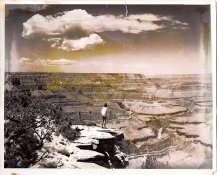
Just for fun...my first print I made myself. Rolleiflex, Verichrome Pan (film developed at camera shop in Flagstaff), printed in employee darkroom at Grand Canyon Nat. Park. Whatever VC RC (glossy) Kodak was selling in 1977.

This copy was put in a mat (non-archival), framed then displayed for 35+ years (thanks, Mom...). I have another copy that has been kept tucked away with other prints from that time and is perfectly fine. Since this was my first time I printed (and unassisted), I am sure that my processing techniques were far from archival!

PS -- Self-portrait using built-in 10-second timer...over-looking the Grand Canyon with the Colorado River below. Had to move fast to get in place! I liked the cloud so much, I used it again in a portrait of a friend in the Sierras three or four years later.
 

Attachments

  • First PrintedPhoto.jpg
    First PrintedPhoto.jpg
    669.7 KB · Views: 252
Last edited by a moderator:

Ronald Moravec

Member
Allowing Ads
Joined
Jan 17, 2005
Messages
1,355
Location
Downers Grov
I have a mounted Kodak RC on a wall since around 1985. Do not remember details, but I am sure it was well washed, minimum fix time, selenium toned. Borders were trimmed off because it was a contest print. RC needs border timing as chemicals impinge on the cut surfaces.

I have been using RC for decades for non permanent prints and never had one fade. Use film strength fix for 30/45 sec, rinse 2/3 times quickly, wash 3 minutes in fast running water changing it 4 times, tone and rewash or tone right after fix, Selenium will not stain a fix saturated print. It ruins poorly wash prints. Learned that from the late Fred Picker of Zone 6.

Long fix with low strength traditional fix and sloppy short wash and you get nice golden yellow prints sooner or later.
 

RobC

Member
Allowing Ads
Joined
Nov 5, 2007
Messages
3,880
Location
UK
Format
Multi Format
I would avoid Sistan at all costs: (there was a url link here which no longer exists)

I think the conclusion of that topic was the operator was not using the correct dilution and processing.

But yes you do need to be careful as there seems to be a risk.
 

AgX

Member
Allowing Ads
Joined
Apr 5, 2007
Messages
29,972
Location
Germany
Format
Multi Format
I would avoid Sistan at all costs: (there was a url link here which no longer exists)

Miha, please read that whole thread. That likely make you change your mind.
 

Photo Engineer

Subscriber
Allowing Ads
Joined
Apr 19, 2005
Messages
29,018
Location
Rochester, NY
Format
Multi Format
Just for fun...my first print I made myself. Rolleiflex, Verichrome Pan (film developed at camera shop in Flagstaff), printed in employee darkroom at Grand Canyon Nat. Park. Whatever VC RC (glossy) Kodak was selling in 1977.

This copy was put in a mat (non-archival), framed then displayed for 35+ years (thanks, Mom...). I have another copy that has been kept tucked away with other prints from that time and is perfectly fine. Since this was my first time I printed (and unassisted), I am sure that my processing techniques were far from archival!

PS -- Self-portrait using built-in 10-second timer...over-looking the Grand Canyon with the Colorado River below. Had to move fast to get in place! I liked the cloud so much, I used it again in a portrait of a friend in the Sierras three or four years later.

Since you can clearly see the yellow mottle in non image areas (border - upper left), this is not associated with silver bronzing but rather with retention of something due to poor wash.

PE
 

Photo Engineer

Subscriber
Allowing Ads
Joined
Apr 19, 2005
Messages
29,018
Location
Rochester, NY
Format
Multi Format
The problem is titane dioxide which is mixed in the upper plastic cover for making it white. Baryt (barium sulfate) is no suited for plastic.
The TiO2 activates the silver and leads to silvering, bronzing and so on. New papers af "electron catchers" which de-activate the TiO2. I don't know how long these catchers work. The may work for 10 or 20 years. But I don't believe that they work let's say 100 years (which is no problem for baryta papers).

Both Baryta and Titanox can be coated in the same fashion, either from gelatin or within the plastic material being used. Titanox absorbs more UV radiation than Baryta and this creates free radicals which are scavenged by "free radical chain stoppers". There are many patents out there, but basically there is just one main problem. The free radicals destroy the plastic causing cracking and crazing. Excess bleed of free radicals into image areas are the secondary problem.

Much work went into solving this twofold problem and there are dozens of patents out there but one main set might explain it more fully. I have not read nor looked it up for years but the patentee is W. Venor at EK.

PE
 

miha

Member
Allowing Ads
Joined
Feb 15, 2007
Messages
3,036
Location
Slovenia
Format
Multi Format
I think the conclusion of that topic was the operator was not using the correct dilution and processing.

But yes you do need to be careful as there seems to be a risk.

AgX said:
Miha, please read that whole thread. That likely make you change your mind.

I did. Aparently using hands instead of a sqeegee to wipe off the excess caused the problem. :confused:
 

Gerald C Koch

Member
Allowing Ads
Joined
Jul 12, 2010
Messages
8,131
Location
Southern USA
Format
Multi Format
Tim Rudman says in one of his books that you need to take selenium toning to completion to get full protection. Unfortuantely that means strong selenium and long enough in toner for no further change to take place. The colour that produces in the print may or may not be desirable.
Sistan (now agfa Stab) produces no colour change at all, is very cheap and gives complete protection from arial oxidation.

So I would suggest using selenium for aesthetic effect and then sistan for complete protection.

p.s. RC paper doesn't tend to tone as well as FB but depends how much colour you want as to whether it works for you I guess.

Research done for museums and libraries like the Library of Congress found that for microfilm there must be a profound change in image color when using either selenium or sulfur toning for archival permanence. Anything less defeats the purpose of their use. Stabilizers like Sistan are based on the observation that when all thiosulfate is removed from a print by using Kodak HE-1 there is a loss of archival permanence. A small amount of a sulfur containing chemical must be left in the print. In the case of Sistan this chemical is a thiocyanate.
 

Vaughn

Subscriber
Allowing Ads
Joined
Dec 13, 2006
Messages
10,275
Location
Humboldt Co.
Format
Large Format
Since you can clearly see the yellow mottle in non image areas (border - upper left), this is not associated with silver bronzing but rather with retention of something due to poor wash.

PE

Yes -- it looks like a test strip, perhaps, was stuck on the front during washing or otherwise contaminated the print. Multiple issues!
 
Photrio.com contains affiliate links to products. We may receive a commission for purchases made through these links.
To read our full affiliate disclosure statement please click Here.

PHOTRIO PARTNERS EQUALLY FUNDING OUR COMMUNITY:


Ilford ADOX Freestyle Photographic Stearman Press Weldon Color Lab Blue Moon Camera & Machine
Top Bottom