I've done canvas at around 20x24 and am working towards around 60" max.
First, you have to test the substrate. Do it at like 5x7 due to the expense of emulsion. I use Foma liquid, which is gorgeous stuff. Foma peels off the substrate if not done right. My success has been:
PVA both sides of the canvas - this is pretty big as it seals the canvas and keeps it more dimensionally stable. And the stuff is cheap.
2 coats of gesso and 2 coats of artist's oil ground. Gesso alone and the emulsion came right off. The oil ground takes days to dry. You could likely use an alkyd primer for your size. I was concerned about long-term stability so i used all artist materials vs. house painting stuff. Then a couple coats of spray poly, which I found pretty glossy. Still experimenting to get a solid coating without the poly. Small scraps to dial all this in are a must.
Foma comes with a hardener, which I use.
Cold chemicals are important, I live in TX so our water is hot. For large pieces, I coil a hose in a cooler of ice to cool the wash water. I collect empty cat litter jugs to store chems. (We adopted a really old stray and she is insane. Drinks form the sink all day, so we go through tons of litter).
I'd look into using a thick, wooly paint roller for chemistry, with a home made trough at the bottom of the print. You can make the trough from plywood, seal it with gorilla glue, coat with porch paint. It's not a boat, that should be enough to hold the chemicals. For my size, I'll just make a plywood tray 6' x 5' and actually expose in the tray with a wall-mount enlarger. I'm concerned about fixing and washing adequately, and my tray design has a drain port and hose connection to the house plumbing drain.
But - if you make a trough that big - it may be much better to "see-saw" a print through it with several people. To keep the canvas from buckling, something like a 3 or 4" PVC pipe could be mounted across the trough, half-in the chems, and run the canvas around (under) it, emulsion-side down, and have several people on each side see-sawing it through. Think these kinds of things out...
Pick a cheap RC paper and use it to determine exposure and contrast (if your emulsion isn't VC, get a good 5x7 or 8x10 test that looks good to you with the emulsion. Then recreate the contrast and density on RC. In my case, Foma is about a 3 to 3.5 grade and is not VC, so my neg needs to be more contrasty. I find a close match on Ilford RC - so if my ilford print matches the emulsion print for 20 seconds at F5.6 with a grade 3.5 filter, and the emulsion print was f11 at 20 seconds with no filter, I can reliably begin dialing in an emulsion print 2 stops down from my RC tests with no filter. This can save you a ton of emulsion). You should likely make a big-ass test strip for your final - that is, prepare a 2' x 6' strip and make sure your exposure is right.
For really big prints, I've had luck making an adapter for my enlarger that holds a Vivitar 285 flash. So instead of 90 seconds, it may take three pops of the flash at 1/8 power. I put a sheet of CTO gel in the filter box to make the flash "tungsten" (also cuts a stop or so). I just aim the flash at the condenser bulb and use some black foamcore. I get even exposure this way. You can use an extension cable with a momentary switch or get a cheap chinese radio trigger. Just make SURE nothing in the building is setting the trigger off!
For coating,
I like this brush. But for something huge, I dunno... a roller will waste a lot of emulsion and a brush will be hard to get it even. I assume that when I get above 3' or so, I'm going to have to experiment with spraying, maybe multiple thinned coats. I own
this HVLP gun ($16 and actually fairly well regarded by auto body guys) and I think it could do well with some testing. HVLP doesn't have much overspray, and you can learn by using things like coffee creamer. Doing coffee creamer tests will also let you figure just how much emulsion you'll need to soften and mix.
I have trouble with even brush coating at 20" on canvas, so I'm experimenting with cutting emulsion with half distilled water & alcohol and doubling coats (Foma calls for 2 coats, so I'd do 4 thinned and see if I get a more even coat).
I'm also leaning towards linen canvas with multiple gesso coats, sanded, to minimize the canvas grain. High spots in the canvas for me have been an issue, the emulsion settles into the texture and I get white spots.
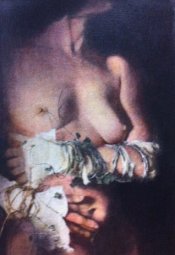
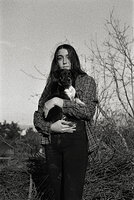
My end-use is tinting with oil glazes and varnishing, I'm going for a sort of "ancient" look that's hard to tell if it's a photo or painting, that uses zero computers or digital processes, all analog. Here's my latest test - keep us posted as to how this goes, but like everyone else has said - start small and work your way up!




 )
)
