
• Welcome to Photrio!
    Registration is fast and free. Join today to unlock search, see fewer ads, and access all forum features.
    Click here to sign up

Questions about Fiber processing

Forum statistics

Threads
203,277
Messages
2,852,217
Members
101,756
Latest member
rsj1360
Recent bookmarks
0

Tim Gray

Member
Allowing Ads
Joined
Sep 2, 2006
Messages
1,882
Location
OH
Format
35mm
I'm going to start printing fiber fo' real soon. Getting ready to place the orders for the necessary things, but just wanted to make sure I've got everything lined up right. I currently use Ilford Rapid fix, but am going to be ordering TF-5, so my questions are two parted, one for the rapid fix, one for the TF-5.

Fixer: If I use the Ilford, I should do two bath fixing (30s, 30s), with the fresh stuff being the second bath, correct? Once I get through that stuff, I'll start using the TF-5. Do I do two bath fixing with the TF-5?

Washing: I don't have a washer yet. While I'm using the Rapid Fix, prints will go into a holding bath with some running water. At the end of the session, I take the prints and put them in a tray with HCA for 10 mins. After that's done, back into the wash tray they go. Let the water run for 10 more mins, with several full water changes during the process. Does this sound about right? Obviously, I'll test with the residual hypo test to figure out how many changes of water and how long I should let the final wash sequence go.

For the TF-5, it would be the same as above, but I can skip the HCA bath, right?

Testing: I plan on ordering some residual hypo test from the Formulary. Should I order up some of the fixer test stuff? What about the residual silver test?

I know this is a lot of questions, but I'm rather excited about adding fiber to my repertoire, but am a bit unclear on some of the specifics. Thanks!
 
Too many questions but here are a couple of responses.

Two bath fix for fiber paper with any fix is best way. The first bath does most of the dirty work, and gets tossed soonest. The second bath is there to finish the job, and being relatively fresh, leaves the remaining hypo in the print in most washable form.

Don't skip the wash aid with any fixing schedule. In the absence of testing for complete washing, I go with ten complete changes of wash water. If you do test, you may find you need less, but be consistent or your tests are meaningless. Keep prints separated all the time or the wash times go up and become unreliable.
 
...Fixer: If I use the Ilford, I should do two bath fixing (30s, 30s), with the fresh stuff being the second bath, correct?...

Two-bath fixing is the best. Try no less than 60s each (30s does not guarantee uniform fixing), but test for complete fixing first.

...Do I do two bath fixing with the TF-5?...

Yes

...I don't have a washer yet. While I'm using the Rapid Fix, prints will go into a holding bath with some running water. At the end of the session, I take the prints and put them in a tray with HCA for 10 mins. After that's done, back into the wash tray they go. Let the water run for 10 more mins, with several full water changes during the process. Does this sound about right? Obviously, I'll test with the residual hypo test to figure out how many changes of water and how long I should let the final wash sequence go...

Your last wash should not be shorter than 30 min. Without a washer, I recommend to wash each print in a tray. Investigate into cascade washing and see with your test if it works for you.

...For the TF-5, it would be the same as above, but I can skip the HCA bath, right?...

Remember, underfixing and underwashing are the two biggest process errors in FB processing.

...I plan on ordering some residual hypo test from the Formulary. Should I order up some of the fixer test stuff? What about the residual silver test?...

HT2 for residual hypo. The fixer test (potassium iodide is not very reliable). You are better off with Tetenal Test Strips. Stay under 1g/l for the 1st bath. You can use toner for the residual silver test.

You are missing toner on your list. FB processing is not complete without toner. I recommend direct sulfide toning for a light warming effect or selenium toning for a light cooling effect. You can also combine them to interesting split-toning effects.
 
Fixer: You can take the two bath approach if you want, but that may not be necessary unless you are working against a hard archival standard. A single, fresh, film-strength bath will do a good job.

Washing: Use a holding bath, then rinse the prints briefly in fresh water before putting them into a hypoclear (Kodak HCA, Permawash, Orbit, etc). Finally, put them in a succession of trays of fresh water, allowing them to soak with intermittent agitation for about 5 minutes in each tray. After about five trays, they will be ready to dry.

Testing: If you want to be anal, you can test. But if you follow a disciplined process, you don' t need to do a lot of testing.
 
You are missing toner on your list. FB processing is not complete without toner. I recommend direct sulfide toning for a light warming effect or selenium toning for a light cooling effect. You can also combine them to interesting split-toning effects.

Toning is an optional extra, you don't have to use it at all, images will last over 100 years without toning if fixed and washed correctly. However toning is often used to add an extra degree of archival permanence, in a way that has little or no effect on image colour/tone.

Selenium toning is most commonly used for image permanence, and longer toning times/less dilution and are used with Warm tone papers to remove slight green tones and give greater warmth.

Ian
 
Toning is on the list but I'll probably add that after I get the rest of the process down.

So I'm hearing that 2 bath fixing and HCA are still advised with a fixer like TF-5 for best practices? I wish I could find the Tetenal test strips, but it doesn't look like they are sold in the US.

Thanks for the rest of the advice!
 
I think I'm right in saying Rapid Fix contains a hardening agent which can interfere with any subsequent toning so Hypam would be a better choice - I'm not familiar with TF-5. Rapid fix would be my choice for film and RC prints for its slightly faster speed. I'm sure someone can pitch in to clarify that?
 
I think I'm right in saying Rapid Fix contains a hardening agent which can interfere with any subsequent toning so Hypam would be a better choice - I'm not familiar with TF-5. Rapid fix would be my choice for film and RC prints for its slightly faster speed. I'm sure someone can pitch in to clarify that?

None of them is a hardening fixer. Hypam is formulated in a way that you can add hardener, but it's not a hardening fixer as it is. Ilford Rapid and Hypam are practically interchangeable.
 
Toning is on the list but I'll probably add that after I get the rest of the process down.

So I'm hearing that 2 bath fixing and HCA are still advised with a fixer like TF-5 for best practices? I wish I could find the Tetenal test strips, but it doesn't look like they are sold in the US.

Thanks for the rest of the advice!

Stick to Ilford Rapid fixer, it's more economic and is only slightly acidic pH 5.2-5.4, you can use a 2% solution of Sodium Sulphite (anhyd) as HCA which cuts costs without comprimising quality.

Ian
 
Toning is an optional extra, you don't have to use it at all, images will last over 100 years without toning if fixed and washed correctly. However toning is often used to add an extra degree of archival permanence, in a way that has little or no effect on image colour/tone.

Selenium toning is most commonly used for image permanence, and longer toning times/less dilution and are used with Warm tone papers to remove slight green tones and give greater warmth.

Ian

Silver selenide and silver sulfide are a lot more stable compounds than the metallic silver in untreated prints. I've seen properly processed prints fade in a few years, because they were exposed to light, new carpets and freshly painted walls. Toned prints, hanging right next to them, were not affected. And who knows what else our domestic environments have in store for us in the next 100 years? Toning is a must for fine-art FB. Everything else can be done on RC.
 
My point about permanence and untoned prints relates to the huge number of untoned images in collections around the world some of which are well over 100 years old and still in good condition.

I'd be worried living in your highly Toxic environment :D Personally I've not seen untoned silver gelatin FB prints affected at all by fresh paint & new carpets, and I know of images that have been in at least 3 houses, all with new carpets and fresh paint.
However I now (since the 80's) always tone my images as a precaution, but just how necessary a precaution is debatable.

Ian
 
My point about permanence and untoned prints relates to the huge number of untoned images in collections around the world some of which are well over 100 years old and still in good condition.

I'd be worried living in your highly Toxic environment :D Personally I've not seen untoned silver gelatin FB prints affected at all by fresh paint & new carpets, and I know of images that have been in at least 3 houses, all with new carpets and fresh paint.

However I now (since the 80's) always tone my images as a precaution, but just how necessary a precaution is debatable.

Ian

Actually that happened in England in 1998 moving into a freshly decorated house in Essex. By 2001, the untoned prints were ruined, the others are still fine. It took me a while until I figured out what the difference between them was. At the Ford Headquarter in Warley, you can see the same thing. The replaced the carpet, and within months, the old Ford prints turned brown from the bottom up. They had survived several decades above previous carpets. Toning protects against these surprises.
 
I'll be sure to test my carpeting :D

I'll be toning eventually once I get some prints worth saving. Can I go right into a selenium bath straight from an alkaline fixer like TF-5/TF-4?
 
Ralph

could you go into direct sulphide toning a bit. I always bleach then sulphide.
I have never heard of using sulphide only and am keen on learning a new trick.

Bob

Silver selenide and silver sulfide are a lot more stable compounds than the metallic silver in untreated prints. I've seen properly processed prints fade in a few years, because they were exposed to light, new carpets and freshly painted walls. Toned prints, hanging right next to them, were not affected. And who knows what else our domestic environments have in store for us in the next 100 years? Toning is a must for fine-art FB. Everything else can be done on RC.
 
I'll be sure to test my carpeting :D

I'll be toning eventually once I get some prints worth saving. Can I go right into a selenium bath straight from an alkaline fixer like TF-5/TF-4?

Tim

FB prints benefit from a 10-minute wash, prior to toning, to prevent potential image staining and toner contamination from acid fixer carryover. Prints processed with neutral or alkali fixers do not require a rinse prior to selenium toning.
 
Ah sounds good. My darkroom is a temporary one in my bathroom, so any reduction in the number of trays or steps is a good one.

I presume direct sulphide toning is the smelly kind?
 
Ralph

could you go into direct sulphide toning a bit. I always bleach then sulphide.
I have never heard of using sulphide only and am keen on learning a new trick.

Bob

Bob

For aesthetic or archival reasons, sulfide toners have been in use since the early days of photography. They effectively convert metallic image silver to the far more stable silver sulfide. Sulfide toning is used either as direct one-step (brown) toning or as indirect two-step, bleach and redevelop, (sepia) toning. Even short direct sulfide toning provides strong image protection
with minimal change in image color.

Polysulfide toners, such as Kodak Brown Toner (potassium polysulfide), Agfa Viradon (sodium polysulfide) and Photographers’ Formulary Polysulfide, can be used for both, direct and indirect toning.
 
Ah sounds good. My darkroom is a temporary one in my bathroom, so any reduction in the number of trays or steps is a good one.

I presume direct sulphide toning is the smelly kind?

Tim

These toners produce toxic hydrogen sulfide gas, as well as the offensive odor that goes along with it. But when direct toning is preferred, they are highly recommended for use on their own or in combination with a selenium toner, as long as adequate ventilation is available.
 
I have used Kodak brown toner which I liked.
I did not like Viradon , always had to wash a couple of times to get rid of a haze.

Is there a formula that you are aware of that I can mix from scratch?
If the colour does not change , what times are I to aim for for good results?

I was not aware of the benifits of direct sulfide with minimal change. Which area of the print is affected most.?
Selenium attaches itself to the darkened silver, how would you describe the action of direct sulfide, when I bleach sepia the highlights are what I am aiming for and then I give a gold which goes for upper midtones and then selenium for the shadows.
Bob

For aesthetic or archival reasons, sulfide toners have been in use since the early days of photography. They effectively convert metallic image silver to the far more stable silver sulfide. Sulfide toning is used either as direct one-step (brown) toning or as indirect two-step, bleach and redevelop, (sepia) toning. Even short direct sulfide toning provides strong image protection
with minimal change in image color.

Polysulfide toners, such as Kodak Brown Toner (potassium polysulfide), Agfa Viradon (sodium polysulfide) and Photographers’ Formulary Polysulfide, can be used for both, direct and indirect toning.
 
...Is there a formula that you are aware of that I can mix from scratch?

If the colour does not change, what times are I to aim for for good results?

I was not aware of the benifits of direct sulfide with minimal change. Which area of the print is affected most?

Selenium attaches itself to the darkened silver, how would you describe the action of direct sulfide, when I bleach sepia the highlights are what I am aiming for and then I give a gold which goes for upper midtones and then selenium for the shadows.

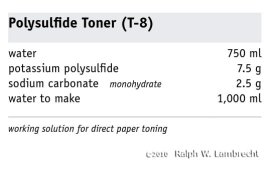
Brown Toner formula is attached. The color does change. As soon as you see a warming effect close to what you want, stop, there will be after-toning in the wash. All print tones are affected and protected. I use direct sulfide toning after selenium toning. This gives me strong shadows and warm highlights, both protected.
 

Attachments

  • BrownToner.jpg
    BrownToner.jpg
    23.5 KB · Views: 134
Hypo alum and a variant of it, Nelson's Gold Toner,
are also direct sulfide toners. Dan
 
This is what is so great about APUG and its members

thanks Ralph


Brown Toner formula is attached. The color does change. As soon as you see a warming effect close to what you want, stop, there will be after-toning in the wash. All print tones are affected and protected. I use direct sulfide toning after selenium toning. This gives me strong shadows and warm highlights, both protected.
 
This is what is so great about APUG and its members

thanks Ralph

Bob:

If you are interested in Brown Toner, you may appreciate this thread as well:

(there was a url link here which no longer exists)

IIRC, the formula posted can actually be found on Kodak's website as well.

Matt
 
Photrio.com contains affiliate links to products. We may receive a commission for purchases made through these links.
To read our full affiliate disclosure statement please click Here.

PHOTRIO PARTNERS EQUALLY FUNDING OUR COMMUNITY:


Ilford ADOX Freestyle Photographic Stearman Press Weldon Color Lab Blue Moon Camera & Machine
Top Bottom