
• Welcome to Photrio!
    Registration is fast and free. Join today to unlock search, see fewer ads, and access all forum features.
    Click here to sign up

Question about Neopan Acros 100

Forum statistics

Threads
203,265
Messages
2,852,049
Members
101,750
Latest member
Duquee
Recent bookmarks
0

photomem

Member
Allowing Ads
Joined
Sep 19, 2009
Messages
624
Format
Medium Format
I have started working with this film and am ready to develop some rolls.

Here is my question: Which of these would be the best developer?

  • Kodak D-76
  • Kodak Microdol-X
  • Ilford ID-11
  • Ilford Perceptol

Any of you have an experience with this?

Tommy
 
Of the 2 it's hard to decide :D

ID-11 is D76, and Perceptol and Microdol-X are very similar although I read a thread by David Kilpatrick somehwhere, he stated that Perceptol was slightly better.

Of you're 4 I'd go for ID-11/D76 rather tahn lose film speed for a fraction better grain, developers make less difference these days when the inherent grain of the emulsions is so much finer.

Ian
 
I have a rather large batch of d-76 mixed. I think I will use that.
 
Tommy,

Until recently I used D-76 1+1 with Fuji Acros. I was happy with that combination until I started using Rodinal 1+50 with it. If you ever get a hold of some Rodinal I would definitely recommend it for Acros.
 
ID11 / D76 and Acros is a combination that works very well indeed
 
I use Diafine... nice smooth curve... takes all the messing around with times and temps out of the equation.
 
Diafine shot at ISO 160 for 4 min + 4 min.... excellent gradation.... use it 70 deg.... you'll love the results and use thaqt for all negs ... even TriX @ 800 Have some fun...

Logan
 
Look, all those developers will give great results. Your results depend more on how you use your materials than the actual materials themselves.

Use ID-11 / D76 for a bit of sharpness and film speed gained over Microdol-X / Perceptol, in exchange for just slightly coarser grain. The difference is not big and you wouldn't even see a difference unless you compared side by side in a large print.

The best thing you can do is to use one of those developers, and use it for dozens, if not hundreds, of rolls continuously to learn how to eke the maximum possible out of that combination. That is how you obtain maximum results, by being familiar with your materials, not by switching around. Once you know how to tweak the results to your liking, you might want to think about using a different film or developer.

Good luck,

- Thomas
 
I find that Acros in D-76 produces solid printable negatives, if a little bit flat. However, there's a look that the Rodinal gives it that I prefer, I use a 1:50 dilution.
 
I've been developing it in D-76 and I have absolutely no complaints. Works great. XTOL is good too, if you care to try that, but don't look for anything terribly different from D-76. I wouldn't even think about grain. It's almost not there regardless of the developer used.
 
I have started working with this film and am ready to develop some rolls.

Here is my question: Which of these would be the best developer?

  • Kodak D-76

    Any of you have an experience with this?

    Tommy

  • ^^^^^^

    I believe everyone should start with D76. It is the standard against which all developers are compared. Use the results with D76/Id11 as a benchmark for comparison of any subsequent soups.
 
For slower fine-grained films like this I tend to throw them in Rodinal without thinking about it. While XTOL will cut metal with the sharpness you'll obtain, it's not necessarily needed with Acros or something similar like PanF. Acros tends to look a bit flat (to my eyes) so I usually prefer Rodinal 1+25 or Rodinal 1+50 with reasonable agitation.

In reality, any developer will work with these films. I don't believe it has a magic combination (e.g. Tri-X/D-76, APX/Rodinal).

Since you're not familiar with the film, you should keep it simple: D-76 1+1.
 
I quite disagree with the recommendation of starting with D76 1+1.

Acros is already such a mild contrast film that developing it in diluted D76 is taking it a bit far. I used full strength and still found the contrast rather soft for my taste. I recommend starting with straight D76 if you're going to use it.
 
I quite disagree with the recommendation of starting with D76 1+1.

Acros is already such a mild contrast film that developing it in diluted D76 is taking it a bit far. I used full strength and still found the contrast rather soft for my taste. I recommend starting with straight D76 if you're going to use it.

D-76 1+1 is a well known option that provides a stable platform from which to make comparisons. The entire point is in not going all custom/crazy/experimental when the person has no frame of reference with this particular film. If his negs turn out flat, that's what paper grades are for. Not really the end of the world.
 
I quite disagree with the recommendation of starting with D76 1+1.

Acros is already such a mild contrast film that developing it in diluted D76 is taking it a bit far. I used full strength and still found the contrast rather soft for my taste. I recommend starting with straight D76 if you're going to use it.

You can always extend development time to bump contrast, or use a harder paper/filter grade. The only real problem IMHO with low contrast negatives is the toe region of the characteristic curve, where shadow definition can be sub optimal.
 
Acros - Low contrast? No way.

Acros can be of low contrast and it can be of high contrast. And that is a function of your film development skills, certainly not a function of the film itself.
Some characteristics are built into the film. Any film can be processed to high contrast.
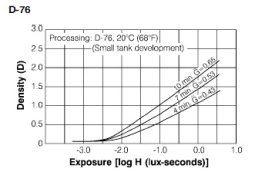
The attachment shows the contrast index of Fuji Acros 120 from Fuji's data sheet, and how it changes with development time.

ANY developer will work with Fuji Acros. Just pick one and run with it. Learn the controls of time, temperature, agitation, and consistency. Learn it well, and you will know how to process your negatives to suit your paper of choice.
 

Attachments

  • Acros.jpg
    Acros.jpg
    42.1 KB · Views: 143
Did a quick regression on the data Thomas posted.
Here are the results. Estimated 13 minutes to gamma 0.80.
This won't format exactly right, but the info is there.

D-76 full strength 20C Acros
gamma...minutes
0.40.....2.9
0.44.....4.0
0.45.....4.6
0.50.....6.2
0.53.....7.0
0.55.....7.6
0.60.....8.8
0.65....10.0
0.70....11.1
0.75....12.1
0.80....13.0

Lee
 
Photrio.com contains affiliate links to products. We may receive a commission for purchases made through these links.
To read our full affiliate disclosure statement please click Here.

PHOTRIO PARTNERS EQUALLY FUNDING OUR COMMUNITY:


Ilford ADOX Freestyle Photographic Stearman Press Weldon Color Lab Blue Moon Camera & Machine
Top Bottom