• Welcome to Photrio!
    Registration is fast and free. Join today to unlock search, see fewer ads, and access all forum features.
    Click here to sign up

Pyro developer stain impacting VC Paper use?

Surprise

A
Surprise

  • 3
  • 0
  • 43
102391040027-2.jpg

A
102391040027-2.jpg

  • 6
  • 4
  • 133

Recent Classifieds

Forum statistics

Threads
201,783
Messages
2,830,114
Members
100,945
Latest member
meatlasagna
Recent bookmarks
0

Removed Account

Member
Allowing Ads
Joined
Apr 6, 2007
Messages
907
Location
Nanaimo, Bri
Format
35mm
I've been reading about pyro developers and wanting to try them for several reasons including the self-masking effect and dabbling in alternative processes while primarily printing on silver paper. I've heard that some, particularly the yellow stain from PMK, can affect green light and somehow impact printing with VC paper. I am likely going to start with Pyrocat-HD and will be developing TXP-320 in 4x5 sheets with a tank and hangar system. Will the brown stain adversely affect printing on VC paper? How will it alter the filter grades, if at all? Do you think I'd be better off just using a "normal" developer? Thanks for the help!

- Justin
 

Dave Miller

Member
Allowing Ads
Joined
Dec 22, 2003
Messages
3,882
Location
Middle Engla
Format
Medium Format
There have been several threads on this subject recently, and the consensus of opinion seems to be that this type of developer does impact on VC printing filtration. Common experience suggests that the use of a harder filtration value equal to about one grade is required in order to retain equivalent contrast in the print. However my experience is that the benefits of staining developers far outweigh any perceived drawbacks by a wide margin.
 

noseoil

Member
Allowing Ads
Joined
Oct 6, 2003
Messages
2,887
Location
Tucson
Format
Multi Format
If you will simply do film and paper tests when starting with this combination, this is a moot point. If you decide to rely on others and forego tests, this will be an issue you will never quite resolve. Pyrocat-hd is a good choice, simple, inexpensive and forgiving. It has advantages with respect to high values in a print. Best, tim
 

Eric Rose

Member
Allowing Ads
Joined
Nov 21, 2002
Messages
6,842
Location
T3A5V4
Format
Multi Format
I find the use of a condenser enlarger very advantageous when using pyro. My favorite soup is PyroCat-HD which I use for 95% of everything I shoot.
 

JBrunner

Moderator
Moderator
Allowing Ads
Joined
Dec 14, 2005
Messages
7,429
Location
PNdub
Format
Medium Format
The stain in pyro type developer is a tremendous benefit in for high contrast situations and rather than a drawback, it can be of used to advantage when split printing. In normal filter grade printing it requires an only an adjustment as to how you interpret your negatives, and this you will soon master.

Eventually you will be able to tailor your negatives to be equally suitable for both silver and many other alt process such as pt/pd.

On first appearance you may consider your first pyro negs unprintable. That won't be the case when you print them. It is a fun surprise, as is the fun of showing pyro negs to somebody unfamiliar with them.
 
Last edited by a moderator:

michael9793

Member
Allowing Ads
Joined
Feb 4, 2003
Messages
2,018
Location
Fort Myers,
Format
ULarge Format
Just one more thought here. I use Pyro-cat HD and a zone VI VC enlarger. This enlarger uses green and blue vs yellow and magenta. I feel there is a difference here where it is slightly less contrasrty using pryo-hd. I seem to get the prints to snap sightly more when I use Microdal-X. P-hd is more of a brown tone than the others that are green or orange in color. this makes it easiler to work with on VC papers.
 

Ross Chambers

Member
Allowing Ads
Joined
Apr 26, 2004
Messages
701
Location
Blue Mountai
Format
Multi Format
Using an Ilford Multigrade 500 head and RH Analyser Pro to print a Pyrocat HD developed 4x5 neg on Ilford MG I found that for the appropriate paper setting to achieve a satisfactory print the overload high and low were flashing way off the scale. My recent contact prints were made by plugging in the old Ilford controller and split grading. There certainly is a difference.

RH Designs do recommend a channel be devoted to chromogenic negatives, this may be a similar situation?

I sought comment on this subject on this forum a few weeks ago, but no-one had any thoughts.

Regards - Ross
 

Dave Miller

Member
Allowing Ads
Joined
Dec 22, 2003
Messages
3,882
Location
Middle Engla
Format
Medium Format
Using an Ilford Multigrade 500 head and RH Analyser Pro to print a Pyrocat HD developed 4x5 neg on Ilford MG I found that for the appropriate paper setting to achieve a satisfactory print the overload high and low were flashing way off the scale. My recent contact prints were made by plugging in the old Ilford controller and split grading. There certainly is a difference.

RH Designs do recommend a channel be devoted to chromogenic negatives, this may be a similar situation?

I sought comment on this subject on this forum a few weeks ago, but no-one had any thoughts.

Regards - Ross

Did you contact the manufacturer with your question?
 

RH Designs

Advertiser
Advertiser
Allowing Ads
Joined
Apr 9, 2003
Messages
651
Location
Yorkshire Da
Format
Multi Format
Using an Ilford Multigrade 500 head and RH Analyser Pro to print a Pyrocat HD developed 4x5 neg on Ilford MG I found that for the appropriate paper setting to achieve a satisfactory print the overload high and low were flashing way off the scale. My recent contact prints were made by plugging in the old Ilford controller and split grading. There certainly is a difference.

RH Designs do recommend a channel be devoted to chromogenic negatives, this may be a similar situation?

I sought comment on this subject on this forum a few weeks ago, but no-one had any thoughts.

Regards - Ross

Our albeit limited experience with staining developers suggests that an increase of half a grade or so in contrast is required, and that seems to be confirmed by other posters here. I've personally done very little work with staining developers - the only time I tried one (DiXactol) it gave me no advantage whatsoever over Rodinal, and was twice as fiddly and many times the price so I didn't do any further testing. Chris Woodhouse did some more thorough investigations and concluded a contrast increase was required when using the Analyser. He also found very little if any advantage to using a staining developer.

Here's a quote from his Dead Link Removed

"Pyro Developed Negatives
Monochrome film, developed in Pyro or derivative developers (like Dixactol / Exactol) can take on a brown and yellow stains on the film base and in the image area. The colour of this stain can affect exposure and sometimes contrast of the paper. In my own experiments with Pyro, Dixactol and Exactol, prints made on fixed grade paper become more contrasty than the meter (or a densitometer) indicate and require more exposure. When the same negative is printed on VC paper, more exposure is required, but the change in contrast is minimal, indicating that the stain is not effectively proportional to image density. Barry Thornton does a good analysis in his book, 'Edge of Darkness'. In one case the stain acts like a safelight filter, in the other case, it acts like a low grade contrast filter."
 

palewin

Member
Allowing Ads
Joined
Nov 23, 2006
Messages
146
Location
New Jersey
Format
4x5 Format
Must confess I find this thread rather confusing (and I have been using PMK for something like 20 years...) First, the stain in pyro developers definitely impacts analyzer or densitometer readings. I don't use either, but this is not an issue of negative contrast, simply the effect of the stain on the measurement. As for contrast, isn't this still a matter of development time? If the negatives are too flat, increase the development time. The stain itself works primarily as a mask on high values, and has very little, if any, effect on low values (i.e. it effects local contrast, not overall contrast). I use a ZoneVI VC head on a DeVere 405, and most of the time use the settings which are supposed to be equivalent to a Grade 2 paper (E-E for those of you using this head). I was in fact getting negs which were too contrasty, so I shortened my time.
 

noseoil

Member
Allowing Ads
Joined
Oct 6, 2003
Messages
2,887
Location
Tucson
Format
Multi Format
Pete, in my opinion, you are correct and I agree with you about development time. I think a lot of the confusion stems from trying to use a film-developer-paper combination, without doing the homework first. The stain does act like a filter, but development time will take care of it without any trouble. If you have developed film for use with a VC paper, the graded paper may show too much contrast, but this is due to a lack of testing, not the developer.

I've used both PMK and pyrocat-hd. The only thing I have to say about PMK, which I don't like about the stain, is on the bottom end. If you do a test at some point, you may find that shadow values can tend to be a bit murky and contrast is reduced by the general stain with PMK, when compared to the pyrocat developer. I've switched to pyrocat for most of my work for this reason, but still use PMK for portraits at times, just like what it does with creamy skin tones. Another plus for me with pyrocat is the ability to do longer developments (minimal agitation and stand development), which can increase contrast in shadows and give better edges. Best, tim
 

gainer

Subscriber
Allowing Ads
Joined
Sep 20, 2002
Messages
3,699
A constant yellow stain acts, of course, like a yellow separate filer of some density on VC paper. The proportional stain of a properly developed PMK negative ADDS a little contrast to VC paper and a lot of contrast to a graded paper. It has been said before: the silver image can be removed, leaving the pyro stain. This pyro stain can be printed on the highest grade of printing paper or on VC paper with a blue color separation filter. It may not be a good print, but it demonstrates that the pyro stain does not reduce contrast. If it did, the stain alone would prioduce a negative image.

The opposite experiment can also be done. A negative originally done in silver alone can be bleached and redeveloped in pyro to restore the silver image and add to it the proportional stain. One can see that before and after prints on VC paper without a printing filter will show somewhat higher contrast after staining.

I'm not arguing against Pyrocat XX. Hydroquinone used in place of catechol in Pyrocat formulas also produces a stain, but of different color spectrum than either catechol or pyrogallol. I don't know if that is of any use to the usual users of staining developers, but it is an interesting fact.

Another fact is that comparisons are not usually between pyrocatechin and pyrogallol but between Pyrocat XX and PMK. What would happen if PMK were used in the same type of formula as Pyrocat? That is a highly diluted high pH working solution. There would no doubt be the difference in stain color, but would there be the different tendencies to overall stain? I did make some of what I called Pyrogal MC, but have not done much with it. Maybe it still works. I mixed it in glycol just as if it were catechol, but using 2/3 as much on the theory that 3 OH groups would be half again as potent as 2.
 

gainer

Subscriber
Allowing Ads
Joined
Sep 20, 2002
Messages
3,699
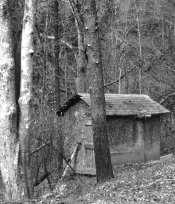
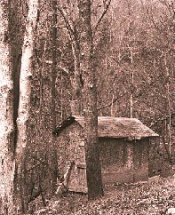
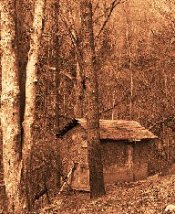
I went into the dungeon and resurrected the Pyrogal MC. I tried it on a test strip I had on FP4+ of my backyard with chicken house. I figured on the basis of a snip test that 8 minutes would be good. Just as I poured the developer in the tank, I remembered the temperature was 62 F, but the snip test said it was OK so I let it ride. It turned out pretty good.

The working solution was 1:1:50 using the same potassium carbonate solution I would use with Pyrocat MC.

The purpose of this excercise was to see if the stain would respond to VC filtering. It's probably just as well the temperature was low. If it had been at 68 F as planned, the contrast would have been too high to start. I have attached two copies of a much cropped portion of the photo so as not to lose too much detail while showing what I want to show. One, labelled "Pyrogal MC nf", was scanned from the straight print. The other was made with 25 units of magent. Both were made in my Super Chromega.

I do not see any evidence of muddied shadows. The change of contrast was more than I would have expected from only 25 units of magenta, but I cannot prove it.

If you would like to compare pyrogallol with catechol and not just two different developing methods, I suggest mixing a batch of Pyrocat MC as per Sandie's instructions and a batch of the Pyrogal MC, using the same instructions but with 2/3 the weight of pyro.
 

Attachments

  • Pyrogal MC nf.jpg
    Pyrogal MC nf.jpg
    140.4 KB · Views: 209
  • Pyrogal MC 25m.jpg
    Pyrogal MC 25m.jpg
    170.9 KB · Views: 212
Last edited by a moderator:

sanking

Member
Allowing Ads
Joined
Mar 26, 2003
Messages
5,437
Location
Greenville,
Format
Large Format
The effect of stain on VC papers is a very complicated issue and one that I have been trying to stay away from recently since I am no longer working with VC silver papers. But I will give it a stab.

First understand that the emulsion of VC papers is both blue sensitive (high contrast) and green sensitive (low contrast). As you introduce more and more magenta into the filtration package, either by the use of higher number VC filters, or by dialing in more magenta on color heads, you progressively block more and more green light. Eventually you will block almost all green light, and at that point only the high contrast blue sensitive part of the emulsion is exposed. At this point the VC paper will print as a graded paper, with no highlight compensation. This happens with all staining developers to some degree. If you are using a VC or MC filter set, the filter number at which most light to the green layer is blocked is about #3.5, though this will vary by filter set.

So in order to take advantage of the stain to compress the highlights, which is very useful in high contrast scenes, you must develop the negative to a very high CI (much higher than would be needed for a Grade 2 paper) that will allow you to make adjustment to contrast VC filters #3.5 and lower that pass green light. You might consider shooting for a negative DR of about log 1.35-1.45, or a CI of around .75.

If you were to develop to a low CI it would be necessary to use VC filters of #3.5 or higher, and this would in effect eliminate the compensating effect in high contrast scenes because the magenta filtration blocks light to the low contrast green sensitive part of the emulsion.

Sandy King
 
OP
OP

Removed Account

Member
Allowing Ads
Joined
Apr 6, 2007
Messages
907
Location
Nanaimo, Bri
Format
35mm
Would you say it would be more worth my time, if I go with Pyrocat-HD, to use graded papers? My main interest in VC is to avoid buying several grades of the same paper. I'd presume that if I test well enough then I could tailor the negs to a specific paper and grade; would this be correct?

- Justin
 

Ross Chambers

Member
Allowing Ads
Joined
Apr 26, 2004
Messages
701
Location
Blue Mountai
Format
Multi Format
To be honest the Pyrocat HD developed negs were aimed at salt printing, but I was curious about their properties as printed on multi contrast off the shelf paper, particularly as some sources find an ideal Pyrocat HD negative (not necessarily mine!) suitable for dual duty. Since my initial projection printing of 4x5s using the RH Designs Analyser Pro (which I strongly recommend) I've done some 5x7 contacts split printed onto Ilford MG FB Warm Tone which I really like: they do tend toward contrasty but have detail in shadow and highlights.

Graded paper BTW is not to be found, to my knowledge, this side of the Equator.

Regards - Ross
 

gainer

Subscriber
Allowing Ads
Joined
Sep 20, 2002
Messages
3,699
Would you say it would be more worth my time, if I go with Pyrocat-HD, to use graded papers? My main interest in VC is to avoid buying several grades of the same paper. I'd presume that if I test well enough then I could tailor the negs to a specific paper and grade; would this be correct?

- Justin

Perhaps, but would it not be just as correct no matter what kind of paper you used? Then, if you made a mistake in calculating contrast, you could simple change a filter in the enlarger.
 

gainer

Subscriber
Allowing Ads
Joined
Sep 20, 2002
Messages
3,699
I have no idea of the workings of the RH Designs system. Before it existed, I designed and built my own. I have what amounts to a projection densitometer with knobs and scales on slope and amplitude. The controls are independent, so that I can set the zero and adjust the slope from that point without changing the zero setting. Conversely, I can change the setting of the slope without effecting the zero setting. I can calibrate the thing for a number of uses. I can set it to read Zones with the proper calibration. Each contrast grade of paper requires a different setting of the slope and intercept knobs, but the test is simple. The best thing about it is it's all analog except the digital display.
 

noseoil

Member
Allowing Ads
Joined
Oct 6, 2003
Messages
2,887
Location
Tucson
Format
Multi Format
"I do not see any evidence of muddied shadows....."

Pat, I think I may have been unclear in my statement about shadow values. I was trying to say that the general stain (as found in PMK) did affect my shadow values in a negative manner (sorry, no pun intended). While the high values seem to retain good separation with PMK, the low values (with much less density) have a muted or muddy effect, which translates into a print with murky shadow values and depressed separation. One big plus for me with Sandy's pyrocat formula is the crisp shadow separation, which is enhanced by longer development times tending more toward the stand type of development. Thanks, tim
 

sanking

Member
Allowing Ads
Joined
Mar 26, 2003
Messages
5,437
Location
Greenville,
Format
Large Format
Would you say it would be more worth my time, if I go with Pyrocat-HD, to use graded papers? My main interest in VC is to avoid buying several grades of the same paper. I'd presume that if I test well enough then I could tailor the negs to a specific paper and grade; would this be correct?

- Justin

There are several potential reasons to use a staining developer.

1. high acutance
2. grain masking
3. capability of building higher contrast for alternative processes
4. highlight compensation

The first three of this reasons are valid for all printing processes, graded and VC silver papers, and for alternative printing. Highlight compensation only applies to VC silver papers, and then only if you do not use a VC filter #3.5 or greater (or dial in the equivalent magenta filtration with a color head).

Sandy King
 

gainer

Subscriber
Allowing Ads
Joined
Sep 20, 2002
Messages
3,699
"I do not see any evidence of muddied shadows....."

Pat, I think I may have been unclear in my statement about shadow values. I was trying to say that the general stain (as found in PMK) did affect my shadow values in a negative manner (sorry, no pun intended). While the high values seem to retain good separation with PMK, the low values (with much less density) have a muted or muddy effect, which translates into a print with murky shadow values and depressed separation. One big plus for me with Sandy's pyrocat formula is the crisp shadow separation, which is enhanced by longer development times tending more toward the stand type of development. Thanks, tim

I don't disagree with what you say. I do think the overall stain is not necessarilly due to pyrogallol, but to the way it is used, especially under the initial instructions to use an alkaline bathe before fix.

When I did the FP4+ test with pyrogallol in place of catechol in the Pyrocat MC formula, there was little staining visible under incandescent light, which either means there was none or that there was very little stained base fog. My HP PhotoSmart 35 mm film scanner could tell, however. I asked it to pretend the neg strip was color neg and it showed a magenta colored scan. An unstained neg showed a sepia color. Maybe I can get that to show in attachments.

What I am getting at is that the difference between PMK and Pyrocat is not only due to the difference between pyrogallol and catechol, but includes differences that we might see even if we used the same agent in both. I used pyrogallol in the formula designed by Sandy King for catechol, and I think the main difference between that and Pyrocat MC is the color of the stain. I haven't tried to use catechol in place of pyrogallol in PMK. I'm sure it would develop film, but I'm not sure it would stain it at a buffered pH of 9.6.

Ain't we got fun?
 

sanking

Member
Allowing Ads
Joined
Mar 26, 2003
Messages
5,437
Location
Greenville,
Format
Large Format
I used pyrogallol in the formula designed by Sandy King for catechol, and I think the main difference between that and Pyrocat MC is the color of the stain. I haven't tried to use catechol in place of pyrogallol in PMK. I'm sure it would develop film, but I'm not sure it would stain it at a buffered pH of 9.6.

Ain't we got fun?

Pat,

I don't think you would get much developer activity at pH of 9.6 (using the 30% sodium metaborate B solution) substituting pyrocatechin for pyrogallol. I tried metaborate with the original Pyrocat-HD formula with the PMK B solution and got almost no action at normal development times. Might be different with Pyrocat-MC, which uses metol in place of phenidone, + ascorbic which is not in Pyrocat-HD. But I have not tried it.

Sandy
 

gainer

Subscriber
Allowing Ads
Joined
Sep 20, 2002
Messages
3,699
i'm sure you would have to increase the concentration considerably to get any action, but remember pyrogallol has an extra OH, so catechol might do something if its molecular concentration in the stock solution were increased by a third.

Meanwhile, when you can't see the stain you can develop a companion strip in a non-staining developer and compare them in a film scanner set to read color negative film. The attachments show the result. The first in line was developed in Pyrogal MC. The other was developed in one of my MC-borax concoctions.
 

Attachments

  • STAINED.jpg
    STAINED.jpg
    26.7 KB · Views: 151
  • UNSTAINED.jpg
    UNSTAINED.jpg
    25.8 KB · Views: 144
Photrio.com contains affiliate links to products. We may receive a commission for purchases made through these links.
To read our full affiliate disclosure statement please click Here.

PHOTRIO PARTNERS EQUALLY FUNDING OUR COMMUNITY:


Ilford ADOX Freestyle Photographic Stearman Press Weldon Color Lab Blue Moon Camera & Machine
Top Bottom