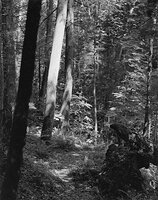
The highlights can block up fairly easily with Tri-X 400 (though not with Tri-X 320).
So, since a good-enough print for most people can be obtained from a negative that is one stop underexposed, and since pushing increases contrast, coupled with the fact that many people exacerbate the problem by deciding to push after they have shot in a dark and contrasty lighting situation, Kodak figures that for the average Tri-X user, "better" results will be obtained most of the time by simply printing the underexposed negative that has not been pushed.
Basically, I think Kodak is saying that a majority of the time, it is better to have to print up an underexposed neg than to take a chance that you may have to try to take contrast away from a neg that has too much of it. In other words, Kodak makes this recommendation basically because most people don't know what the hell they are doing, and there is less possibility of Joe Photographer screwing up his shot by not pushing than there is by pushing.
Of course, if you know when to do it, you can push any film you want however you want. Just know what you should expect to get before you do it, because, as Kodak sez, in many cases, simply having an underexposed and normally developed neg is better than having an underexposed and pushed neg.