Pushing film
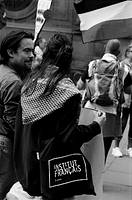
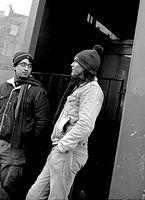
About 3 months ago I photographed a candlelight vigil here in Ottawa; I used two of the last rolls of my beloved Agfapan 400 film. It was exposed in two of my trusty Nikon Fs; one with a 50mm lens for 1/30 second @ f/1.4, the other was exposed with a 35mm lens for 1/8 second @ f/2.8. I braced my elbows on my ribcage to make the 1/8 second exposure.
I developed the film in a 16-oz tank, in D-23, for 40 minutes at 83°F, followed by a immersion in a static bath of a 1% solution of sodium metaborate (aka Kodalk) for 5 minutes, also at 83°F. The grain is large, but sharp and tight. There is acceptable shadow detail, and while the highlights appear to be burned out in the contact sheets, there is detail and separation in the highlights, although considerable burning in is required. The base plus fog is also very high, as would be expected from that degree of development.
The stop bath and fixer (without hardener) were also at 83°F. After fixing, I placed the film in a tank of 83°F water, and gently brought the temperature down by cooling the tank with a spray of 55°F water, until the water in the tank was 68°F. Then, two minutes in hypo clear, ten minute wash, dunk in a wetting agent, and hung until dry. Before processing the film, I immersed a chip of the same film in 83°F water for two minutes, and tried my best to damage the emulsion by rubbing it between my thumb and forefinger. The emulsion stayed intact, so I figured that 83°F was okay. The next time I go this route, I will try a test with 100°F water; if the film passes, the new developing time will be about 20 minutes at 100°F.
There are as many procedures to deal with a low light, high contrast situation as there are photographers, and this is what worked for me in this situation. I estimate the exposure index that resulted from this procedure to be about EI 4000 to EI 8000, although one must keep in mind that when viewing the results there is a lot of subjective analysis involved: I am happy with the resulting prints, whereas another photographer might not be. Also, this procedure would not produce anything resembling an ANSI speed, as speed determination is based partially on midtone detail, but mostly on shadow detail, and there is a precise definition of contrast involved in the calculation.