• Welcome to Photrio!
    Registration is fast and free. Join today to unlock search, see fewer ads, and access all forum features.
    Click here to sign up

Pushing Arista II 400 to 3200

Street portraits

A
Street portraits

  • 0
  • 0
  • 15
Street portraits

A
Street portraits

  • 0
  • 0
  • 12

Recent Classifieds

Forum statistics

Threads
201,682
Messages
2,828,498
Members
100,889
Latest member
aLLinSE
Recent bookmarks
0

brofkand

Member
Allowing Ads
Joined
Aug 9, 2008
Messages
598
Location
North Carolina
Format
Digital
Hey all,

I checked out the digitaltruth site and it said I should start with an 8 minute development time, and multiply x4.5 to push this film to 3200. I am using the Arista liquid developer.

With this formula, logic follows I should be developing for 36 minutes. This seems excessive to me; I've heard a minute per stop is what you need. Any tips? Thanks!
 

2F/2F

Member
Allowing Ads
Joined
Apr 29, 2008
Messages
8,031
Location
Los Angeles,
Format
Multi Format
There is no rule about a minute per stop...at least not one that actually holds true. It will differ with each person, camera, film, etc. General rules of thumb are usually expressed in percentages of normal development, and are usually very rough. One exception of which I am aware is C-41 processing of Kodak Portra 800, where the rule is 30 sec. per stop, up to two stops.

36 min. is very excessive if keeping with a standard agitation routine. I can almost guarantee you that you cannot get the highlights of the film to 3200 (3-stop push) with development alone, so all you will be doing is mushing up any sharpness and detail that you do have, which, given a three stop underexposure, is probably not much.

This is why I say it is almost 100% not possible: A true three stop push means that you are taking something that was exposed in a way that would give it a tonality of middle grey with normal development, and pushing it up to a very very light grey (practically white, but with some visible texture) via overdevelopment. This just ain't gonna happen. With most films I have tested, even a "true" two-stop push is barely attainable with development.

Now, this does not mean you won't get printable exposures. They will just be hard to print. It just means that beyond a certain point, pummeling your film any more won't really do much to help you print the negs. It will make the shadows more grainy and washed out, the details less sharp, and the tonal relationships could get somewhat "odd" in the midtones. You are better off developing the film as far as it can go while maintaining reasonable quality, and then intensifying via the Formulary intensifier and/or selenium toning.

As for what I would do...I would probably develop using that Website's +2 guideline (2.25x = 18 min.), which I would say is a good generalization, and see what I got. (Actually, I would develop at 24C to reduce the time.) Then, if I wanted to print any of the pix, I would probably end up trying to get the best print that I could with the original neg., then start trying intensification. In most cases, you can get to + 3 or a little farther more cleanly by developing to + 2 then intensifying.

Just FYI, the film in question is actually Agfa 400 resold as Arista II, if my memory is correct...which it may not be. It could be Forte or Foma if not Agfa. The Arista relabelling specifics can get somewhat confusing, so I am hoping someone chimes in with Arista II's true source.

I know for sure that Efke 400 is Agfa 400, in case you want to get more.

All of this, of course, is assuming that the metering technique was good, meaning that you were actually underexposing by three stops from the "best" exposure. Sometimes you think you need to push but you really don't because certain things are throwing off your best judgment or your meter. Yet another reason to develop to + 2 maximum: you get to see the negs before deciding if they need more density.

Stand development is something which I am sure someone will bring up. A semi stand combined with a push would probably be a great option, but, of course, is all rather iffy without some testing first.

 
Last edited by a moderator:
OP
OP

brofkand

Member
Allowing Ads
Joined
Aug 9, 2008
Messages
598
Location
North Carolina
Format
Digital
800, 1600, 3200...three stops. Or is there a speed somewhere in the middle that I am missing? Or did I just not count it right?
 

2F/2F

Member
Allowing Ads
Joined
Apr 29, 2008
Messages
8,031
Location
Los Angeles,
Format
Multi Format
800, 1600, 3200...three stops. Or is there a speed somewhere in the middle that I am missing? Or did I just not count it right?

I counted wrong, then fixed it! Sorry

BTW, I just discovered in my bag of yet-to-be-developed film four rolls of Efke 400 wrapped together and marked "3200". Since it is the same film, we are in the same boat! My film was exposed about two years ago, though....heh heh
 
Last edited by a moderator:
OP
OP

brofkand

Member
Allowing Ads
Joined
Aug 9, 2008
Messages
598
Location
North Carolina
Format
Digital
No problem. I got kind of confused :smile:

So, a three-stop push is not acceptable? The Freestyle rep I spoke to said that would give me grain, but still a usable negative. I am afraid I will get a blank negative if I do this, however. I shot at 50, f/8 with flash (I used a Rebel 2000, so I can't be sure what power the flash fired at...no manual flash with that camera). I also used a sync flash I got from Wolf Camera.

I may be able to just develop at 400 or 800 and get a good image. What are your thoughts? There's really no way to know until I try it, but I am scared I'll either get an all dark negative if I go with 800 or an all clear, thin negative if I go with 1600 or 3200...
 

2F/2F

Member
Allowing Ads
Joined
Apr 29, 2008
Messages
8,031
Location
Los Angeles,
Format
Multi Format
No problem. I got kind of confused :smile:

So, a three-stop push is not acceptable? The Freestyle rep I spoke to said that would give me grain, but still a usable negative. I am afraid I will get a blank negative if I do this, however. I shot at 50, f/8 with flash (I used a Rebel 2000, so I can't be sure what power the flash fired at...no manual flash with that camera). I also used a sync flash I got from Wolf Camera.

I may be able to just develop at 400 or 800 and get a good image. What are your thoughts? There's really no way to know until I try it, but I am scared I'll either get an all dark negative if I go with 800 or an all clear, thin negative if I go with 1600 or 3200...

How did you rate your film on the camera? That will determine the exposure you got.

As for "acceptable", that will have to be your decision. What I said is that it is probably not possible without intensification.

If using flash, the only reason you would need to push would be if you told your camera that you were using a 3200 film, but were really using a 400 film.

There can really be no recommendations until we know to what EI you set your camera's meter. You don't develop "at" an EI, but "for" an EI to which you set your camera. So, you EXPOSE at the EI, not develop at it. Your development just compensates for the exposures you made.

But as to your fears that you will get a more blank negative with added development...I am scratching my head.
 
Last edited by a moderator:
OP
OP

brofkand

Member
Allowing Ads
Joined
Aug 9, 2008
Messages
598
Location
North Carolina
Format
Digital
2F/2F:

Yes, I told the camera I was using 3200 film. But, I also used a slave sync flash which obviously wasn't figured into the meter. That sucker is pretty bright, so I am thinking I may be able to disregard the rating. I could very well be wrong, which is why I am a member here at APUG. :smile:
 

2F/2F

Member
Allowing Ads
Joined
Apr 29, 2008
Messages
8,031
Location
Los Angeles,
Format
Multi Format
What was the guide number of your slave flash and how far from the subject/s was it located, on average?

Whatever power your flash thinks it should have fired at was actually three stops more dim that what it should have fired at for a 400 film. The slave's power was not controlled by the camera, however. Therefore, the slave will likely become your main light and the camera's flash the fill light.

So, depending on the power (and location) of the slave, you may not need to overdevelop so much.

So, just hope the slave was in a "flattering" location and that it had a decent amount of power. If so, your camera's flash should be a nice fill at three stops under.
 
Last edited by a moderator:
OP
OP

brofkand

Member
Allowing Ads
Joined
Aug 9, 2008
Messages
598
Location
North Carolina
Format
Digital
I can't find the guide number anywhere in the documentation, but according to a Google search an Amazon reviewer rated it at about 10-20ft at ISO 100.

I had it about 5 feet from the subject.
 

2F/2F

Member
Allowing Ads
Joined
Apr 29, 2008
Messages
8,031
Location
Los Angeles,
Format
Multi Format
OK. A GN (in feet) of 10 to 20 at 5 feet from subject means use f/2 to f/4 at ISO 100. This means use f/4 - f/8 at ISO 400, which your film actually is.

So, if your GN is 10, you need to push two stops. If it is 15, you need to push one stop. If it is 20, you can develop normally. You just need to decide what GN you want to assume, and you are good. You can just assume one, or you can test it before you develop your exposed roll.

The *only* effect rating your film to 3200 had in this case was to underexpose the on-camera flash by three stops, effectively making it a fill light. (This is assuming the camera was set on manual made and the flash was set on TTL auto mode.)

I would probably just develop the film to + 1 myself. If it is not quite enough, the on-camera flash will help slightly, and/or contrast can be added in printing. It is better to have to add contrast in printing than to have to take it away, IMO. You can also always intensify the neg with selenium to up the contrast if it is still too flat, while you can't really lower the contrast of the neg after the fact.
 
OP
OP

brofkand

Member
Allowing Ads
Joined
Aug 9, 2008
Messages
598
Location
North Carolina
Format
Digital
2F/2F:

I will push one stop, to 800. Now, the question is: how much should I increase development time? 8 minutes is the standard rate for the film at 20C. I would feel more comfortable pushing one stop, and using a 3 or 4 filter in my enlarger when I print.

Thanks for all of your help so far.
 
OP
OP

brofkand

Member
Allowing Ads
Joined
Aug 9, 2008
Messages
598
Location
North Carolina
Format
Digital
OK, let me give an update:

I developed using stock (1:9) Arista liquid developer, for 10 minutes at 68F. I had originally expected to do 12, but got gun-shy and poured it out at 10.

The film is hung up to dry right now. It looks good. I will print them either later tonight (depending on how late I stay up), or tomorrow. After which I will post results.

Thanks 2F/2F for all your help. I am excited to print these buggers.
 
OP
OP

brofkand

Member
Allowing Ads
Joined
Aug 9, 2008
Messages
598
Location
North Carolina
Format
Digital
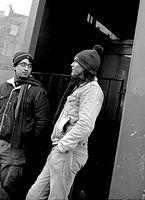
Here is the finished project. Just imagine it in a black frame with a white matte around it.
project.jpg


All in all, it's exactly what I want. Lots of grain, gloomy, dark setting, harsh shadows. Thanks again for your help, 2F/2F.
 
Photrio.com contains affiliate links to products. We may receive a commission for purchases made through these links.
To read our full affiliate disclosure statement please click Here.

PHOTRIO PARTNERS EQUALLY FUNDING OUR COMMUNITY:


Ilford ADOX Freestyle Photographic Stearman Press Weldon Color Lab Blue Moon Camera & Machine
Top Bottom