
-
Welcome to Photrio!Registration is fast and free. Join today to unlock search, see fewer ads, and access all forum features.Click here to sign up
You are using an out of date browser. It may not display this or other websites correctly.
You should upgrade or use an alternative browser.
You should upgrade or use an alternative browser.
Pulling acros (120) 100 to 25 - rodinal or xtol?
-
A
- Thread starter 1kgcoffee
- Start date
Recent Classifieds
-
For Sale Rodenstock Apo Sironar N 300mm RARE
- Started by x.rasenas
-
For Sale Leica M9 not working sensor _ for repair
- Started by Manual Camera
-
Want to Buy WTB: 4x4 Resin 81B Filter
- Started by NortheastPhotographic
-
For Sale LINHOF SUPER TECHNIKA III VERSION 5 with Raptar 135, film holders and FP4
- Started by Simon Benton
-
For Sale LINHOF TECHNIKA III ver 5 LENSBOARDS
- Started by Simon Benton
Forum statistics

I suggest shooting at the proper speed.What do you folks suggest?
ACROS is very tolerant of over-exposure, as you have done bu2 stops.
The highlights won't block up. There will still be detail, but with significant density.
- Leigh
The problem you encounter is the film can achieve a density much higher than you can print on any available paper.
If you scan the negs you might be able to capture a bit wider range, but this is not a digital site.
I suggest reducing the development time by perhaps 30% in an attempt to compress the highlights.
- Leigh
If you scan the negs you might be able to capture a bit wider range, but this is not a digital site.
I suggest reducing the development time by perhaps 30% in an attempt to compress the highlights.
- Leigh
P C Headland
Subscriber
Probably worth a test with another roll if there's pictures you don't want to lose.
As a starting point, I'd try Rodinal 1+100 with minimal agitation - something like three gentle inversions at the start of each minute for the first three minutes, then one gentle inversion every three minutes. Usually for Acros in Rodinal I'd develop for 18 minutes, so you might want to knock that back to 12 or 15 minutes total.
As a starting point, I'd try Rodinal 1+100 with minimal agitation - something like three gentle inversions at the start of each minute for the first three minutes, then one gentle inversion every three minutes. Usually for Acros in Rodinal I'd develop for 18 minutes, so you might want to knock that back to 12 or 15 minutes total.

Whenever I use Rodinal, I consider that I automatically lose one full stop in speed, so rating at 25 means over exposing by only one stop. I would consider developing as normal or reducing time by 10-15%. MDC calls for Rodinal 1+50 @11 mins for ISO 50.
I would use D76 1:2 less 25% time to start, you want to sacrifice a frame or 2 so you can use -25% as a start then fine tune your times.
- Joined
- Nov 26, 2008
- Messages
- 20
My 2 cents is to develop it in Xtol. Acros LOVES Xtol. The grain smoothness and resolution is amazing.
It all depends on how you metered, so the ISO 25 value alone is not an indication that your severely overexposed. If you did a general incidence reading and got an exposure value, but have deep shadows in your scene, you may be properly exposed.
For me, I would use Xtol for 7 minutes at 72f (21.2c) if your going to scan the negative---certainly no less then 6 minutes if your analog printing. It is just a guess though.
Pete
It all depends on how you metered, so the ISO 25 value alone is not an indication that your severely overexposed. If you did a general incidence reading and got an exposure value, but have deep shadows in your scene, you may be properly exposed.
For me, I would use Xtol for 7 minutes at 72f (21.2c) if your going to scan the negative---certainly no less then 6 minutes if your analog printing. It is just a guess though.
Pete
I wonder why.Whenever I use Rodinal, I consider that I automatically lose one full stop in speed...
I've used Rodinal for well over 50 years with no loss of speed on slow films. (I almost never shoot films over ASA100.)
Perhaps it's a difference in the development protocol.
- Leigh

I did shoot some Acros at ei 25 a few years ago and it came out beautifully. The subject was a black cat lying in the sun in a window and I got easily printable, natural looking detail everywhere. The problem is that I don't remember what developer I used, but it would have been either Xtol or Beutlers formula.

If this was my roll of film, and without testing results for this rating first, I would reduce the development time by 30% of what you normally use with Acros, you should be in the ballpark.
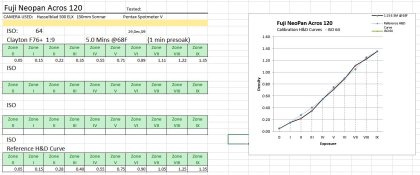
As a reference point, my normal EI for Acros 120 is 64, and my development time is almost 20% less than what manufacturer's recommendation for my setup which is cold light enlargement. Below is the last time I calibrated Neopan 120 with Clayton F76+. Measurements are with my transmission densitometer (Macbeth TD504). Method of testing follows the old Zone VI Workshop process. Chart from Excel attached.
As a reference point, my normal EI for Acros 120 is 64, and my development time is almost 20% less than what manufacturer's recommendation for my setup which is cold light enlargement. Below is the last time I calibrated Neopan 120 with Clayton F76+. Measurements are with my transmission densitometer (Macbeth TD504). Method of testing follows the old Zone VI Workshop process. Chart from Excel attached.
Attachments
Last edited:

You should consider a fine grain developer like Perceptol, where you already take a speed hit anyway. There's a nice collection of night shots on Flickr from a photographer who shot it at 25 and developed in Perceptol.
https://www.flickr.com/photos/spiritusmentis/22301709675/
https://www.flickr.com/photos/spiritusmentis/22301709675/

With long exposure work, contrast is all skewed, so it is difficult to give good advice.
How contrasty was the ambient illumination in the areas of the subject you are most interested in?
If that light was contrasty, consider a pull. If the contrast was low or moderate, I would develop normally.
How contrasty was the ambient illumination in the areas of the subject you are most interested in?
If that light was contrasty, consider a pull. If the contrast was low or moderate, I would develop normally.

I read somewhere that acros can theoretically get 20 stops. Wouldn't overexposing it get you maximum tonal range (exposing to the right in digital terms)
The POTA developer was devised to take pictures of atomic bomb blasts. It was a special formulation and could handle an exposure range of 18 stops. Ordinary developer/film combinations can handle only a 5 stop tonal range. I therefore find it difficult to believe that Acros could handle a greater range without special treatment. I would be suspect of any such claim.
Thanks for the responses.
Well I developed the film last night, and messed up twice. First in the exposure (aperture not stopping down) and calculated development times as if I were PUSHING two stops and realized only halfway through the development. Also experienced a bit of frame overlap on the kiev-6c. Ended up developing about 11.5 minutes at 1:2 xtol Should have been closer to 7 as Pete pointed out. There are a few good shots on the roll which I intentionally underexposed for experimentation. From the negatives the long exposures look about 5-7 stops overdone but I can still make out detail. Going to post some scans here later.
In any case after shooting a roll of tri-x and developing in diluted xtol the same day, I definitely prefer the traditional grain. Will probably pull pan-f one stop in the future for the long-exposure effect I am looking for (subdued contrast with a dreamy soft look to it, almost like pinhole)
Well I developed the film last night, and messed up twice. First in the exposure (aperture not stopping down) and calculated development times as if I were PUSHING two stops and realized only halfway through the development. Also experienced a bit of frame overlap on the kiev-6c. Ended up developing about 11.5 minutes at 1:2 xtol Should have been closer to 7 as Pete pointed out. There are a few good shots on the roll which I intentionally underexposed for experimentation. From the negatives the long exposures look about 5-7 stops overdone but I can still make out detail. Going to post some scans here later.
In any case after shooting a roll of tri-x and developing in diluted xtol the same day, I definitely prefer the traditional grain. Will probably pull pan-f one stop in the future for the long-exposure effect I am looking for (subdued contrast with a dreamy soft look to it, almost like pinhole)

Um, developing doesn't affect sharpness/softness.(subdued contrast with a dreamy soft look to it, almost like pinhole)
If you are inexperienced with the film and developer, then start by sticking to the manufacturer recommended ISO and development. DON'T start with wild experimentation. Only after you have mastered the process, and I am talking several months of continuous shooting and development, only then start experimenting a little, and even then change only one variable at a time. I think you will get much better, and more predictable, results this way.
Many of us do tend to down-rate, or pull a film by 1/3 to a full stop, e.g. setting our meter to an EI of 64 for Acros, if we rely on a built in meter to ensure good shadow detail, but even here starting with the manufacturer recommended numbers is not a bad way to start.
Many of us do tend to down-rate, or pull a film by 1/3 to a full stop, e.g. setting our meter to an EI of 64 for Acros, if we rely on a built in meter to ensure good shadow detail, but even here starting with the manufacturer recommended numbers is not a bad way to start.
With long exposure work, contrast is all skewed, so it is difficult to give good advice.
How contrasty was the ambient illumination in the areas of the subject you are most interested in?
If that light was contrasty, consider a pull. If the contrast was low or moderate, I would develop normally.
Flat light bright with not too much contrast besides the water. Midday, with the sun behind me, lots of clouds but full sun. One of the shots turned out ok.. kind of what I was aiming for. Looking back I should have maybe just stacked nd filters to get the desired exposure time but I found acros to be a little too punchy at 100

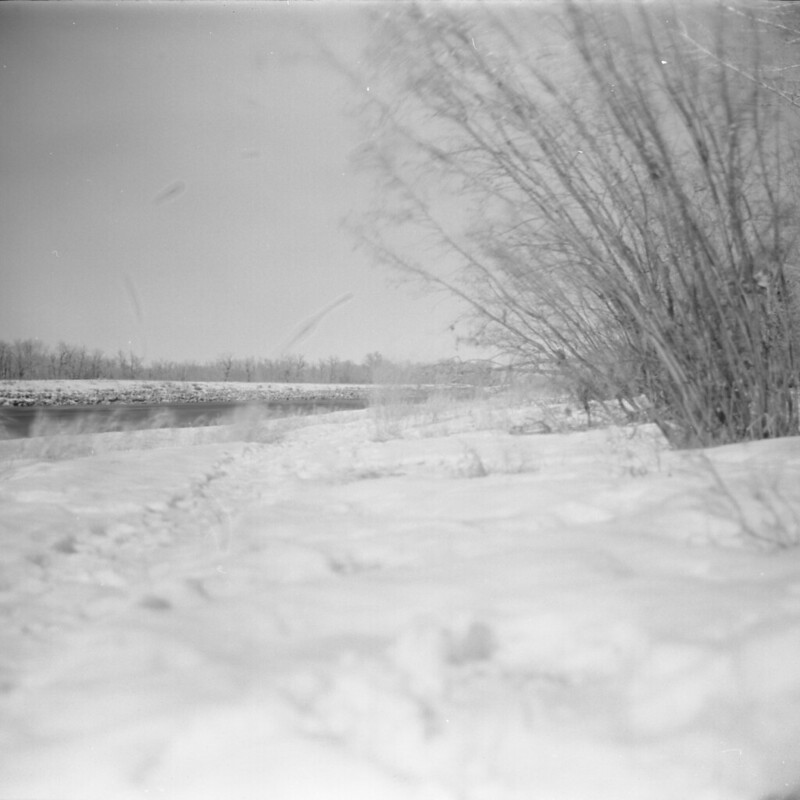 acros_at25asa_march3rd2017 by Aaron, on Flickr
^^^ An orange filter would accentuate textural/tonal detail in an image like that.
Forgive the obvious, but...... for the long-exposure effect I am looking for (subdued contrast with a dreamy soft look to it, almost like pinhole)
Why not shoot normal EI with a neutral density filter?
- Leigh
Thank you old-n-feeble, filters on my to buy.
Leigh, I find acros to be pretty contrasty at 100. My understanding as a film noob is that pulling will generally reduce contrast and grain which is almost non-existent in 6cm t-grain films anyways. I think this is why a lot of people shoot traditional low grain films like pan-f at a slower asa just too much natural contrast. Also depends on the lighting I guess. In this case harsh mid-day.
Leigh, I find acros to be pretty contrasty at 100. My understanding as a film noob is that pulling will generally reduce contrast and grain which is almost non-existent in 6cm t-grain films anyways. I think this is why a lot of people shoot traditional low grain films like pan-f at a slower asa just too much natural contrast. Also depends on the lighting I guess. In this case harsh mid-day.
Contrast is controlled by development time, not exposure.
If your results are too contrasty for your purposes, reduce development by 10% and try again.
Shadows (low density) change imperceptibly as you change development, but highlights change a lot.
- Leigh
If your results are too contrasty for your purposes, reduce development by 10% and try again.
Shadows (low density) change imperceptibly as you change development, but highlights change a lot.
- Leigh
Contrast is controlled by development time, not exposure.
If your results are too contrasty for your purposes, reduce development by 10% and try again.
Shadows (low density) change imperceptibly as you change development, but highlights change a lot.
- Leigh
+1
Surprising how often this pops up. So it is worth repeating; development controls contrast, exposure controls density.
| Photrio.com contains affiliate links to products. We may receive a commission for purchases made through these links. To read our full affiliate disclosure statement please click Here. |
PHOTRIO PARTNERS EQUALLY FUNDING OUR COMMUNITY:  |