• Welcome to Photrio!
    Registration is fast and free. Join today to unlock search, see fewer ads, and access all forum features.
    Click here to sign up

Protectan on the budget, a small experiment

Forum statistics

Threads
203,268
Messages
2,852,151
Members
101,753
Latest member
Janek201
Recent bookmarks
0

sandermarijn

Member
Allowing Ads
Joined
Oct 19, 2005
Messages
704
Location
Leiden, Neth
Format
35mm
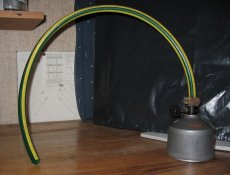
I've been reading about Tetenal Protectan and how ordinary 'smelly' gas should be able to do the same job: protect the chemistry in half-filled bottles from oxidation. Protectan is not very cheap (12 1/2 euros for 400 ml), the same gas (with odor) made for camping purposes is a bit cheaper. So I connected a piece of garden hose to the camping stove to see if that would do the same thing. Unsurprisingly perhaps, it does.

On 19/2 I filled up two 500 ml plastic bottles with about 200 ml of Paterson FX-39 1+9 each. One bottle was topped with gas, the other just air.

These bottles are from Silverprint. I have used them before to store D76 stock, which keeps for at least one year in a completely filled bottle. It seems like there is little diffusion through the walls of these containers. The caps have washers and don't seem to leak either.

Now, after only five days, the developer mix in the air-filled bottle has already gone yellowish while the gas-topped bottle is still clear. So it really works, this 'Protectan'. I can't think of any disadvantage other than having to be careful with open fire, like always with any gas (I wonder if the real Protectan burns as easily).

Just thought I would share so that maybe other people may do the same trick. I used a relatively expensive gas tank of the self-sealing type; the puncture type canisters are cheaper and should work equally well (provided you have the right type of stove).
 

Attachments

  • gas_tank_with_hose.jpg
    gas_tank_with_hose.jpg
    43.5 KB · Views: 388
  • with_without_gas_5days.jpg
    with_without_gas_5days.jpg
    27.7 KB · Views: 309
Aside form being potentially explosive (really big problem), there is also the reaction between the gas and your chemistry. It will react and what will be the outcome? It's best to ask a chemist on this one.
 
Aside form being potentially explosive (really big problem), there is also the reaction between the gas and your chemistry. It will react and what will be the outcome? It's best to ask a chemist on this one.

Flammability is an issue, but if you're so worried about it, then keep in mind that any spray you have at your house is a potential bomb, a lot stronger than a bit of propane/butane in a bottle. Just have a look at the contents.

That said, Sander's way is a bit too much for me. I'd rather use lighter gas and smaller bottles. This way, you don't have to use too much gas.
 
Last edited by a moderator:
I'd rather use lighter gas and smaller bottles. This way, you don't have to use too much gas.

I had been thinking of getting lighter-gas (gas for a lighter) instead of Protectan, but then I didn't know of a cheap place to get it, and I had the camping gas and my stove a few meters away. I have a couple of old, almost empty canisters, leftovers from camping trips not involving airplanes. They're pretty much useless for camping now but have enough left to fill a zillion half-filled darkroom bottles.

The sound of the gas flowing into the bottles makes me want to use too much gas. I don't mind the smell either. Maybe the attraction is more in those things than in the actual preservative action.

I'm not a chemist (physics being more fun) and wouldn't know for sure if propane and butane are completely inert to all chemicals used in the darkroom. It seems unlikely that there is a problem anywhere, especially considering that Tetenal use the same thing for their Protectan.
 
Bottles come in many sizes. I got amber glass bottles that are graduated. I mix a liter of developer (stock solution) and divide it to fill them to the top. I use the same hypo (different dilutions) for both film and prints so the concentrate is never around long enough to go bad but I imagine you could do the same with it. I've had some of the same bottles for thirty years so they are cost effective.
 
I remember years ago, Beseler had a developer preservative in a spray can. Don't know what it is, but it's a gas that's heavier than air so it will sink towards the bottom of the bottle. It acts sort of like a plastic wrap on top of the developer to protect the it from oxidation. I still have a can in my darkroom and use it for expensive bottles of developer. It works really well and a little goes a long way.
 
ordinary 'smelly' gas should be able to do the same job

if you mean you are using natural gas from your home supply, don't use it. They put mercatans into the gas to make it smelly and it's going to react with your chemicals.

I have a small compressed nitrogen cylinder that I got at the local welding supply house and I use that to cover the mixed bottles of developer.
 
Some numbers:
Tetenal Protectan canister contains 400 ml or 0.22 kg @ 12.5 euros => 56 euros/kg,
Typical puncture type gas canister contains 0.19 kg @ 2 euros => 11 euros/kg,
Typical gas consumption by outdoor gas stove is 0.15 kg/h => 1.3 h/canister.

Conclusions:
1. Protectan is more expensive than camping gas but not massively so,
2. One bottle of Protectan lasts a really long time.

It's fun to play around with stoves and things but economically it doesn't really make sense. Hardware, chemistry, paper, film, water and energy make up the bulk of the cost.
 
They put mercatans into the gas to make it smelly and it's going to react with your chemicals.

That's a bit disconcerting Kirk. Do you have a source where I can read about this? I tried wikipedia but it doesn't say about reactivity.

Would not the concentration of the mercatans in natural gas be so low that they can't do much harm even if the stuff by itself has a reactive nature?
 
As far as I know, the main odorant added to natural gas in North America is t-butyl mercaptan. The concentrations are low and it is a relatively unreactive molecule as thiols go, but testing is probably in order for anything important.
 
Thanks Jordan. I will prepare a 1+25 Rodinal solution, store this for a month in a half-filled container topped with mercaptan-polluted natural gas and then use it to develop a test film.

There is also oxygen in the water that the Rodinal will be added to. This may play havoc with the experiment. I'll just try and see what happens.
 
t-butyl mercaptan is used because it has a very strong smell, so the amount added is extremely small. The concentration should be far too low to have any measurable negativ effect.
 
Last edited by a moderator:
Using those combustible gases seem kind of risky to me,what about carbon dioxide,if it does not hurt the chemicals it would be a safer and cheaper method for purging the air out.
Mike
 
Considering how hard raw chemicals are to get by in Netherlands in general, it should be near-impossible for the ordinary consumer to get hold of something as 'narcotic' as ether.

Btw, ether is just as flammable as natural gas, in case that concerns anyone.

Ether gas at room temperature is 60 times heavier than air. Being also not very reactive, ether should be a good candidate for use in the darkroom. Just don't get addicted.
 
Using those combustible gases seem kind of risky to me,what about carbon dioxide,if it does not hurt the chemicals it would be a safer and cheaper method for purging the air out.
Mike

CO2 in solution is practically carbonic acid. It will alter the pH of the solution. I don't know to what extent it will happen and how severe the effect will be, but I'd rather not use it.
 
Well I routinely use butane refill gas. It works very well. Protectan is also flammable isn't it? I use it specifically with stock solution developer and have never had any problems or unusual and nasty surprises with it.
 
Kirk is right. Nitrogen gas is better because it's inert, odorless, and nonflammable.
 
Protectan is indeed flammable and a mixture of Butane and Argon.
You can also use some drops of Ether but it's flammable too and narcotic. In most cases you can get Ether without too many problems in the Pharmacy, even in Holland.
You can also use Vacuvin, where you take out the air in the bottle but this will only work with small tube bottles where the Vacuvin will fit.
 
look into 'private preserve' in better wine shops. It feels empty when purchased, and is marketted as preventing oxidation in wines and scotches by laying in a protective blanket over the liquid after the bottle is openned. I used it before purchasing a nitrogen cylinder and pressure regulator, originally to drive chemicals though a now binned wing lynch e-6 processor.
 
I use a propane soldering torch cylinder to do the same thing and have been doing so for years. It has no effect on the chemistry. It does stink, but it's cheap. A cylinder of gas costs about $3 - $4 US and lasts me about a year.
 
I use a propane soldering torch cylinder to do the same thing and have been doing so for years. It has no effect on the chemistry. It does stink, but it's cheap. A cylinder of gas costs about $3 - $4 US and lasts me about a year.
This is the same thing I have been doing. Propane is heavier than air and will settle on the surface of the liquid in your bottle. It is not necessary to fill the top of the bottle completely for the propane to protect your developer from any air not displaced. Natural gas, on the other hand, is lighter than air.

Dan
 
Argon is great, it is also very expensive, even in a refillable high pressure cylinder. If you want to use argon, head off to a welding store and buy a small refillable/exchangeable tank and a regulator or flow meter.
 
Photrio.com contains affiliate links to products. We may receive a commission for purchases made through these links.
To read our full affiliate disclosure statement please click Here.

PHOTRIO PARTNERS EQUALLY FUNDING OUR COMMUNITY:


Ilford ADOX Freestyle Photographic Stearman Press Weldon Color Lab Blue Moon Camera & Machine
Top Bottom