
• Welcome to Photrio!
    Registration is fast and free. Join today to unlock search, see fewer ads, and access all forum features.
    Click here to sign up

Printing glass negatives

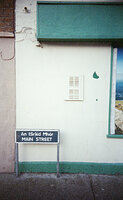
An tSráid Mhór

A
An tSráid Mhór

  • 1
  • 0
  • 36
IMG_1285.jpeg

D
IMG_1285.jpeg

  • 0
  • 0
  • 33

Forum statistics

Threads
203,125
Messages
2,850,208
Members
101,690
Latest member
nisherii
Recent bookmarks
0

timpppa

Member
Allowing Ads
Joined
Feb 19, 2006
Messages
40
Location
Finland (no,
Format
Multi Format
Hello!

I might get a change to print some old glass negatives.
Is this in any way wise to get involved in such job anyway?
I have not yet seen those negs and cannot tell anything about
their quality or condition. What could be the major problems
in printing those negs? I don't have a clue where to begin in printing
those negs. How much do they differ from printing ordinary negs?

--
Regards,
Timo Leppiniemi
 
years ago i printed a large batch for a friend who bought some at an auction.

the biggest issues was finding a negative carrier to use with the glass negatives. I was using a beseler 45 and the negative carrier is hinged, which wasn't a good thing to use with the glass plates as they are much thicker than film.
I ended up using an omega 4x5 carrier that was a hinged version and it worked fine.

I found them no different than any other negative,
 
First thing, they're very fragile, being made of glass, obviously. Then, if they have any historical value, you might want to be extra careful. Wear cotton gloves at all times, never touch the emulsion surface, don't rub anything to remove the dust.

In terms of printing, depending on the era, contrast will be a very important issue.

If you have really old plates, i.e. mid-19th century, those will be collodion negatives, and require papers able to handle a lot of contrast. POP (printing out paper) is probably your best bet. Contact printing is the only way to go. Collodion is also flamable, so stay away from any direct heat with those.

More modern plates may have less contrast, but still require quite a low grade of paper. Getting your hands on some Azo might be worthwhile. At any rate, make a test by contact printing them on normal enlarging paper, a see whether you have blown highlights and/or lack of shadow details.
 
I contact print them by replacing the glass in the printing frame with the glass negative. This eliminates stress on the negatives. If you can get some Azo use that. If not, most glass plates do very well on kallitype.
 
I had to make enlarge prints from some 8x10 and 5x7 glass negs. What was nice about them was that they were I guess pyro negs and they printed so beautiful! I mean one or two tests and I was done. Damn nice.
I used a 10x10 glass neg carrier. The bottom half. Rested the neg on and slide the carrier into the enlarger. It worked just fine. No newtons or anything.
Of course, pay real attention to the edges and don't drop it! :smile: :smile:
 
At the Oregon Historical Society, our head photographer prints glass negatives all the time. He uses a really old 8x10" enlarger (originally built to handle glass plates) that is converted to a modern cold-light diffusion light source. Everything is printed on Ilford multigrade paper. Paper developer is Dektol or the equivalent. He makes excellent exhibition prints. He also makes contact prints using the same paper and chemicals. No problem at all -- have fun! Old negs can make beautiful prints, as Robert said above. (Hi, Robert!)

Pete Gomena
 
If you have really old plates, i.e. mid-19th century, those will be collodion negatives, and require papers able to handle a lot of contrast. POP (printing out paper) is probably your best bet. Contact printing is the only way to go. Collodion is also flamable, so stay away from any direct heat with those.
When I worked at the Victoria & Albert Museum in London (1970 - 1972), I printed a lot of wet collodion negatives. As "mhv" says, people depended on the self-masking effect of contact printing on POP to control contrast, which is high by modern standards, but the main problem I had was that the photographers of the 1860s did not (as is often stated) have an instinct for correct exposure but instead overexposed like crazy. Most of the old plates were so dense that you could not tell what the subject was by looking but only by making a contact print (exposing for 5 or 10 minutes instead of the 5 or 10 seconds needed for a modern film neg). The overexposure was so heavy that it detracted from sharpness even on a contact print. The reason for this, I am sure, was lack of skill; as I understand it, you can control the density of a collodion neg by varying development, and there are of course well-recognized reducers to combat excess density. If you take the job, let's hope your negs are of better quality! More modern plates exposed and processed to allow enlargement are of course nowhere near as much of a problem and should print fine on modern paper.

Regards,

David
 
Thanks for everybody for the input! I will let you know how it went if I get the job.
 
I tried to print an old 4x5 glass negative of my grandparents that was in poor shape. My attempts to print it conventionally on my Omega enlarger were a failure. I had better luck scanning the negative and then fixing it in Photoshop.
 
Most of those old glass negatives were shot for densities using albumen paper. DR for albumen is 2.2 and even denser....way to dense for normal silver papers or even azo. But the tonal range for a good albumen print can be amazing. Beautiful stuff.
 
Also a collodion negative can be intensified after it has been developed and fixed to increase the densities to the desired level. So a decent photographer with some experience didn't have to nail the exposure and development right on. They could intensify the negative after development and fixing to reach the desired density. With a little practice they could get these pretty close visually for albumen printing.
 
Hello Timo,

Can you tell from the subject matter roughly what period it is? Gelatin dry plates were produced about 20 years after wet plate, and were in general use by the 1880s - 1890s and lasted well into the 20th century, so you'll encounter many more dry plate negs than wet plate ones.

I recently got a lot of old glass negatives which looked dense compared to my film negatives, but turned out not to have enough contrast to produce a satisfactory contact print on centennial POP, however they printed surprisingly well on ilford multigrade without having to take any special measures at all.

I look forward to hearing about your results!

Regards,
Neil.
 
I also confess that I scan them. Might it be possible to make an interneg on slide copying film though?

David.
 
Some time ago I did it also for a friend and layed down the glass negatives on top of the 4x5" carrier of my LPL enlager. It works fine and resulted in "great" prints.
 
At the Oregon Historical Society, our head photographer prints glass negatives all the time. He uses a really old 8x10" enlarger (originally built to handle glass plates) that is converted to a modern cold-light diffusion light source. Everything is printed on Ilford multigrade paper. Paper developer is Dektol or the equivalent. He makes excellent exhibition prints. He also makes contact prints using the same paper and chemicals. No problem at all -- have fun! Old negs can make beautiful prints, as Robert said above. (Hi, Robert!)

Pete Gomena

I've done exactly the same thing myself with some old glass plate negatives lent to me by a friend. Printed on Adorama's house brand or variable contrast, resin coated paper using an Omega D series enlarger with a Dichro head, and developed in Dektol. I made a negative carrier from a couple of pieces of cardboard to hold the negatives. Attached are a couple of samples. So yes, it can be done and it's no different than printing an acetate negative.
 
Last edited by a moderator:
Photrio.com contains affiliate links to products. We may receive a commission for purchases made through these links.
To read our full affiliate disclosure statement please click Here.

PHOTRIO PARTNERS EQUALLY FUNDING OUR COMMUNITY:


Ilford ADOX Freestyle Photographic Stearman Press Weldon Color Lab Blue Moon Camera & Machine
Top Bottom
