
• Welcome to Photrio!
    Registration is fast and free. Join today to unlock search, see fewer ads, and access all forum features.
    Click here to sign up

Print Washing in a Community Darkroom

Coburg Street

A
Coburg Street

  • 1
  • 1
  • 58
Jesus

A
Jesus

  • 1
  • 1
  • 54

Recent Classifieds

Forum statistics

Threads
201,737
Messages
2,829,371
Members
100,923
Latest member
GB-A2
Recent bookmarks
0

mgb74

Subscriber
Allowing Ads
Joined
Jan 24, 2005
Messages
4,783
Location
MN and MA US
Format
Multi Format
Looking for advice as to best approach to print washing in a community darkroom where 3-4 individuals might be washing prints at the same time. Mostly RC but occasionally fiber. Will (hopefully) be re-configuring the darkroom, so now a good time to address.

(there was a url link here which no longer exists) has been helpful, but questions remain.

Right now each user sets up his/her own trays, but there is a common washer. That washer is a 2 tier tray system where a siphon washer is in the top tray and exhausts into the bottom tray. The workflow is to put prints in the bottom tray for a prewash then transfer to the top tray for a final wash. This is in a separate sink from the main sink as it takes a lot of room. An archival slot washer is also available, once repaired. It handles up to 11x14, but doesn't work well for small prints (hard to get to).

Our larger sink has internal dimensions of 41" x 108", has full access on 3 sides, and allow 2 users to set up there own line of trays. There would be room at one end for 2 11x14 trays washers or one 16x20 tray washer. Or the archival washer.

The darkroom is available 12 hours per day. Sometimes 3 people may be using it at once, sometimes it might be 3 people sequentially. No realistic way to control or plan this.

There are a few issues to deal with:
  • Concerns about cross contamination when one person adds a print to the washer where other prints may be near completion.
  • Multiple prints in a tray washer tend to bunch up. Presumably this makes the washing less effective.
  • Hot water usage. Winter cold water temps can be in the low 60s. Obviously hot water can be used to adjust, but then hot water can sometimes run out by the end of the day, especially when people are using the washer sequentially. At times inn the summer, it might be difficult to get water below 72 deg.
  • Most people are washing RC paper, but a few using fiber.
  • Hard to mandate use of a hypo clearing agent / wash aid and it requires an additional tray (trays aren't a problem, but the sink space they require is).
So I'm thinking of buying or building 3 print washers like this. Each user would have his own and be in control of what goes in and when he/she removes prints. For the occasional larger print, a tray with siphon washer would be available. Alternatively, a single 16x20 version could be used by 2-3 people. This would work very well for washing RC; for fiber I suppose the slot washer could be used.

I've even thought about converting a free standing utility sink (laundry tub) into a dedicated print washer.

So some questions:
  • Is cross contamination (adding a freshly fixed print to the washer with prints almost done with the wash) a real issue or a theoretical one?
  • Is washing with relatively cold water (say 62 deg) or hot water (say 72 deg) a problem? It's my understanding that reticulation far less an issue with paper than film (and even less an issue with film than it used to be).
  • Other than expensive slot washers, are there more space efficient designs (compared to a large tray) that minimize the impact of multiple prints bunching up?
 

MattKing

Moderator
Moderator
Allowing Ads
Joined
Apr 24, 2005
Messages
55,118
Location
Delta, BC Canada
Format
Medium Format
The fact that you are doing both fibre and RC certainly complicates matters.

If you can, add a third tier to your washing system. The bottom tray is for a short wash/rinse, the middle tray is for the bulk of the wash and the top tray is for the final part of the wash.
For RC, you can have relatively short times in each tier. If possible, make it a rule that the top tray never has more than one print in it.

For fibre, you may need to consider a separate wash space after the first tier.
Assuming reasonably compliant users, that should minimize the problem of contamination.
 

williaty

Member
Allowing Ads
Joined
Mar 31, 2016
Messages
179
Location
Licking County, Ohio, USA
Format
Medium Format
Regarding small prints in the slot washer:

A stick of plexiglass approximately 2.00"x0.25"x(a bit more than the depth of your washer) with a couple of rubber bands wrapped around it near to one end will fish small prints (even ones stuck to the dividers in the tank) out of the bottom of a slot washer.
 
Joined
Sep 10, 2002
Messages
3,671
Location
Eugene, Oregon
Format
4x5 Format
Have a separate washer for fiber-base prints only. If it doesn't get used much, then so be it. Fiber-base prints take significantly longer to wash and would really benefit from a hypo-clearing step. If I were running the darkroom, I would mandate that fiber-base prints get a hypo-clear step and a good rinse before going into the washer (the bottom tray of the tier-washer could be used for the rinse). I would reserve the slot washer(s) for fiber-base prints and would use a washing regime that included two-bath fixing, a hypo clear step and a thorough (5-min. minimum) rinse before washing. Wash time 45-60 minutes.

Washing in batches may help your hot-water problem. You could just run a couple of holding trays and turn the water off for the washers until you actually had batches to wash, thus using less hot water.

Contamination of prints by adding more to the wash later in the process is less of a problem when they are rinsed thoroughly first. That said, the ideal practice would be to wash in batches and never add prints to any one batch at a later stage. For RC papers, which wash rapidly, that shouldn't be a problem; simply collect however many prints the washer capacity is in a holding tray (ideally with running water). When that number has been reached, start the wash process with that batch and start collecting the next batch in the holding tray.

If you are using trays for washing multiple prints, you must agitate! Letting prints sit on top of each other with no agitation is risking disaster. If you have ten prints in a tray washing, someone should be there shuffling (maybe you need a wash assistant?)

If the wash water temp climbs to 72°F or even a little higher, it should be no problem; in fact, it will speed up the washing a bit. If the water temp drops much below 68°F, the washing process slows down quite a bit and you'll need longer to wash. I would recommend trying to keep wash water at 68° and above.

You may want to add wash/fixer tests to your workflow. HT-2 for residual hypo (washing) and ST-1 or Kodak Rapid Selenium Toner for residual silver (fixing) test are common and fairly easy to do once you have the chemicals on hand. Search here for more info.

Best,

Doremus
 

eddie

Member
Allowing Ads
Joined
Jul 24, 2005
Messages
3,259
Location
Northern Vir
Format
Multi Format
When I ran a University darkroom, the biggest cause of contamination came from insufficiently washed prints placed on the drying racks or contaminating the aprons on the drum dryers. Proper washing technique was something the students were reminded of daily.
 

darkroommike

Subscriber
Allowing Ads
Joined
Mar 22, 2007
Messages
1,738
Location
Iowa
Format
Multi Format
When I ran a University darkroom, the biggest cause of contamination came from insufficiently washed prints placed on the drying racks or contaminating the aprons on the drum dryers. Proper washing technique was something the students were reminded of daily.
Same here, and the minute you turn your backs the students start throwing prints out of the fixer into the washer full of already washed prints or cheating the clock and washing for half the recommended time. I finally added extra time to the proper wash in the hopes that prints would get a better wash. it's also nice when I have at least one conscientious student at the sink watching everyone else so that their own works doesn't get contaminated.

As far as community darkrooms go...everyone should have their own washer, if you are washing RC a print only needs a couple of minutes so water usage should not be a big issue. FB users should provide their own washers. If your water heater still can't recover you need a bigger water heater, more BTU's, or an additional unit.

When I used a community darkroom, I rewashed my prints when I got home and dried them on a line in my bathroom, but I'm picky that way.
 
OP
OP
mgb74

mgb74

Subscriber
Allowing Ads
Joined
Jan 24, 2005
Messages
4,783
Location
MN and MA US
Format
Multi Format
The fact that you are doing both fibre and RC certainly complicates matters.
If you can, add a third tier to your washing system. ...

If using a separate wash "station", I have a large tub at the end of each set of trays to hold prints in water. That would act as the third tier.

A stick of plexiglass approximately 2.00"x0.25"x(a bit more than the depth of your washer) with a couple of rubber bands wrapped around it near to one end will fish small prints (even ones stuck to the dividers in the tank) out of the bottom of a slot washer.

Excellent idea.

Have a separate washer for fiber-base prints only... Washing in batches may help your hot-water problem... Contamination of prints by adding more to the wash later in the process is less of a problem when they are rinsed thoroughly first....If you have ten prints in a tray washing, someone should be there shuffling (maybe you need a wash assistant?)...You may want to add wash/fixer tests to your workflow. ...

The slot washer could be "dedicated" to fiber use. As to shuffling, the dilemma is that, as much as possible, I don't want anyone handling someone else's prints. This is not for classes where there's an instructor, it's for use by individuals doing their own work. In fact, if I could, I'd reconfigure into 3-4 small darkrooms each with wet and dry side and have reservations. But for a couple of reasons, that's not feasible.

Proper washing technique was something the students were reminded of daily.

Unfortunately, these aren't students; these are individuals who pay a monthly fee to access the darkroom. Some can be reminded and others think they know everything. In our situation, it's difficult to enforce a workflow. For example, I think most users wash their RC prints too long (they leave them in the washer until ready to put on the drying rack) and their fiber prints too short (anxious to finish up and leave). I think better signage ("Ilford recommended wash process") will help.
 

tedr1

Member
Allowing Ads
Joined
Feb 3, 2016
Messages
940
Location
50 miles from NYC USA
Format
Multi Format
When I used a community darkroom, I rewashed my prints when I got home and dried them on a line in my bathroom, but I'm picky that way.

The challenge is washing the FB prints not the RC ones. The same idea crossed my mind, rewash the FB prints at home, a bathtub can be used.
 

MattKing

Moderator
Moderator
Allowing Ads
Joined
Apr 24, 2005
Messages
55,118
Location
Delta, BC Canada
Format
Medium Format
If using a separate wash "station", I have a large tub at the end of each set of trays to hold prints in water. That would act as the third tier.
The advantage of an actual third tier is that it ensures flow, without any additional use of water.
But otherwise, the holding tray does help - if the (RC) prints receive at least a cursory rinse first.
 
OP
OP
mgb74

mgb74

Subscriber
Allowing Ads
Joined
Jan 24, 2005
Messages
4,783
Location
MN and MA US
Format
Multi Format
The advantage of an actual third tier is that it ensures flow, without any additional use of water.
But otherwise, the holding tray does help - if the (RC) prints receive at least a cursory rinse first.

You're right, but there's another reason I'm leery of a 3rd tier. 3 tiers would, I think, require too much space in the sink where we have our developing trays. It could be put in the 2nd sink, but then the top tier would be taller than the lip of the sink. And we've already had issues with people splashing water onto the floor. If we had a deeper sink, it would work very well.
 
OP
OP
mgb74

mgb74

Subscriber
Allowing Ads
Joined
Jan 24, 2005
Messages
4,783
Location
MN and MA US
Format
Multi Format
I should add that the darkroom is available 64 hours per week. It would not be feasible to staff it with an attendant.
 

MattKing

Moderator
Moderator
Allowing Ads
Joined
Apr 24, 2005
Messages
55,118
Location
Delta, BC Canada
Format
Medium Format
My (2) tiered trays are almost immediately above each other. I have drain holes and a deflector in the top tray, which drains into the edge of the bottom one.
I'm sure you could do the same with three trays.
 

Neal

Subscriber
Allowing Ads
Joined
Dec 3, 2004
Messages
2,027
Location
Chicago, West Suburbs
Format
Multi Format
Dear mgb74,

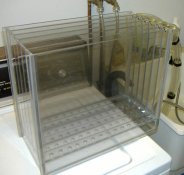
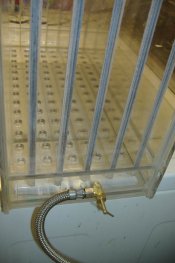
I dealt with the cross contamination question by building a washer out of 1/4" Lexan that keeps each print in its own chamber. The pieces were cut with a table saw and all holes were drilled and/or tapped with a small drill press. They are held together with RTV silicone and the separators slide out for cleaning. The design of the area where the water exits the washer is terrible and I have been telling myself to make it right since 2004. Unfortunately for me it works pretty well.

Human nature, on the other hand, is far more difficult to deal with. ;-)

Good luck,

Neal Wydra
 

Attachments

  • PrintWasher1.jpg
    PrintWasher1.jpg
    90.8 KB · Views: 298
  • PrintWasher2.jpg
    PrintWasher2.jpg
    67.9 KB · Views: 149

mrosenlof

Member
Joined
Feb 25, 2010
Messages
631
Location
Colorado
Format
Multi Format
back when I used a shared darkroom, I mostly did RC, but on the few occasions that I used FB paper, I took them home wet for a final wash in the tub.
 
OP
OP
mgb74

mgb74

Subscriber
Allowing Ads
Joined
Jan 24, 2005
Messages
4,783
Location
MN and MA US
Format
Multi Format
Dear mgb74,

I dealt with the cross contamination question by building a washer out of 1/4" Lexan that keeps each print in its own chamber. The pieces were cut with a table saw and all holes were drilled and/or tapped with a small drill press. They are held together with RTV silicone and the separators slide out for cleaning. The design of the area where the water exits the washer is terrible and I have been telling myself to make it right since 2004. Unfortunately for me it works pretty well...

This is like having 6 individual tray washers stacked and on edge. Nice.
 

thefizz

Member
Allowing Ads
Joined
Dec 8, 2004
Messages
2,351
Location
Ireland
Format
Medium Format
Taking prints home to wash is fine as long as they don't dry before you get home. Fixer cannot be washed out of prints that have dried.
 
Joined
Sep 10, 2002
Messages
3,671
Location
Eugene, Oregon
Format
4x5 Format
... Fixer cannot be washed out of prints that have dried.

Where do you get this information. I would question whether this is true. I can't think of any chemical change that would happen in drying that would render anything soluble in the print insoluble. One should be able to rewash dry prints, or continue washing a print after it has dried before being completely washed (although certainly not best practice...), with no problem. Conservators have been doing this for years. I'd be happy to hear comments on this.

Doremus
 

thefizz

Member
Allowing Ads
Joined
Dec 8, 2004
Messages
2,351
Location
Ireland
Format
Medium Format
I believe it was Ralph Lambrecht, in his book or on Apug, can't remember which. Will try to find it.
 

bdial

Subscriber
Joined
Jan 2, 2005
Messages
7,514
Location
North East U.S.
Format
Multi Format
Where do you get this information. I would question whether this is true. I can't think of any chemical change that would happen in drying that would render anything soluble in the print insoluble. One should be able to rewash dry prints, or continue washing a print after it has dried before being completely washed (although certainly not best practice...), with no problem. Conservators have been doing this for years. I'd be happy to hear comments on this.

Doremus

I believe it was Ralph Lambrecht, in his book or on Apug, can't remember which. Will try to find it.

My understanding is that ammonium thiosulfate is difficult to dissolve at room temperature, if so, that seems like it would make it difficult to continue the wash after a print is dry.

As for adequate washing in a group darkroom, I have some 40 YO prints that were done in a group darkroom, FWIW. We tried to cycle prints through washing, but it was never perfect. The darkroom in question had a tray siphon wash in the darkroom used as a holding bath, then one of those large print washers with a drum for the actual wash. Last time I looked at them, none of the prints seem to have any keeping problems.
But the the apparent success could be that the washer was enormous, and probably held at least 20 gallons of water, and we generally ran it with pretty high flow rates. (the drum could accommodate 16x20 prints, maybe 20x24, don't remember now).
 
OP
OP
mgb74

mgb74

Subscriber
Allowing Ads
Joined
Jan 24, 2005
Messages
4,783
Location
MN and MA US
Format
Multi Format
I think a holding bath is essential if a community wash tank. It will drastically reduce the fixer entering the "final" wash. The enoromous print washer that bdial described is great in that it a) minimizes overcrowding and b) drastically dilutes any fixer on the print that added. But it's not in cards at least for now.
 
Photrio.com contains affiliate links to products. We may receive a commission for purchases made through these links.
To read our full affiliate disclosure statement please click Here.

PHOTRIO PARTNERS EQUALLY FUNDING OUR COMMUNITY:


Ilford ADOX Freestyle Photographic Stearman Press Weldon Color Lab Blue Moon Camera & Machine
Top Bottom