• Welcome to Photrio!
    Registration is fast and free. Join today to unlock search, see fewer ads, and access all forum features.
    Click here to sign up

Portfolio for fibre prints

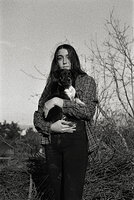
Iriana

H
Iriana

  • 2
  • 0
  • 52
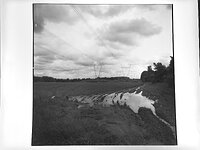
Puddle

Puddle

  • 4
  • 2
  • 97

Forum statistics

Threads
202,734
Messages
2,844,775
Members
101,487
Latest member
Bmattei
Recent bookmarks
0

adelorenzo

Member
Allowing Ads
Joined
Mar 10, 2012
Messages
1,420
Location
Whitehorse, Yukon
Format
4x5 Format
2012 was my first year printing in a darkroom and I'd like to put together a portfolio of prints. Something to show to friends, mostly, as I am not a commercial photographer. I was thinking of just putting some loose prints into a box but I print on fibre paper. Even with a print dryer the prints aren't totally flat.

Does anyone have suggestions? Mount or mat and then place in a box? Some kind of album? I realize there are all kinds of products out there but I'm looking for ideas or suggestions...
 
As you say there are many options. I wouldn't mount or mat since that would increase the size and thickness which could reduce the number of pictures in the portfolio. Another consideration is handling the prints especially if your friends were eating barbeque wings while looking at your prints. It might be most practical to use an album. Check the PrintFile website ( they are APUG advertisers ). You could also create a web album or scan them for digital viewing and portability.

http://www.jeffreyglasser.com/
 
For showing stuff to friends and (especially) for clients, an iPad is pretty cool.

But for prints, I'd find a way to get them in an album. People will assume everything's digital, retouched, etc. these days. Fiber prints have something special, and you can't get your iPhone shots run off at the drug store on fiber. The tactile feel of a fiber print is wonderful, but they'll get dirty and damaged over time.

Find a beautiful wooden box, and put your prints a pair of cotton gloves in it - your friends have to put on the gloves to flip through 'em. Now that will wow them, right?

Seriously, I once did a booklet of polaroid transfers on watercolor paper. I stacked the sheets and added a front cover of heavy hand-made paper and a back cover of matte board, and "bound" them with a row of pop rivets (I scored the sheets so the pages would turn). The edges got a little aged, but it kinda added to the "old book" feel - and it made the work into a cohesive "object" that seemed kind of rare and beautiful. Something like that would be nice, especially for images that fit into a theme. (I think I gave it to some babe i was trying to impress...)
 
Thanks for the suggestions. I'm not too worried about handling issues as I can always re-print.

Nice idea about the rivets... I have a gun in the garage, maybe wrap some thin plywood covers around a stack of prints and rivet them. That might be something to check out.
 
One of the things I like to do is to make my own book with good paper, about 90lb, and to mount the images to the pages.

Total hand made feel. (because it is!)
 
Hi,

The notion of "not worried about handling.... I can always reprint" will change quickly once you start doing intricate manipulations. Each print can take so much effort and element of luck that you start treasuring your own work. One of my prints took 2 months - printing every weekend to perfect!

I have several methods.

For my own storage, I use Itoya portfolio.
To show someone a print or two, I typically put it in my temporary mat/backboard set. It's hinged and has photo corners that I can slide in the film.
When it has to absolutely look their best, I dry mount, and mat, then put it in clear sleeves. Take them out of the sleeve to show and put it back in once done.

I almost NEVER hand over a naked print unless it's a junk print. I spent so much time printing and processing, keeping in mind being archival and all that, I don't want people casually handling my prints.
 
I get ya regarding print time and keeping things pristine. On the other hand, I have to say that there's something appealing to me about a group of prints being presented as an "object", that over time will show signs that it's been handled and examined. Where time itself, and signs of the people who experienced the art, becomes part of the presentation.

That's all a little esoteric, and neither viewpoint is the "right" one certainly!

The OP mentioned he's not a commercial shooter, but that's unimportant - he's spending time doing something creative & beautiful when many are sprawled before the TV - glad to see so many ideas for him to share his work. Let us know what you come up with.
 

I love doing this too. For 16x20 prints I have this nice book that is meant for water color artists. I put photo corners on each page for a print, and insert one on each page. Works great, looks great, and the prints are perfectly protected.
 
Thomas, could you link me to the source of your water color book?

Horace
 
If you're only intent is to show images to friends, then the iPad is pretty nifty (even the Photos app has a good slideshow function), or any number of digital options up to using on line facilities like Flickr on your television. Regrettably (perhaps), this is how most people show and exhibit their work these days. It is expected to be at least a part of your repertoire, no matter the audience.

Showing actual prints unpresented, is a sure sign of your amateurism, in its most vulgar sense. Nothing looks worse than bare, warped prints, a problem magnified by appparent contradictory "professional" use of fiber based papers. Your commitment to your art and its medium is evidenced by your desire and proficiency at setting the stage properly for your work. I strongly suggest you mount them (or have them mounted) for presentation (windows not being necessary for portfolio use), where they may be handled safely by others through proper support, and given the respect they deserve by any viewer – friend, gallery owner, or even better, both.


PorfolioIYosemiteValley.jpg
 
Last edited by a moderator:
Your first issue of print flatness can be easily overcome by cranking the heat on your print dryer (I am assuming you have a drum/canvas type), placing the prints face up in a stack and tightening it down. Turn off the heat and let them cool in the dryer. I have been doing this for many years, and it works. To keep them flat over the long term, I overstuff paper boxes so when I stack them the prints carry the weight and not the box. This method keeps them flat as a pancake.

If you want to keep it simple, I would suggest getting a box that is nice and putting the flattened loose prints in it with some gloves. Black portfolio boxes are nice and not expensive. An aluminum box would be a little nicer. You can find them both at the usual sources for archival supplies, or your local art store.

Personally, I only mount prints when I have to. Showing prints to friends does not qualify. Even when showing prints to serious people, I will still show loose prints. I print pretty small though. If your prints are large you need to mount them to protect them, or at least handle them yourself. Everyone has their own thing though. For some people the presentation is part of the work.

One problem with a traditional medium like darkroom prints is people tend to think there is only one way to make and present them since mounting and matting has been done forever. ROLs methods may work for him but aren't necessarily a universal truth. I don't think calling someone's efforts or choices vulgar does anyone any favors. One example that contradicts his approach is Masao Yamamoto, one of the most successful artists today. Take a look at how he does it. Hardly vulgar/hardly amateurish. As the French say, chacun a ses goüts.
 
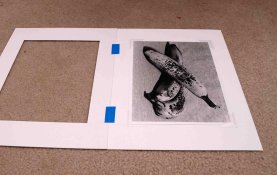
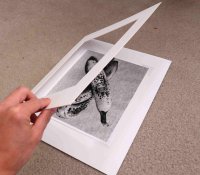
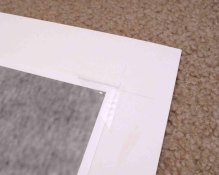
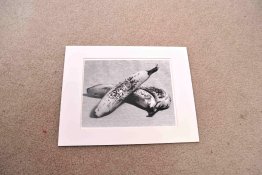
Maybe a set of pictures will help. This is my method.

I have a bunch of these for various sizes. I had Frame Destinations cut these for me pretty inexpensively. These are made out of buffered paper, so they are pretty inexpensive. As you can see in one of the photographs, there are "photo corners" at 4 corners, so these are re-usable. Prints stay flat, protected from handling, and looks decent. I use these for casual presentations.

I take my prints out of my folders, put them in these temporary mats, and hand them over to whomever wants to see them.

I would imagine this is matter of personal choice but to me, photographs look so much better with mats around them. As I said earlier, I really don't like bare hands touching my prints, so this is my default method. There are all kinds of boxes available at art stores, you could buy them if you want. I made one myself out of available materials. I usually take them out before handing them over, so what it is made out of doesn't matter to me.
 

Attachments

  • presentation1.jpg
    presentation1.jpg
    426 KB · Views: 172
  • presentation2.jpg
    presentation2.jpg
    211.2 KB · Views: 165
  • presentation3.jpg
    presentation3.jpg
    123.1 KB · Views: 152
  • presentation4.jpg
    presentation4.jpg
    596.9 KB · Views: 166
Last edited by a moderator:
Thank you to everyone for all the excellent suggestions and comments.

Digital presentation is out as I like working in the darkroom and am looking to share some of my work with friends and guests. They see my stuff on Flickr and whatnot.

I make no claims to being anything other than an amateur and enthusiast. I do hate the feel of dried fibre paper, to me it doesn't even feel like paper at all, it feels like wood. RC paper feels and handles much more like a photograph to me but I don't like the look of it which is rather more important. :smile:

ROL that link has some good information on mounting and presentation thanks for sharing.
 
ROLs methods may work for him but aren't necessarily a universal truth. I don't think calling someone's efforts or choices vulgar does anyone any favors.

You've misrepresented what I said, and you need to look up the term "vulgar" for proper definition. I said, "Showing actual prints unpresented, is a sure sign of your amateurism, in its most vulgar sense." No one is calling anyone else vulgar. Bare prints (for presentation) = unsophisticated, unrefined amateurism. Simple. Take an English course. I remind folks of one classically accepted option, but many others exist, some more or less successful. Some prints on some supports require other kinds of presentation other then dry mounting – but then, that wasn't the OP's concern. Presenting fiber based prints is.

And I'm not looking for favors from anyone, only to help in as experienced a way as I am able. You, Patrick Robert James, have provided no evidence that you have anything to offer other than opinion, unsophisticated (vulgar) at that. You would also do well to moderate your opinions with less personal confrontation.
 
Last edited by a moderator:
Sorry ROL, I don't take troll bait.

I am tired of the internet being full of egotistical people who think their way is the only way; opinion disguised as fact. It is the same people over and over again. You are one of them. Here and elsewhere. It should be evident to anyone reading this thread (and who have sent me pm's surprisingly) what actually has been written and I feel no need to defend myself.

I hope the OP finds a way to share his images with others that pleases him. It is a commendable act for him to invite others into his world of expression.
 
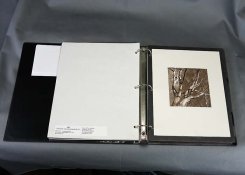
Here is something I came up with a while back (and haven't kept up with too well :confused: ).

I called it a "Mini-Portfolio." I usually print my initial selections at 5x5 or 5x7 inches as "test prints" and then select down from there to final prints around 10.5x10.5 or 11x14. I played around and mounted some of the trimmed test prints on rectangles of mat board with dry mount tissue. I then attached the mat board to black paper -- construction or pastel paper such that it created a black border. One edge of the border is punched (and reinforcement rings added on the back) and the pages are placed in a ring binder.

I also used rag drawing paper to create an interleave page and on the lower corner of that added a couple of adhesive labels printed on the computer. They typically show a title, date, and perhaps some details about camera, film, etc. The labels are no where near contacting the actual print, so I didn't worry about 'archival' properties. The beauty of this method is that I could get the mat board rectangles out of the window cut-outs from the framed larger prints! hehe!

148464997.jpg

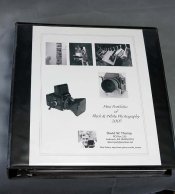
Using a ring binder with a transparent sleeve on the outside, one can even create jazzy cover art.

148464998.jpg

Several people, including a community college art and photography instructor who've seen one of these in the flesh liked the concept.
 
Last edited by a moderator:
I like THAT idea! Thank you for showing it.
 
I use Itoya presentation books, self published book, and special boxes.
I really like the idea of purchasing an artists book and mounting the prints on the pages - thanks :smile:
 
Photrio.com contains affiliate links to products. We may receive a commission for purchases made through these links.
To read our full affiliate disclosure statement please click Here.

PHOTRIO PARTNERS EQUALLY FUNDING OUR COMMUNITY:


Ilford ADOX Freestyle Photographic Stearman Press Weldon Color Lab Blue Moon Camera & Machine
Top Bottom