• Welcome to Photrio!
    Registration is fast and free. Join today to unlock search, see fewer ads, and access all forum features.
    Click here to sign up

please dont shoot me

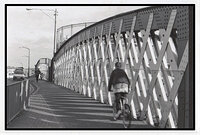
crossing the bridge

A
crossing the bridge

  • 0
  • 0
  • 10
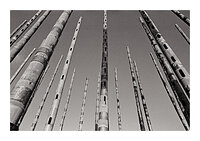
Hooters gonna hoot

H
Hooters gonna hoot

  • 2
  • 0
  • 28

Recent Classifieds

Forum statistics

Threads
202,488
Messages
2,841,460
Members
101,351
Latest member
pavdee
Recent bookmarks
1
Hello:

"The f-number f/#, often notated as N, is given by

f/\# = N = \frac fD \

where f is the focal length, and D is the diameter of the entrance pupil. By convention, "f/#" is treated as a single symbol, and specific values of f/# are written by replacing the number sign with the value. For example, if the focal length is 16 times the pupil diameter, the f-number is f/16, or N = 16. The greater the f-number, the less light per unit area reaches the image plane of the system."

wiki-pedia
 
aperture is the diameter of the lens opening expressed as a fraction of its focal length. (a quote from "The Negative")

I believe you would multiply the "mm" designation by 25 to convert to inches: inches of focal length divided the diameter of the opening = aperture.


Chuck
 
aperture is the diameter of the lens opening expressed as a fraction of its focal length. (a quote from "The Negative")


I'm sorry as I meant to say "The Camera"
 
I believe you would multiply the "mm" designation by 25 to convert to inches: inches of focal length divided the diameter of the opening = aperture.


I think you would be better of *dividing* the MM figure by 25. You would be better off still keeping the whole thing in metric: 300 divided by 6.7 is a much easier sum than 12 divided by seventeensixtyfourths.


Richard
 
The aperture numbers we're used to seeing is written as f/#, and the f stands for focal length. So the number is given by #=a/f, where the a is the aperture diameter in the same units of measurements as the focal length. Being metric I find it easiest to keep everything in millimeters.

To be absolutely correct, you should use the entrance pupil and not the physical opening of the aperture for this calculation. In practice, and especially with typical LF focal lengths, the error you introduce by using the stated opening can safely be ignored. You may be shooting at f:20 intead of f:22, but does that matter?
 
FWIW, I have a couple of Reichert Neupolars whose aperture scales are in mm. Their indicated maximum aperture = focal length/largest number engraved. I suspect that's a hint.
 
Same here - except mine is a Voigtländer Periskop. :smile:
 
The aperture numbers we're used to seeing is written as f/#, and the f stands for focal length. So the number is given by #=a/f, where the a is the aperture diameter in the same units of measurements as the focal length. Being metric I find it easiest to keep everything in millimeters.

I think you meant #=f/a
 
You don't have to convert anything from metric to imperial or vice-versa. The aperture ratio will resolve to the same number whether you measure in metric or standard, as long as BOTH measurements are in the same format. After all, a ratio is a ratio is a ratio even if it's measured in peanut shells ... :smile:
cheers eh?
 
Easy. Get a tape with mm of course. When focused measure from the aperture ring to the GG. Divide the mm on the aperture into that measurement. ie. you measure 240mm focused. The aperture is 6mm. You're at f40 (f32.5) Zeiss did this on many of the old Protar sets because it's faster to figure it out that way than doing all the mental gymnastics remembering which 2 lenses of the 4 in the casket set you combined and what that combination equals and which scale matches etc. etc.

BTW, if you're lucky enough to have an IKEA near by, they have beautiful paper measuring tapes available for free when you walk in the door.
 
Photrio.com contains affiliate links to products. We may receive a commission for purchases made through these links.
To read our full affiliate disclosure statement please click Here.

PHOTRIO PARTNERS EQUALLY FUNDING OUR COMMUNITY:



Ilford ADOX Freestyle Photographic Stearman Press Weldon Color Lab Blue Moon Camera & Machine
Top Bottom