• Welcome to Photrio!
    Registration is fast and free. Join today to unlock search, see fewer ads, and access all forum features.
    Click here to sign up

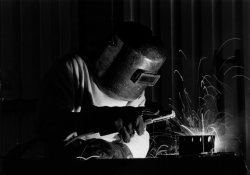
photographing arc welding

Tractor & Tulips

A
Tractor & Tulips

  • 0
  • 0
  • 10
Tree with Big Shadows

Tree with Big Shadows

  • 2
  • 0
  • 69

Forum statistics

Threads
203,456
Messages
2,855,025
Members
101,852
Latest member
keith1420
Recent bookmarks
0

hec

Member
Allowing Ads
Joined
Jul 16, 2004
Messages
50
Location
Hermosillo,
Format
Multi Format
hello,

has someone here photographed arc welding? I have searched without success regarding a recommended exposure. BTW, I will be using Ilford fp4.

Because I look forward to having long spark lines on the photograph, I would guess that in order to accomplish that it would be required a shutter speed between 1/4 and 1/30.

Thanks for your advice...
 
I think you are on the right track.

You may want to bracket and I'd suggest longer exposures yet; longer exposures mean not just longer trails but more trails.

The welding and sparks are point sources, like light bulbs. If you expose for a light bulbs burning filament everything else will be quite dark.

With the longer exposures you may want to use a flash to freeze the person welding.

So in practical terms what I'm suggesting is to set the camera for around 2-3 stops underexposed from ambient, use a shutter speed closer to 5-10 seconds, use flash to get the person properly exposed.
 
Be careful not to look at the arc, it's extremely bright and you may get 'arc eye' which is very nasty. Once or twice I struck the arc just before I could get the mask to my eye and the brightness was so intense I couldn't see anything but pure white for some seconds (I used to work as a toolmaker). I'd be hesitant to look at the arc through a camera lens, maybe set up on a tripod and use a welding mask like the welder.

http://en.wikipedia.org/wiki/Arc_eye
 
Be careful not to look at the arc, it's extremely bright and you may get 'arc eye' which is very nasty. Once or twice I struck the arc just before I could get the mask to my eye and the brightness was so intense I couldn't see anything but pure white for some seconds (I used to work as a toolmaker). I'd be hesitant to look at the arc through a camera lens, maybe set up on a tripod and use a welding mask like the welder.

http://en.wikipedia.org/wiki/Arc_eye

Ditto!
 
Looking at the people and things on your website one would guess that these will be very close to the fire. I would encourage you to take many shots bracketing your exposure by many stops. You will have a wide range of light, way beyond the capability of the film, so much of your success will be by chance. The more varied shots the better your chances.

This sounds like a very interesting subject especially at the close range you use. I hope you will share your pictures with us, either here or on your website. Please let us know how the project goes.

John Powers
 
I don't have any to show, as they're Ektachrome, but I have gotten some good arc welding photos. I used a welding face glass over the lens. This protects the lens and cuts the brightness and UV for both the camera and your eyes.
Mind what perkeleellinen says. Looking at the arc without protection can permantly damage the retina worst case, and will cause severe pain due to 'sunburn' of the eyes.
Using flash to fill in the scene is a good thing to try. If the subject is well lit, this may not be necessary. 1/4 sec. has worked for me, but you may want to try longer. Too long and there are too many streaks and the scene becomes confusing.
 
Be careful not to look at the arc, it's extremely bright and you may get 'arc eye' which is very nasty. Once or twice I struck the arc just before I could get the mask to my eye and the brightness was so intense I couldn't see anything but pure white for some seconds (I used to work as a toolmaker). I'd be hesitant to look at the arc through a camera lens, maybe set up on a tripod and use a welding mask like the welder.

http://en.wikipedia.org/wiki/Arc_eye

+1.

I would add that arc welding produces a huge amount of UV light. Welders get lots of sunburns on their heads and hands (until they learn to cover up). You might want to use a UV filter, and you surely don't want to look at the arc when it's active, so tripod only and no looking through the lens. Wear UV safety glasses, look at the welder's face (mask) instead of the workpiece, and use lots of SPF-50 sunblock (a tee-shirt is good for about SPF-8 or less, and less if it's wet).
 
Last edited by a moderator:
thank you for your comments.

I would be hesitant to use exposures longer than 1 sec. because I expect to get a sharp texture of the welder's mask and in my experience people hardly hold still for longer than 1/15, once I get into 1/8 I start to see a faint blur at the print. But I will give it a try to see it for myself.

Regarding ambient light, the place is a long & tall warehouse with huge doors at both ends. So I have the option of putting a wall or daylight behind the welder, although I'd prefer a wall far behind to get better contrast on the sparks.

I will be doing the photographs next Friday morning, a good friend has a workshop and has given me access. I will let you know how it turns out (and post a photo).
 
No welding, but if this picture I made is anything to go by in terms of what you might expect with arc welding, the following data may be of use (tripod used):

Exposure
F4, 1/10 sec.

70-200mm / F2.8 lens used set at 200 mm.

DN1_0097_25.jpg


Marco
 
I am looking at a Kodachrome of my dad welding, taken in the 50s. AFAIK, nothing special was done to adjust things by using filters or special exposures. The sparks are trails just as in Marco's photo and the arc shows surprising detail.

I think what might confound us all is the fact that the arc appears bright to us, but all color films and some B&W films have UV protective layers. So this makes the exposure appear nearly correct. If it is not, then a UV filter would help.

PE
 
Shoot for the ambient light, and let the light from the arc fall where it may. You will not have detail in the arcs anyway so overexposing them will be fine.
 
I would be hesitant to use exposures longer than 1 sec. because I expect to get a sharp texture of the welder's mask and in my experience people hardly hold still for longer than 1/15, once I get into 1/8 I start to see a faint blur at the print. But I will give it a try to see it for myself.
).

A tripod will take out your part of the movement. Anything of the welder's that doesn't move will be tack sharp.

John
 
Ambient/Flash control

Remember the little formula that the aperture controls the light from the flash and the shutter controls the ambient background light. If your flash has a set output, adjust your aperture for correct flash (foreground) exposure and fiddle up and down the shutter speed range to manipulate the duration and strength of the arc trails.
It helps use up your film!
 
PERSONAL recommendations

filter recipe
uv
polarizer

or auto darkening welding helmet

the one I use is
huntsman AutoView 9.5 shade hi sens short delay

usually wear Carhartt coat or winter weight BDU

make test exposures with D***tal
 
The person doing the welding will not likely move much at all; part of making good welds is being steady and gentle. Their hand and welding stick might move, but that's about it. This may help for the long exposures. If you're near the welding, don't wear synthetic clothing, and wear something over your eyes even if it's not a auto darkening mask. From several feet away for a short time, goggles made for acetylene welding will provide both visibility and short term protection if an auto darkening mask isn't provided or isn't in the budget.
 
If you've ever been out in the desert or beach with a camera, you will be aware of the damage fine sand can do - Treat a welder's environment the same. When they pick up a grinder, the dust will get everywhere and if your gear is in the line of fire, particles will get embedded in the body and lens.
Has anyone suggested a UV filter yet - Use one. It will protect the front of your lens.
 
filter recipe
uv
polarizer

or auto darkening welding helmet

the one I use is
huntsman AutoView 9.5 shade hi sens short delay

usually wear Carhartt coat or winter weight BDU

make test exposures with D***tal

+1, When you don't have a helmet on wear dark sunglasses, Sunscreen can help, but I've gotten a sun burned even after as little as 5 minutes of Mig Welding.

If you meter for ambient, get the welder to strike briefly instead of running a long bead. If your after the sparks flying off, this will probably give you the best effect, if he doesn't even really weld anything, jsut does a bunch of short strikes (not tacks or beads)
 
As a person who did TIG & MIG welding in the Navy, please be careful, especially with your eyes.

Protect them.

So as you can enjoy a long life seeing your world.

Have a wonderful weekend.
 
I'm rather new to welding, and as an asthma sufferer I had to go with TIG as it produces very little smoke (soldering smokes more). It also doesn't throw sparks (unless something goes wrong and I've done that once or twice) so it's not as spectacular from a photography perspective. (Makes great welds though.) Other processes that use flux coated rods or wire will produce significant smoke. That will effect the image you record and it might be what you want or it might not. Just keep that in mind.
 
the negatives are drying now... they look promising. Tomorrow I'll print a few and share them with you.

I used a 135mm lens to have some space between the welder & myself. During the shooting it helped me to take off the finder of my F2, easier on my eyes, so I was looking down at the camera and wearing a cap.

I did a lot of bracketing and from what I see on the negatives the best ones were exposed between 1/8 & 1/30 @ f8 & f5.6.
 
+1, When you don't have a helmet on wear dark sunglasses, Sunscreen can help, but I've gotten a sun burned even after as little as 5 minutes of Mig Welding.

Yes, when I was taken welding classes, I got a nasty triangle shaped sunburn atop my chest from wearing a v-neck shirt one day. Basically the area below my facemask and above my apron.
 
Don't be afraid to use a little flash, especially a slow or rear-sync. This can help to freeze your subject while still allowing the arc trails to register on your film.
 
Picture turned out great ,Hector.Could use a little full flash or some to tone down contrast inbackground.
 
Last edited by a moderator:
Photrio.com contains affiliate links to products. We may receive a commission for purchases made through these links.
To read our full affiliate disclosure statement please click Here.

PHOTRIO PARTNERS EQUALLY FUNDING OUR COMMUNITY:


Ilford ADOX Freestyle Photographic Stearman Press Weldon Color Lab Blue Moon Camera & Machine
Top Bottom