Is Phenylenediamine a liquid, a powder, or both. I am using KennyE 777's formula to make a developer and it calls for 7 g of PPD. Also, does anyone know where it can be purchased? Photographers Formulary does not seem to carry it.
Roger P.
PPD comes as the free base, (a tarry black material that does not keep well) or a white to brownish powder which may be either the Sulfuric Acid or the Hydrochloric Acid salt. It is becoming less and less popular due to its tendency to cause severe allergies. It use has declined or been banned in many areas in hair dyes. Supplies are dwindling.
I made up some Edwal 12 developer that called for PPD. I took PE Ron's advice and substituted CD-2 in place of PPD and it worked very well indeed. I really couldn't find a source where I could easily buy PPD.
Here was a little help on how I did the conversion:
JW PHOTO:
If you want to try to use a PPD deriviative such as CD-2 in place of PPD, one logical starting point would be to use a mol/mol weight substitution. As an example:
Mol. weight of PPD: ~108g
Mol. weight of CD-2: ~215g
So you would start out by using approximately 2x the amount of CD-2 (suppose the the formula calls for 5g PPD, you'd start with 10g CD-2).
However you would likely also need to adjust the final pH of the developer when making this kind of substitution. CD-2 is an acid salt as opposed to PPD free base.
I never adjusted the PH and it worked just fine for me. If I play around some more I'm buying some pre-packaged Edwal 12 from Photographers Formulary and then do a PH comparison.
But you can still buy it in Just for Men Beard Dye, and read all the unhappy reviews on Amazon from people who have developed allergies to it. Blisters on the face and neck are not my idea of fun.
I have a few grams of PPD around here that a lichenologist gave me years ago before I knew of its allergenic properties. You might look contact your local lichenologist (check the yellow pages ) to find out where they are getting it. They use it for an aid in species identification.
I made up some Edwal 12 developer that called for PPD. I took PE Ron's advice and substituted CD-2 in place of PPD and it worked very well indeed. I really couldn't find a source where I could easily buy PPD.
Here was a little help on how I did the conversion:
JW PHOTO:
If you want to try to use a PPD deriviative such as CD-2 in place of PPD, one logical starting point would be to use a mol/mol weight substitution. As an example:
Mol. weight of PPD: ~108g
Mol. weight of CD-2: ~215g
So you would start out by using approximately 2x the amount of CD-2 (suppose the the formula calls for 5g PPD, you'd start with 10g CD-2).
However you would likely also need to adjust the final pH of the developer when making this kind of substitution. CD-2 is an acid salt as opposed to PPD free base.
I never adjusted the PH and it worked just fine for me. If I play around some more I'm buying some pre-packaged Edwal 12 from Photographers Formulary and then do a PH comparison.
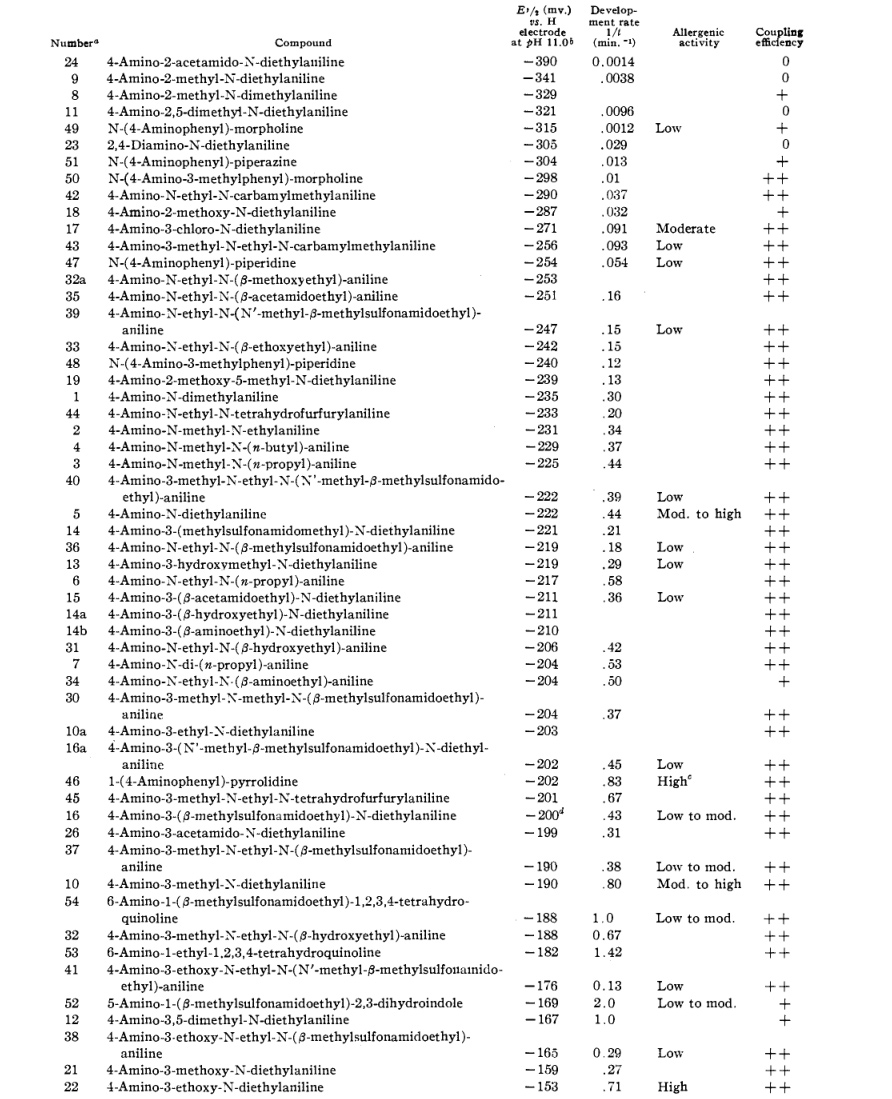
From Chemical Constitution, Electrochemical, Photographic and Allergenic Properties of p-Amino-N-dialkylanilines
"The ability of color-forming developing agents of the p-amino-N-diaakylaniline type to release electrons was measured by
their polarographic half-wave potentials"
I made up some Edwal 12 developer that called for PPD. I took PE Ron's advice and substituted CD-2 in place of PPD and it worked very well indeed. I really couldn't find a source where I could easily buy PPD.
Here was a little help on how I did the conversion:
JW PHOTO:
If you want to try to use a PPD deriviative such as CD-2 in place of PPD, one logical starting point would be to use a mol/mol weight substitution. As an example:
Mol. weight of PPD: ~108g
Mol. weight of CD-2: ~215g
So you would start out by using approximately 2x the amount of CD-2 (suppose the the formula calls for 5g PPD, you'd start with 10g CD-2).
However you would likely also need to adjust the final pH of the developer when making this kind of substitution. CD-2 is an acid salt as opposed to PPD free base.
I never adjusted the PH and it worked just fine for me. If I play around some more I'm buying some pre-packaged Edwal 12 from Photographers Formulary and then do a PH comparison.
PPD has been implicated in the UK with a higher than normal incidence of bladder cancer in women who use it as a hair coloring. It has been shown to be excreted by the kidneys. I developed a severe allergy to CD-1 the diethyl derivative of PPD. So there is some danger in even making substitutions. PPD is only a slow and weak developing agent and its use in formulas is mainly for its silver halide solvency. It can also create dichroic fog with some fast films. PPD has a distinctive odor described as medicinal and not unpleasant and so its presence can be easily detected in commercial developers. As with some other chemicals the main danger is working with the solid. Once in solution normal care such a wearing nitrile gloves should be adequate. PPD is also a "cross sensitizer" in that it can create sensitivities to other chemicals such as Metol. That risk alone should rule out its considered use.
Before considering its use read the following two documents.
I am unfamiliar with Kenny E's 777 developer but assume by the name it is similar to the Germain 777 formula. The problem with the Germain and ED-12, etc developers is that there is no good proof that they produce any better results with modern films developed in say Xtol. To me there appears to be a bit of snobbery in using these old formulas and rejecting the use of modern ones.
BTW Bluegrass firmly denies that their 777 bears any similarity to all the purported versions of its developer.
I am unfamiliar with Kenny E's 777 developer but assume by the name it is similar to the Germain 777 formula. The problem with the Germain and ED-12, etc developers is that there is no good proof that they produce any better results with modern films developed in say Xtol. To me there appears to be a bit of snobbery in using these old formulas and rejecting the use of modern ones.
BTW Bluegrass firmly denies that their 777 bears any similarity to all the purported versions of its developer.
KennyE 777's formulae are a total joke, there's some variations, 777a and 777b will work in very mysterious ways as they contain not one, two or even three developing agents but gets there mystical powers by combing five
Even Germain's formula is a bit of a joke since it throws together 3 developing agents without any regard as to their nature. The mixture is not super-additive and the amounts appear to be capricious. As I mentioned in another thread Germain's seems to be what you get when you "leave out the frog." See the link below.
(there was a url link here which no longer exists)
Before WWII there were Ilford, Gevaert, and Kodak deep tank photofinishing developers with 3 developing agents, they used a small amount of Pyrogallol as an oxygen scavenger, it's supposed to have given a cleaner working developer.
There's also the excellent developers Johnsons used to make and sell in the UK using Meritol effectively a fusion of PPD and Pyrocatechin along with another developing agent. So 3 developing agents is not uncommon but 5 is someone having a joke at the expense of those who believe what's being suggested.
Three developing agents seems to be the useful upper limit. As mentioned it helps if they make a super-additive mixture. The Johnson developers IIRC use Metol and Meritol which would be fine. Pyrogallol is an excellent oxygen scavenger and is still used today whenever it is necessary to obtain an oxygen free environment. It is used in microbiology when dealing with anaerobic bacteria.
I've found that CD-2 is a somewhat more active developing agent than PPD. It may also produce somewhat greater grain. My experience with the substitution is, however, limited.
The PPD I have (from Photographers' Formulary) is a light purple shade. Both PPD and CD2 are sort of lavender in solution. I was recently trying to determine if my PPD was the base or the hydrochloride. I dissolved 10 grams in 100ml of distilled water and measured the pH - 9.2. I concluded that it was the base. Was I wrong?
! like the results the old timers obtained with PPD developers in the 30s till the 50s but as may be seen from the link I never manged to get a formula that worked as well using a CD replacement for PPD:
(there was a url link here which no longer exists)
Alan, there is good reason for that. CDs are designed to work with couplers for maximum image in their presence, and so the formula must be jiggered to fix this up. CD3 is perhaps the worst one to pick.
Photrio.com contains affiliate links to products. We may receive a commission for purchases made through these links. To read our full affiliate disclosure statement please click Here.




 ) to find out where they are getting it. They use it for an aid in species identification.