
-
Welcome to Photrio!Registration is fast and free. Join today to unlock search, see fewer ads, and access all forum features.Click here to sign up
You are using an out of date browser. It may not display this or other websites correctly.
You should upgrade or use an alternative browser.
You should upgrade or use an alternative browser.
Paper developing time
-
A
- Thread starter JJB
- Start date

Recent Classifieds
-
For Sale Zone VI Chemicals
- Started by Beevo
-
Sold FREE for Shipping, 4 rolls of Kodachrome 120
- Started by Roseha
-
For Sale Cable release with adapter
- Started by Jon Shiu
-
Want to Buy Konica film, preferably pro 400
- Started by Warmaji
-
Sold SOLD! Bossy Turtle 4x5 Camera
- Started by B.S.Kumar
Forum statistics

I think it's important. You want to be consistent in your processes.
For fiber, my development time is 2 minutes. I only use RC for proofing, but I try to develop those for 1 minute.
I use a timer for both.
For fiber, my development time is 2 minutes. I only use RC for proofing, but I try to develop those for 1 minute.
I use a timer for both.

Thomas Bertilsson
Member
You use a standard developing time for silver gelatin papers. All controls are at the exposure stage. This is so you develop to completion.
My time is 3 minutes with replenished Ethol LPD developer. I never deviate from this, and have a metronome constantly going during my printing sessions.
The point is to be able to have repeatable results. Just follow the notes you made from the first print you liked from the same negative. This way you can make many prints that look as close to exactly the same as possible.
- Thomas
My time is 3 minutes with replenished Ethol LPD developer. I never deviate from this, and have a metronome constantly going during my printing sessions.
The point is to be able to have repeatable results. Just follow the notes you made from the first print you liked from the same negative. This way you can make many prints that look as close to exactly the same as possible.
- Thomas

Depends on the type of paper, Bromide papers need full development as the manufacturers recommend, but warm tone bromo-chloride/chloro-bromide can be pushed and pulled in the developer to give significant changes in image colour/tone with experience.
There's a huge amount of control at the development stage with Warm tone papers, but learn the basics first.
Ian
There's a huge amount of control at the development stage with Warm tone papers, but learn the basics first.
Ian

hallo
in dektol 1+2 i use 2 min for all
in dektol 1+2 i use 2 min for all
RC papers usually need less dev time, go by Ilford's data-sheets.
Ian
Ian

Papers essentially develop to completion which means that past a certain point there is little change in contrast or density. Now this doesn't mean you can leave the print in the developer for an extended amount of time. But the worst thing you can do is to pull a print too soon because it is getting too dark. This will lead to mottling and other problems. Since the amount of time in a developer is dependent on temperature a timer is of little use for print development. You need to look at the print and not a timer. BTw, You don't dont want to use a timer -- a simple, essy to read, wall clock with a second hand is all you need. Once you have made a good print you will know the correct time for the current darkroom session. Then just keep developing each print for the same time. After awhile you will become familiiar with a print's appearance vs completion and find that you are no longer need watch the clock.
This ONLY applies to bromide papers.
Ian
Ian
Papers essentially develop to completion which means that past a certain point there is little change in contrast or density. Now this doesn't mean you can leave the print in the developer for an extended amount of time. But the worst thing you can do is to pull a print too soon because it is getting too dark. This will lead to mottling and other problems. Since the amount of time in a developer is dependent on temperature a timer is of little use for print development. You need to look at the print and not a timer. BTw, You don't dont want to use a timer -- a simple, essy to read, wall clock with a second hand is all you need. Once you have made a good print you will know the correct time for the current darkroom session. Then just keep developing each print for the same time. After awhile you will become familiiar with a print's appearance vs completion and find that you are no longer need watch the clock.

I use a couple of cheapie digital kitchen timers, one for developing and one for fix. Developing times vary by paper manufacturer recommendation. I shoot for 90 seconds for RC and 3 minutes for FB, but these times can be varied for a specific look. Times are also dependent on developer such as Dektol vs Selectol or Selectol soft, etc.

Fixed time for RC (120 s) and factorial development for FB (usually 3 to 3.5 min).
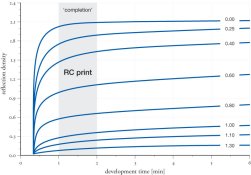
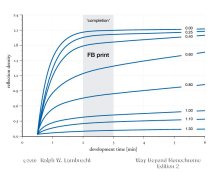
'development to completion' is a bit of a myth. As you can see from the attachments, print density increases with development time for all tones except Dmax. For consistency, it is best to terminate the development after a material dependant fixed time (RC) or to control it through factorial development (FB).
Attachments
JJB
That only works as a rough estimate. It is best to do a test strip with the same materials used for the final print.
That only works as a rough estimate. It is best to do a test strip with the same materials used for the final print.

I will be on the lookout for a timer to help with this then.
Thanks!
JJB:
Timers for developing B & W prints are nice, but an analogue clock with a clear face and a sweep second hand works well too.
As long as you standardise on a development time that is reasonably long (a minimum of 1 minute, but I prefer 2) a few seconds either way won't make much difference.
I use a battery powered clock that hangs over my trays. I wait until the second hand reaches the next 1/4 minute, and time from there.
I think I paid $5.00 for my clock.
It also helps to have the time on the clock set to the actual time. Not that I've ever lost track of time in the darkroom
 .:rolleyes:
I have never heard that "development to completion" applied only to bromide papers. Can you supply a reference.
One finds this expression over and over agian in articles on printing.
One finds this expression over and over agian in articles on printing.
Last edited by a moderator:
I have never heard that it applied only to bromide papers. Can you supply a reference.
Any older Kodak, Ilford, Agfa, Gevaert etc handbook has details. It was common practice.
With warm tone papers & warm tone developers all companies suggested varying Exposure & Development to control image colour.
If you develop a Warm tone paper to completion you kill off most of the papers warmth.
Ian
Last edited by a moderator:
Gerald
You are right. This expression is found everywhere. Still, it is not correct. I didn't know that it only applies to bromide papers, because I don't use them. My test above was done on MGIV.
You are right. This expression is found everywhere. Still, it is not correct. I didn't know that it only applies to bromide papers, because I don't use them. My test above was done on MGIV.
-

- RalphLambrecht
- Deleted
/
It is so hard to explain things to anybody without drowning in endless details which are secondary to the main point. One runs the danger of hearing, "Is there a caboose on this train of thought?" So I sometimes become fixated on the main portion and don't consider exceptions.
I haven't used warm tone papers/developers in many years finding them rather a bother. Now that you mention it I do remember reading what you say about warm tone developers.
I follow AA in wanting a purely neutral image tone. I think that is what most photographers desire, certainly those new to prnting should strive for this first. Therefore, I missed this subset of printing.
Any older Kodak, Ilford, Agfa, Gevaert etc handbook has details. It was common practice.
With warm tone papers & warm tone developers all companies suggested varying Exposure & Development to control image colour.
If you develop a Warm tone paper to completion you kill off most of the papers warmth.
Ian
It is so hard to explain things to anybody without drowning in endless details which are secondary to the main point. One runs the danger of hearing, "Is there a caboose on this train of thought?" So I sometimes become fixated on the main portion and don't consider exceptions.
I haven't used warm tone papers/developers in many years finding them rather a bother. Now that you mention it I do remember reading what you say about warm tone developers.
I follow AA in wanting a purely neutral image tone. I think that is what most photographers desire, certainly those new to prnting should strive for this first. Therefore, I missed this subset of printing.
Last edited by a moderator:
I follow AA in wanting a purely neutral image tone. I think that is what most photographers desire, certainly those new to prnting should strive for this first. Therefore, I missed this subset of printing.
Judging by the number of warm tone papers available the term "most" is rather way off the mark, but sales of warm ton papers are lower, and it's true AA disliked them. But we have to take into account exceptions or people may not get the best out of other materials.
On some B&W printing workshops the first step is demonstrating how exposure/time alters image colour and tone, with warm tone papers.
Ian
Last edited by a moderator:
Depends on the type of paper, Bromide papers need full development as the manufacturers recommend, but warm tone bromo-chloride/chloro-bromide can be pushed and pulled in the developer to give significant changes in image colour/tone with experience.
There's a huge amount of control at the development stage with Warm tone papers, but learn the basics first.
Ian
What Ian says is quite correct, but there are not many papers that respond in this manner. When you do find one, it is still important to develop the print fully. You balance exposure and development time to get the desired effect.
With most papers, you need to keep your eye on the clock, not the print. You try to develop "to completion." The time depends a bit on both the paper and the developer, but the manufacturer's recommendations are a good starting point. I have found very little, if any, difference between FB and RC papers. With my usual developer (54-D) and routine, it generally runs about 1 minute 50 seconds.

It's purely dependent on materials, developer strength and temperature. Just the other night I threw a print into some still lukewarm new Selectol 1+2 and it was fully developed in around 1.5 minutes. By the time I stopped printing a couple of hours later prints were done around in 2.5 minutes. I use an RH Process timer with factorial (factor from 4-6 depending on paper and what I want).
I don't think sticking to a set time is always best unless said set time is long enough to be longer than "completion." It's material and environmentally dependent.
I don't think sticking to a set time is always best unless said set time is long enough to be longer than "completion." It's material and environmentally dependent.
The word 'most' mixed with opinion is all too common but rarely founded.
... With most papers, you need to keep your eye on the clock, not the print. You try to develop "to completion." The time depends a bit on both the paper and the developer, but the manufacturer's recommendations are a good starting point. ...
Fully agree!
... I have found very little, if any, difference between FB and RC papers. With my usual developer (54-D) and routine, it generally runs about 1 minute 50 seconds. ...
That's not my experience but depends on materials. MGIV in Dektol responds as I've shown in the graphs of an earlier post. Quite a difference between RC and FB.
| Photrio.com contains affiliate links to products. We may receive a commission for purchases made through these links. To read our full affiliate disclosure statement please click Here. |
PHOTRIO PARTNERS EQUALLY FUNDING OUR COMMUNITY:  |