
-
Welcome to Photrio!Registration is fast and free. Join today to unlock search, see fewer ads, and access all forum features.Click here to sign up
You are using an out of date browser. It may not display this or other websites correctly.
You should upgrade or use an alternative browser.
You should upgrade or use an alternative browser.
Over exposed processing
-
A
- Thread starter cabledog
- Start date
Recent Classifieds
-
For Sale KODAK COLOR THERMOMETER F
- Started by Jon Shiu
-
Want to Buy Sinar P2 8x10 Bellows (Need the frames)
- Started by Jessxi
-
Free Super rare Minox accessories
- Started by spookyphoto
-
Want to Buy Jobo ATL-1000 or ATL-1500
- Started by Rolfe Tessem
-
For Sale Leica M-A Black Chrome Camera Body MINT-
- Started by samuelphoto
Forum statistics

What film were you using? So you exposed the ISO 400 film at an EI of 100 (you overexposed by 2 stops). Check the manufacturers instructions for the film. Effectively you would "pull" process the film (the opposite of push processing). Ilford Delta 400 (for example) can be pulled to 200 which involves a reduced development time. If you are lucky enough to have been using XP2 you'll be fine but the negatives will be dense.

If they are negative film then simply process as normal and print accordingly.
If they are negative film then simply process as normal and print accordingly.
If he can see through the negatives! But might get away with it.

No.I exposed two rolls of 400 speed film 2 stops over because my nd4 filter fell off and didn't realize it. Would I under develop 2 stops to compensate?

bdial
Subscriber
What were the lighting conditions like?
If it was contrasty, for example bright sun, pulling is probably a good idea. Otherwise process normally and enjoy the extra shadow detail.
If you can afford to lose a few frames, you could do a clip test, see if you like the result, and adjust if necessary.
If it was contrasty, for example bright sun, pulling is probably a good idea. Otherwise process normally and enjoy the extra shadow detail.
If you can afford to lose a few frames, you could do a clip test, see if you like the result, and adjust if necessary.

That's exactly what I would do.What were the lighting conditions like?
If it was contrasty, for example bright sun, pulling is probably a good idea. Otherwise process normally and enjoy the extra shadow detail.
If you can afford to lose a few frames, you could do a clip test, see if you like the result, and adjust if necessary.

B&W negative films have a considerable latitude from 4-1/2 stops over exposed to 1 stop under exposed. Just develop normally and be prepared to deal with a denser than normal negative. Since this question is asked over and over this thread should be a sticky thread!
- Joined
- Dec 4, 2007
- Messages
- 258
- Format
- 4x5 Format
It would also depend on how you plan to print the film. Printing dense negatives in a classic darkroom is way easier then getting them scanned. I once overexposed HP5+ at 32 iso because i forgot to reset my exposure meter after i had used P55. Still printable with very long printing times in the darkroom, but impossible to scan. And indeed: very nice shadow detail.
When wet printing: follow Bdial's advise, otherwise pull them a bit more.
When wet printing: follow Bdial's advise, otherwise pull them a bit more.
One stop over for negative is kind of right on. Two stop is a little dense but provide guarding against under exposure due to metering/technique. Chances are the 2 stop over film would yield better prints than the one shot at 400.If he can see through the negatives! But might get away with it.
I wonder if decreasing development time a bit (15-20% ?) and using constant agitation would help to tame excessive density while retaining reasonable contrast.
- Joined
- Jun 21, 2003
- Messages
- 29,810
- Format
- Hybrid
couldn't agree more !One stop over for negative is kind of right on. Two stop is a little dense but provide guarding against under exposure due to metering/technique. Chances are the 2 stop over film would yield better prints than the one shot at 400.
there is nothing worse than a thin sheet of film.
Since 2 rolls are involved perhaps process one at normal times and assess whether adjustments in processing are required for the other roll. Or pull one roll a bit and again assess.
The only thing extra camera exposure does is change the placement of the tones on the curve, they all just slide to the right.I wonder if decreasing development time a bit (15-20% ?) and using constant agitation would help to tame excessive density while retaining reasonable contrast.
The only adjustment needed to print the thicker negative is adjusting exposure at the enlarger so that the same amount of light reaches the paper.
Decreasing development changes the contrast rate, makes the mid-tones muddier, regardless of the exposure.

A couple of us actually did a test of this recently for our Darkroom Group.
This is T-Max 400 developed in 1+1 D76. Light was directional, but moderately flat (think rainy high overcast).
One negative was exposed "normally" using a spotmeter reading from a grey card.
The other negative received two stops more exposure.
We shot two rolls. The first was developed normally. The second was developed for 33% longer.
I then did contact proof sheets and, for fun, another set where the exposure for each negative was varied to try to achieve similar densities.
The first example shows the result when the two stop over-exposed negative received an additional stop of print exposure (same as Bill Burk's scenario).
The second example shows the result when the two stop over-exposed negative received an additional two stops of print exposure.
These are scans of the contact sheets, cropped to the subject negatives.
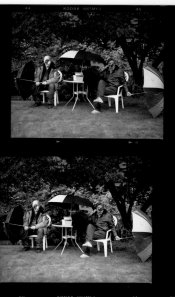
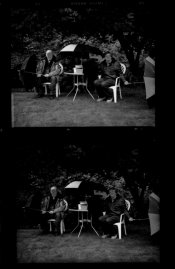
The identity of the models has been intentionally obscured
This is T-Max 400 developed in 1+1 D76. Light was directional, but moderately flat (think rainy high overcast).
One negative was exposed "normally" using a spotmeter reading from a grey card.
The other negative received two stops more exposure.
We shot two rolls. The first was developed normally. The second was developed for 33% longer.
I then did contact proof sheets and, for fun, another set where the exposure for each negative was varied to try to achieve similar densities.
The first example shows the result when the two stop over-exposed negative received an additional stop of print exposure (same as Bill Burk's scenario).
The second example shows the result when the two stop over-exposed negative received an additional two stops of print exposure.
These are scans of the contact sheets, cropped to the subject negatives.
The identity of the models has been intentionally obscured
The only thing extra camera exposure does is change the placement of the tones on the curve, they all just slide to the right.
The only adjustment needed to print the thicker negative is adjusting exposure at the enlarger so that the same amount of light reaches the paper.
Decreasing development changes the contrast rate, makes the mid-tones muddier, regardless of the exposure.
I know but the goal is to decrease overall negative density while retaining appropriate contrast.
To maintain a contrast rate development needs to remain the same. Pulling reduces contrast rate.I know but the goal is to decrease overall negative density while retaining appropriate contrast.
Reducing exposure though will reduce overall density.
I ask rhetorically: Why is it necessary to decrease that overall density?I know but the goal is to decrease overall negative density while retaining appropriate contrast.
Those normally processed two stop over-exposed T-Max 400 negatives are eminently printable.

Several years ago, I accidentally over exposed HP5 sheet film at EI 64 (thought it was FP4) and developed it normally in Xtol 1+1. To my surprise, it printed beautifully!
- Joined
- Jun 21, 2003
- Messages
- 29,810
- Format
- Hybrid
i take back my last post,
i think the OP needs to over develop the film by at least 2, maybe even 3 stops and then
using an arcane formula for miners reducer ( not farmer's reducer ) it's found in a rare 1920s handbook
bleach back all the film one frame at a time and re-fix them afterwards
and then if the film is too thin the OP needs to intensity each frame 1 at a time in selenium intensifier
then make copy negatives because they will need to be duplicated
( i have some professional duplicating film that was stored
in a mountain in nevada if you need some i can sell it to you cheep ! )
after all the point is to make everything as complicated as possible !
OP in case you don't realize it from my whistley guy
i am joking with this post ...
your film will look beautiful as is and developed normally
good luck ( and have fun )
...
i think the OP needs to over develop the film by at least 2, maybe even 3 stops and then
using an arcane formula for miners reducer ( not farmer's reducer ) it's found in a rare 1920s handbook
bleach back all the film one frame at a time and re-fix them afterwards
and then if the film is too thin the OP needs to intensity each frame 1 at a time in selenium intensifier
then make copy negatives because they will need to be duplicated
( i have some professional duplicating film that was stored
in a mountain in nevada if you need some i can sell it to you cheep ! )
after all the point is to make everything as complicated as possible !
OP in case you don't realize it from my whistley guy
i am joking with this post ...
your film will look beautiful as is and developed normally
good luck ( and have fun )
...
To maintain a contrast rate development needs to remain the same. Pulling reduces contrast rate.
Reducing exposure though will reduce overall density.
I know that but using 'constant' agitation with reduced development time should maintain contrast while decreasing overall density, right? It probably isn't worth the trouble though... basically an insignificant difference.
I ask rhetorically: Why is it necessary to decrease that overall density?
Those normally processed two stop over-exposed T-Max 400 negatives are eminently printable.
That's generally true unless the SBR goes beyond the film's limits... unlikely though.

- Joined
- Feb 9, 2010
- Messages
- 9,528
- Format
- 4x5 Format
Had you come to us saying "I accidentally shot at 1 whole second instead of 1/125 second", then your overexposure would be so extreme that your darkroom time might jump from 15 second print to over a whole minute printing. That kind of situation would call for less development to keep the density from getting too extreme to be practical to print. But as Gerald Koch said early on, you could easily overexpose 4 stops and not have a serious problem... and so normal development time is OK in those kinds of cases.
| Photrio.com contains affiliate links to products. We may receive a commission for purchases made through these links. To read our full affiliate disclosure statement please click Here. |
PHOTRIO PARTNERS EQUALLY FUNDING OUR COMMUNITY:  |