
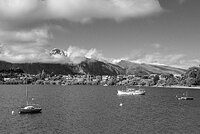
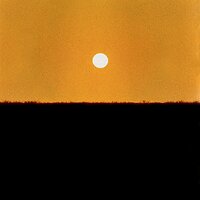

During a printing session with a particularly difficult negative (backlit, thin shadows), and after trying dodging and burning, split grading, etc. I decided to try flashing. This was a technique I had heard about for years but had never used.
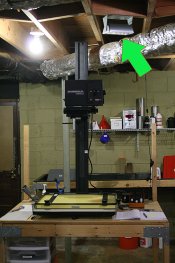
After a little thought, I found an old safelight, took out the filter and replaced it with two pieces of foam core. I screwed it to the ceiling, ran an extension cord down to the Darkroom Automation f-stop timer and set to testing.
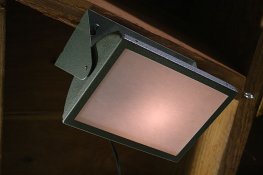
With a standard 15 watt bulb, I was surprised to find that it took 3 stops (~8 seconds) of exposure to get me below the threshold, and a full 3.5 stops (~12 seconds) to produce just the very lightest gray below the paper base on Ilford MGFB. That seemed much longer than I ever would have imagined given how bright it seemed when switched on; I will no longer worry about the tiny bits of light that periodically creep around the door on bright days.
Anyhow, it works! Within another 20 minutes, I had my pilot 8x10 tests for the eventual 16x20 print, which will probably get done tomorrow. After wrapping up, I dug out an old Time-O-Lite which I will use so I don't have to plug and unplug from the f-stop timer. The main thing is just the modified safe light. You could probably put a small nylon strap on it and temporarily fasten it to an enlarger column or head if you wanted to do local flashing/burning. It's stupid easy, cheap, and it works.
I'm releasing this under the GNU Public License, which means that if you take this idea and do anything GNU to it, you have to send me some $$$. Hope that helps!
After a little thought, I found an old safelight, took out the filter and replaced it with two pieces of foam core. I screwed it to the ceiling, ran an extension cord down to the Darkroom Automation f-stop timer and set to testing.
With a standard 15 watt bulb, I was surprised to find that it took 3 stops (~8 seconds) of exposure to get me below the threshold, and a full 3.5 stops (~12 seconds) to produce just the very lightest gray below the paper base on Ilford MGFB. That seemed much longer than I ever would have imagined given how bright it seemed when switched on; I will no longer worry about the tiny bits of light that periodically creep around the door on bright days.
Anyhow, it works! Within another 20 minutes, I had my pilot 8x10 tests for the eventual 16x20 print, which will probably get done tomorrow. After wrapping up, I dug out an old Time-O-Lite which I will use so I don't have to plug and unplug from the f-stop timer. The main thing is just the modified safe light. You could probably put a small nylon strap on it and temporarily fasten it to an enlarger column or head if you wanted to do local flashing/burning. It's stupid easy, cheap, and it works.
I'm releasing this under the GNU Public License, which means that if you take this idea and do anything GNU to it, you have to send me some $$$. Hope that helps!


