
• Welcome to Photrio!
    Registration is fast and free. Join today to unlock search, see fewer ads, and access all forum features.
    Click here to sign up

Old Kodak NC (Non-Curling) Film - Development question

Sprung

H
Sprung

  • 3
  • 2
  • 51
Hensol woods

A
Hensol woods

  • 9
  • 1
  • 96

Recent Classifieds

Forum statistics

Threads
202,966
Messages
2,848,207
Members
101,561
Latest member
esnaps
Recent bookmarks
0

AdrianW

Member
Allowing Ads
Joined
Jun 13, 2007
Messages
35
Format
Medium Format
My girlfriend recently bought a Rolls Bakelite Camera (made around 1939). Inside the camera was an exposed 127-format roll of Kodak NC film. This film type was replaced in 1931 with Kodak Verichrome film. That seems to indicate that the film was already quite old when it was loaded into the camera.

We are very interested to see what, if any, images might be on this roll of film. But I have no idea what processing time to use to develop this roll, and also if either of my two main developers - T-Max and HC-110 - would be appropriate to use for this film.

Any suggestions regarding the processing of this ancient film are greatly appreciated.
 
It will fit into Patterson reels adjusted to the 127 position.

Otherwise, you might consider contacting George Eastman House to see if they can point you toward developing information.
 
I've been trying to find the link to this great little applet that determines the effective rate of speed for film based on its age and other factors, but I'm coming up empty. Perhaps others know what I'm talking about - it's fantastic at coming up with appropriate development times.

I would definitely incorporate an agent to reduce fog such as benzotriazole.

Good luck!
 
Any suggestions regarding the processing of this ancient film are greatly appreciated.

You can find my process described in details here:
http://foundfilm.livejournal.com/16982.html
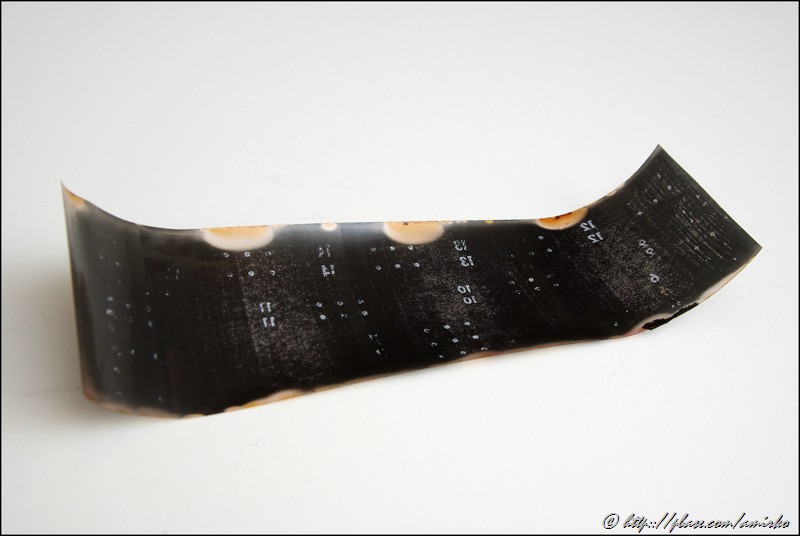
The problem with films this old is the base -- they all have nitrate cellulose base and "nitrate won't wait" as the saying goes.
Here is the nitrate is action:
http://www.pbase.com/amirko/image/130407946
Nothing will revive it.
The emulsion/latent image is another story; it could survive. For instance, the film referenced above had the images, but I was able to (partially) save just one:
http://www.pbase.com/image/130407923
I had very limited success with film that old. I have few successfully developed rolls from 30s and one from 20s.

Good luck,
 
Verichrome was introduced in 1907/8 by Wratten & Wainright which was bought by Eastman in 1912, and stayed in production, switching to safety base in 1931. So N.C. and Verichrome existed side by side for quite a long time.

Iam
 
Verichrome was introduced in 1907/8 by Wratten & Wainright which was bought by Eastman in 1912, and stayed in production, switching to safety base in 1931. So N.C. and Verichrome existed side by side for quite a long time.

Iam

Ian, Kodak Verichrome was born 1931, according to >Kodak History file<
The one you've mention is old Wratten & Wainright Verichrome emulsion, is not the same. W&W invented the emulsion and made plates for narrow markets, but the roll film was released just in 1931 after years of development and Kodak recycled the old name they owned for so long (it was based on the original W&W invention after all).
 
HC-110 Dilution B, say 7 to 9 minutes. It's orthochromatic film, so you can inspect it during processing by red safelight. Fix it longer than you would fix TMAX, say 10 minutes, these old films are hard to fix.
 
Thanks for all these great responses.

Matt, I did contact the George Eastman House and my question is up on their web site but I haven’t got any response yet. I do have a Patterson reel that I have been using with 127 format Efke film.

Emir, your web links are very helpful. Another friend of mine confirms your suggestion that the key to retrieving images is by using a highly concentrated developer at a very low temperature for a short time. This seems to be the best hope to control excessive fogging.

John, you make an important point that this ortho film can be safely viewed under a red safelight. The biggest concern I have is that this nitrate film may fall apart as I’m loading it on to a reel. Emir’s web link shows what can happen. It is some relief to know that if that happens I can switch on a safelight and gather up the pieces, but obviously I would most like to figure out if there is some way to handle the film to lessen the chances of that happening.
 
The biggest concern I have is that this nitrate film may fall apart as I’m loading it on to a reel.

I have seen it written (but can't confirm just now) that all Kodak roll films (as opposed to 35mm) were made with non-nitrate base from the beginning. Your biggest problem is likely to be that the film has a really aggressive tendency to stay rolled up, and secondarily the base may have degraded and caused the coating to separate.
 
If you have a full darkroom, I would forgo the reel entirely. I would give it a short presoak, just to soften the base, fill a tray half full with developer, switch on your safelight, and do it the old fashioned way: see-saw the film into the developer, back and forth, until you get acceptable results. Not only do you avoid the possible problems from loading it onto a reel, you can see exactly when your film is done, and whether you got anything on it.
 
I have seen it written (but can't confirm just now) that all Kodak roll films (as opposed to 35mm) were made with non-nitrate base from the beginning. Your biggest problem is likely to be that the film has a really aggressive tendency to stay rolled up, and secondarily the base may have degraded and caused the coating to separate.

According to what I know all NC films were nitrate based, see for example >this< document.
If nitrate is in bad shape, nothing will save it. If it is more or less ok, there still will be usual problems with backing paper sticking to the emulsion, frame numbers and lettering transferred to the film, cracks in the emulsion and base, etc. Here is much never old Plus-X film I once developed (BTW it has produced nice >pictures<):
original.jpg
 
The cited document certainly looks authoritative. I believe that the reference that I remember was a Kodak publication, but it is possible that something was garbled even there.

It seems that the definitive test is to ignite a small sliver of the film base and observe; I have several rolls of Ansco Ultra Speed Pan Film with a March, 1949 expiration date that are nitrate base, even though by some published data they should, as postwar manufacture, be safety base. My guess would be that they were wartime production motion picture film packaged for retail sale after the war.
 
I know this thread is some years old but thought I'd add my 2 cents worth anyways if it's still of help. On Flickr there is a user who has shot an ancient 1917 Kodak Non-Curling 120 film just late last year and has developed it and got outstanding results https://www.flickr.com/photos/56296811@N05/11577796173/ how he got the film to work was do a 15 second exposure at f-16 aperture. Anyways more importantly and in relation to this thread, he developed this film in D-76 for 10 min and fixed for 5 min all at room temperature. So judging by his results, D-76 should work great for this film. I personally shoot vintage film myself including film from the 1930s and I develop all my B&W films in Caffenol C at 20 deg C for 13 min and get great results each time. If Caffenol C (coffee, vitamin C, soda) can work for vintage films then I guess any B&W developer will do the job for your film.
 
Photrio.com contains affiliate links to products. We may receive a commission for purchases made through these links.
To read our full affiliate disclosure statement please click Here.

PHOTRIO PARTNERS EQUALLY FUNDING OUR COMMUNITY:


Ilford ADOX Freestyle Photographic Stearman Press Weldon Color Lab Blue Moon Camera & Machine
Top Bottom