
• Welcome to Photrio!
    Registration is fast and free. Join today to unlock search, see fewer ads, and access all forum features.
    Click here to sign up

Old Chemicals, Good, Bad, Ugly?

Recent Classifieds

Forum statistics

Threads
202,847
Messages
2,846,483
Members
101,564
Latest member
swedafone
Recent bookmarks
0

Larry the sailor

Member
Allowing Ads
Joined
Feb 3, 2016
Messages
333
Location
NE Oklahoma
Format
Multi Format
Included with a big lot of darkroom stuff I bought a few months ago was a fair sized box of dry chemicals, most in amber glass bottles, some in small baggies. as well as half a dozen bags of Zone VI print developer.
Guessing, based on the age of other stuff they are at a minimum of 20 years old, some by the style of the packaging are a good bit older.
Quite a bit are still factory sealed. Some are clumped up and hard, some are still free moving powder.
Some are pretty common but a few I have no idea what they would be used for.
Anyone able to offer recommendations as to which are probably OK to use even if clumped up and which are candidates for proper disposal.
This is what I have: the ones with * are my head scratchers as to use
SODIUM SULFITE (ANHYDROUS)
NaOH
SODIUM CARBONATE (MONOHYDRATED)
SODIUM BISULFATE
SODIUM METABORATE
AMMONIUM THIOCYNATE
POTASSIUM NITRATE
*ETHYLENDINITRILO DISODIUM SALT
SODIUM BORATE
CITRIC ACID
SODIUM CHLORIDE
POTASSIUM FERRICYANIDE
POTASSIUM META-BISULFATE
POTASSIUM CARBONATE
*POTASSIUM PERMANGANATE
BALANCED ALKALI
POTASSIUM BROMIDE
*CHLORAMINE T
*SODIUM DITHIONITE
 
I found a couple bags of that Zone VI print developer at a clean out this summer, but when mixed performed perfectly fine.
 
One can always look at the MSDS for each chemical. These documents usually contain storage requirement and information about stability. Unless those on the list were terribly treated they should be good except perhaps for the dithionite which is not too stable. Chloramine T is a biocide and used as a disinfectant. .
 
Last edited:
I plan on giving the Zone VI print developer a go next time I'm printing, hopefully later this week.
 
While we are at it, I was gifted some lab chemicals some years ago (AR grade) and one of them was sodium bisulfite. It reeks when opening the plastic bottle and has an off white, to yellow, colour. Does this keep well, or should I avoid using it?
 
This is what I have: the ones with * are my head scratchers as to use
*ETHYLENDINITRILO DISODIUM SALT
I would guess that this the disodium salt of Ethylenediamine Tetraacetic Acid aka EDTA. This is a good sequestering agent for water hardness.
*POTASSIUM PERMANGANATE
Potassium Permanganate is used in black&white reversal bleaches, i.e. you need it if you want to make slides from standard B&W film and don't want to deal with the highly toxic and carcinogen Potassium Dichromate. Make sure you understand how to handle it, before you open the container.
*CHLORAMINE T
AFAIK this is an antibacterial agent, see here for details. This may be quite toxic to humans, too, so make sure you understand how to handle it, before you open the container.
*SODIUM DITHIONITE
Sodium Dithionite is used in reexposure bath for both color and B&W reversal processing. It is a powerful reducing agent, which will reliably fog silver halide emulsions, so keep it away from any photographic developer (except from second developers in reversal processes). Make sure you understand how to handle it, before you open the container, it smells awfully.
 
Thanks for the replies folks.
Yeah, I was missing the EDTA abbreviation till I google-ized it, I'm not sure I've ever seen it all spelled out before:redface:. I knew Chloramine is a disinfectant and is used in water treatment (controversial issue). Mostly I just wasn't up on the photographic uses.
In the bottom of the box is another bag of small baggies with various chemicals I need to make a list of and add here, they look like stuff used in some kind of color processing.
 
I would be a bit cautious about using the following if they have been exposed to humid air via a leaking pack:
Sodium sulfite, Sodium hydroxide, Sodium Bisulfite, Potassium metabisulfite, Ammonium Thiocyanate, (Potassium Carbonate?).

Potassium Permanganate is also used in Kodak TC3 tray cleaner and Kodak S6 Stain remover.
 
Most of this stuff will still work. Big question is will you ever use it? Do you mix your own ? I have a bunch of stuff, scales, the whole works. I occasionally mix up stuff from scratch it's fun. I would use the print developer. If it's brown when you mix it toss it otherwise use it. The potassium permanganate and potassium nitrate are oxidizers so you want to be careful not to mix these with the wrong thing :smile: . Mike
 
If anyone doubts that potassium permanganate is not a strong oxidizing agent I would suggest the Chemistry 101 demonstration. Take a VERY SMALL amount of the permanganate, say 1/2 tsp, and make into a pile. Place a drop of two of glycerin on it and step back. After a few sends the mixture will take fire. Quite dramatic in a darkened room. In the amounts given the reaction is safe. There is no explosion. Still do it on an old plate or surface that cannot burn.

A word of caution. Permanganate bleaches use concentrated sulfuric acid and potassium permanganate. I know that some on APUG are fond of making concentrated stock solutions. Not a good idea unless you are instructed to do so. NEVER DO THIS WITH PERMANGANATE BLEACHES. Mixing solid potassium permanganate with concentrated sulfuric acid WILL result in a powerful explosion. The mixture is only safe when diluted in water. So follow the directions carefully and do not mix up the order of addition.

If you look at the periodic table you will see that manganese is in group VIIB and the halogens are in group VIIA. This means that manganese in some respects has a chemistry similar to the halogens. Therefor both chlorine and manganese form a heptoxide (Mn2O7). Both are violent explosives, shock sensitive, and powerful oxidizers. The lab in which I was working was damaged when an instructor prepared what he thought would be a cleaning solution as is made from potassium dichromate and concentrated sulfuric acid. The sink where the explosion occurred was severely damaged and we ever found any large pieces of the glass mixing container.

https://en.wikipedia.org/wiki/Manganese_heptoxide
 
Last edited:
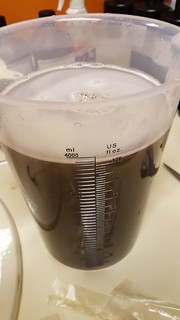
I bottled it up. I'll give it a try this weekend but I've got a fresh batch of Dektol ready to go just in case.
 
Photrio.com contains affiliate links to products. We may receive a commission for purchases made through these links.
To read our full affiliate disclosure statement please click Here.

PHOTRIO PARTNERS EQUALLY FUNDING OUR COMMUNITY:


Ilford ADOX Freestyle Photographic Stearman Press Weldon Color Lab Blue Moon Camera & Machine
Top Bottom