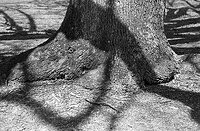
Dave is more active in pinhole photography than me. I don't even have a darkroom at the moment. There is a persistent itch to include one in a garage I'm having built, though.
Pinhole Designer with a user constant of 1.4 or a bit larger is my favorite way of calculating pinhole diameters. The Rayleigh constant was derived by a scientist and based more on theory than on practice.
As for material, .002 brass shim stock perhaps works cleaner than thin aluminum. Thinner shim stock might be even better, but more difficult to work with. The dimple and sand method thins the edges of the pinhole, so thickness of the material isn't too important. I've drilled larger pinholes with tiny drills. For this, thin material is best. If it is sandwiched between firm surfaced material for drilling, fewer burrs are created. To deburr a pinhole, I may use a needle that has its tip ground to a blunt point much like a machinist's center punch. This is gently twirled in both sides of a pinhole. A sharp needle lightly twirled in the pinhole usually removes remaining burrs. A feather-light touch should be used for these two operations. A magnifying glass helps guiding the tool into the pinhole to prevent damaging its edges. Gee, how can something as simple as a pinhole become so complicated?