


• Welcome to Photrio!
    Registration is fast and free. Join today to unlock search, see fewer ads, and access all forum features.
    Click here to sign up

No luck with PET subbing

Somewhere...

D
Somewhere...

  • 3
  • 1
  • 72
Iriana

H
Iriana

  • 6
  • 1
  • 139

Recent Classifieds

Forum statistics

Threads
202,745
Messages
2,844,982
Members
101,494
Latest member
FlyingDutchman
Recent bookmarks
0

infinit

Member
Allowing Ads
Joined
May 26, 2014
Messages
10
Format
Medium Format
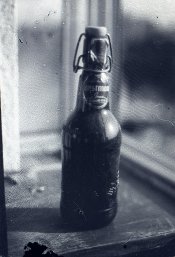
This is a simple washed bromide, no sulfur sensitization at all, shot at 1/2 ISO, sun at the right. 35mm negative in-camera.
I used PET as a base, subbed with gelatin and chrome alum.
The sub look well and tight... then coated the emulsion, shot the picture and voilá: Development, fixer, and emulsion completely detached AFTER dry!
Sub layer too thick having way different dilation than the emulsion? Note the beautiful "cracking" effect in the image. No abrupt temp changes were made at all.

Does anybody ever had any luck with pet base + sub?

I'll have to wait weeks after my estar arrives. The thing is I can't wait that long.
I should try corona discharge, but haven't had time to work out the device. I thought to make it with a tv flyback.
 

Attachments

  • pvc-35mm-001.jpg
    pvc-35mm-001.jpg
    945.1 KB · Views: 242
A fellow did not use subbing but corona treatment with DIY-charger with success. It likely is the best procedure anyway.
 
Gelatin subbing does not work well with any plastic support unless you use an intermediate layer that allows the gelatin to truly bond to the plastic. I'm afraid that this is what to expect without the proper subbing. I'm very sorry about the problem, but nothing can be done at this point.

PE
 
What intermediate layer would you use to bond gelatin to PET? A polyurethane? I am thinking of trying this as PET is readily available to me as scrap from thermoforming processes (end rolls).
 
You can try flame treating the PET and then a thin coat with gelatin as a sub. It may work. If you hunt in the forum there is a long thread about all our trials and tribulations trying to sub and coat PET. It is not easy although it can be done.

If anyone really works out a corona discharge setup I would love to see it. One fellow did do it but we never saw the schematic. It's probably the best solution.

Polyurethane can also be made to work but I dont know how it affects photographic qualities. Kodak had some patents on using polyurethane as a subbing layer.

Or you can try the Grafix wet-media film. It is subbed PET and works quite well.
 
You just added another project to my electronics list. High voltage! I am assuming voltage is based on the conductivity (mhos or siemens) of the plastic and amperage varies with the area being treated, and yes most plastics show some conductivity. This might have to wait until I finish my sailboat drive.
 
If you are processing commercial PET base film you might need to process it more carefully than normal.
 
If you are processing commercial PET base film you might need to process it more carefully than normal.

Why do you say that?

I have posted this before but at work, we screen print both solvent based and UV cured inks onto polyester. There are a variety of surface treatments available for both types of ink. Both coatings and high voltage treatment.

If I was coating emulsion, I would try one which has been treated to suit the printing of UV cured (water based) ink.

Dead Link Removed


Steve.
 
Why do you say that?

I have posted this before but at work, we screen print both solvent based and UV cured inks onto polyester. There are a variety of surface treatments available for both types of ink. Both coatings and high voltage treatment.

If I was coating emulsion, I would try one which has been treated to suit the printing of UV cured (water based) ink.

Dead Link Removed


Steve.

HiSteve
Many people report problems eg with Efke film I've never had any, but eg I temper every bath and use water stop.
Noel
 
This is a simple washed bromide, no sulfur sensitization at all, shot at 1/2 ISO, sun at the right. 35mm negative in-camera.
I used PET as a base, subbed with gelatin and chrome alum.
The sub look well and tight... then coated the emulsion, shot the picture and voilá: Development, fixer, and emulsion completely detached AFTER dry!
Sub layer too thick having way different dilation than the emulsion? Note the beautiful "cracking" effect in the image. No abrupt temp changes were made at all.

Does anybody ever had any luck with pet base + sub?

I'll have to wait weeks after my estar arrives. The thing is I can't wait that long.
I should try corona discharge, but haven't had time to work out the device. I thought to make it with a tv flyback.

First of all, CONGRATS on the nice emulsion!

There is nothing a "civilian" can do to PET to make it hold onto emulsion. The effects either don't last, or are uneven across a given sheet, or fog the emulsion.
As mentioned by Jason (kb3lms) Grafix Wet Media Dura-lar is an excellent base. It's all I've used for the last two years. It has never failed me. I use it for sheet film and roll film and can run it through any camera, including a Pentax 645N with automatic advance.

The bottom section of this page talks a bit about the material. It also comes in rolls. http://www.thelightfarm.com/cgi-bin/htmltutgen.py?content=08Mar2013

If you want to go strictly DIY, you can easily sub acetate film. I say "easily", but with a caveat. It's a horrible stinky job. Spouse has banned acetate subbing from our house and Spouse is a very tolerant man :smile:. It's not as nice a surface as the magic elves at Grafix make, but it's perfectly acceptable and has a nice shabby chic look to it that wet plate and tintype fans would appreciate.

 
I like pure DIY, I'd love to be able to DIY as much as possible, but this is a negotiation between "diyer's-happiness" and the pragmatic man I am.
duralar wet 25" x 50' sounds like a dream come true. Just saw it in amazon.
Thanks Denise, one more time.
 
infinit,

After breakfast, coffee, and a little further reflection, I'll offer an opinion -- not actually asked for, but what the heck :smile:

The scan (I assume) of your piece of emulsion is lovely. If the emulsion stayed on the PET until it was dry, the image is dimensionally stable and obviously usable. If you treat it carefully there is no reason to consider it inferior to a piece of emulsion on film. Using inexpensive PET in this manner would cut down on expense quite a bit. Dura-lar isn't cheap. If you are so inclined, I'd love to see you post your subbing recipe here.
 
oops! Crossed posts.
Thanks! I really do love Grafix Wet Media. Hope you will too!
d
 
By the way everyone, it is great to see some emulsion threads picking up steam again. Keep it coming!

I love DIY too and would prefer to have something in pocket that doesn't depend on a manufacturer making it so that we have something available for the ages. That being said, subbing is frustrating and can easily turn into a rabbit hole. The Graphix material solves the problem neatly and the cost is not excessive.

If I were trying to sub PET again, and I am not right now and won't until I see somebody else have some better ideas than me to start from, I would go in this order for working methods:

1) corona discharge
2) flame treatment
3) polyurethane

Saponification can work but ruins the emulsion over the long term due to use of strong alkalis. Flame treatment is the only thing I have gotten to work in practice, but it hasn't been consistent. Polyurethane works as a subbing but I did not test with live emulsion. It is hard to lay down a nice optically uniform coating and get it to dry without excessive dusty and bubbles.

Jason
 
Last edited by a moderator:
A naive suggestion from a carbon printer:

Perhaps a layer of (hardened) Albumin would help. In carbon printing it is used to coat plastic sheets to uses them as temporary support for double transfer.
 
Albumi(e)n shows up in some of the older emulsion recipes. I haven't gotten around to trying one of them yet, so I'm not sure what effect it might have on the emulsion. I would guess that it would come up off the PET as a fused layer with the emulsion. I can imagine no effect, positive effect, or negative. Sulfur in the egg white might fog the emulsion, or it might sensitize the emulsion at the fusion point. That could be interesting! Thanks for the idea. I think it's worth pursuing beyond the temporary support purpose.
:smile:, d
 
I have read about adding PVC solvent (the one used to seal plastic pipes) to the sub but haven't tried it yet. BTW I have never ever tried anything related to albumin other than food related =) but I should.
 
That hardly would work as PET is most resilient agains organic solvents. Furthermore those solvents must have polarity to dissolve good in the subbing potion.
 
Albumi(e)n shows up in some of the older emulsion recipes. I haven't gotten around to trying one of them yet, so I'm not sure what effect it might have on the emulsion. I would guess that it would come up off the PET as a fused layer with the emulsion. I can imagine no effect, positive effect, or negative. Sulfur in the egg white might fog the emulsion, or it might sensitize the emulsion at the fusion point. That could be interesting! Thanks for the idea. I think it's worth pursuing beyond the temporary support purpose.
:smile:, d

In carbon printing the albumin layer helps quite a lot to maintain the gelatin layer on the plastic. But of cause the gelatin layer is not coated on the plastic sheet, but just transferred onto it. Without the albumin the gelatin layer would simply float away.
Here is a video of Tod Gangler doing the coating of the temporary support with albumin:

https://www.youtube.com/watch?v=eVyfx57Lglg


I think he is using bichromate to harden the albumin with UV light. (The orange color of his bath)

I’m using alum to harden the albumin (both potassium aluminium sulfate and Chromium(III) potassium sulfate works). So first an albumin bath and then a bath with alum. However with my method the albumin layer gets sometimes a little uneven, when too much albumin is sticking on the plastic when I transfer to the alum bath.
 
Thanks for the video and additional info! Carbon printing is such a lovely process and it's always seemed to me like the perfect blend of craft and art.
 
I have read about adding PVC solvent (the one used to seal plastic pipes)

That can be done for a PVC film but not PET. The active solvent is tetrahydrofuran and is one of the few real solvents for PVC. It is a very powerful PVC solvent and will easily distort the film. Quite a bit of tweaking would be required to get it to work. For PVC pipes it works by dissolving the PVC to a plastic "mush" where the plastic from the two pipes then mixes and become one when the solvent evaporates.

On the other hand, polyurethane can sub both PVC and PET.

This albumin thing is interesting. I know nothing about it, though.
 
Hi all,Especially to PE
My first question on this forum for awhile is is directed to PE. Concerning gold in an emulsion for increased speed. Can Au be added to the developer instead or in addition to having the gold with S in the emulsion? The reason I ask is that too much Au in the emulsion causes severe fogging. Would gold in the developer cause the same thing?.
If this has been addressed before, I apologize.
Bill
 
Photrio.com contains affiliate links to products. We may receive a commission for purchases made through these links.
To read our full affiliate disclosure statement please click Here.

PHOTRIO PARTNERS EQUALLY FUNDING OUR COMMUNITY:


Ilford ADOX Freestyle Photographic Stearman Press Weldon Color Lab Blue Moon Camera & Machine
Top Bottom