
-
Welcome to Photrio!Registration is fast and free. Join today to unlock search, see fewer ads, and access all forum features.Click here to sign up
- Home
- Forums
- Analog Workflow Forums (100% Analog/Traditional)
- Analog Equipment
- 35mm Cameras and Accessories
You are using an out of date browser. It may not display this or other websites correctly.
You should upgrade or use an alternative browser.
You should upgrade or use an alternative browser.
NIKKOR 85mm f2 vs. 1.8 version?
-
A
- Thread starter chip j
- Start date


Recent Classifieds
-
For Sale FS: Vintage leather ever-ready case for Nikon Rangefinder camera.
- Started by AnselMortensen
-
For Sale FS: Stereo Realist Leather Ever-Ready Case
- Started by AnselMortensen
-
Under Offer FS: Graflex RH-8...8-exposure Roll Film Back for 4x5 Graflok
- Started by AnselMortensen
-
For Sale Ilex Oscillo-Paragon no. 3X universal shutter (CLA'd)
- Started by OAPOli
-
For Sale Stainless Developing Tank with 2 35mm Reels, Japan
- Started by Jon Shiu
Forum statistics

For all practical purposes there is very little in it.
Buy whichever you can find at best value and enjoy using it.
Tom
Buy whichever you can find at best value and enjoy using it.
Tom

Both are Planar derivatives and the maximum aperture difference is absolutely negligible. There is basically no picture that you could take handheld with the f:1.8 while failing miserably with the f:2.
The only remarkable difference is that lenses with higher maximum aperture usually perform better (=are optimised by design) at larger apertures. The f:1.8 probably reaches its best at f:5,6 or f:8, while the f:2 probably peaks around f:11. Personally, I have chosen the f:1.8 because I figured that I was going to use it preminently as a portrait lens, where selective focus is a primary need, so I thought that I would prefer a lens that would reach its peak at larger apertures. If you have in mind to use it for architectural details or landscape, the f:2 is probably a more rational choice.
The only remarkable difference is that lenses with higher maximum aperture usually perform better (=are optimised by design) at larger apertures. The f:1.8 probably reaches its best at f:5,6 or f:8, while the f:2 probably peaks around f:11. Personally, I have chosen the f:1.8 because I figured that I was going to use it preminently as a portrait lens, where selective focus is a primary need, so I thought that I would prefer a lens that would reach its peak at larger apertures. If you have in mind to use it for architectural details or landscape, the f:2 is probably a more rational choice.
Last edited:
The 85/2 is smaller.
https://www.flickr.com/photos/90768661@N02/albums/72157648772797710
The F1.8: many versions, the last version will focus closer than prior versions. The later versions are Multi-Coated. It was never made as a factory-original Ai, but many were converted as photographers preferred it to the newer F2 version "in the day".
https://www.flickr.com/photos/90768661@N02/albums/72157646850343504/with/15550135810/
The 105/2.5 is sharper. The 85/2 was known as a good portrait lens as it was a bit softer.
https://www.flickr.com/photos/90768661@N02/albums/72157648772797710
The F1.8: many versions, the last version will focus closer than prior versions. The later versions are Multi-Coated. It was never made as a factory-original Ai, but many were converted as photographers preferred it to the newer F2 version "in the day".
https://www.flickr.com/photos/90768661@N02/albums/72157646850343504/with/15550135810/
The 105/2.5 is sharper. The 85/2 was known as a good portrait lens as it was a bit softer.

I have and love both.the f/2 has the benefit of smaller filter I believe.Any opinions? manual-focus
Ralph, although the f:1.8 has a larger barrel, I seem to remember that by placing the writings on the outer ring Nikon saved space enough so that both lenses could share the same 52mm filters.
An outstanding benefit of the f:2, however, is that it's cheaper and much easier to find. The f:1.8 - at least in its AI version - is a nigthmare to be found (regardless of price), and good luck finding a not overused unit!
An outstanding benefit of the f:2, however, is that it's cheaper and much easier to find. The f:1.8 - at least in its AI version - is a nigthmare to be found (regardless of price), and good luck finding a not overused unit!

The 85mm f/1.8 is the oldest Nikkor lens that I still use. I purchased it in the 1970s and later had Nikon convert it to an AI lens.
When I worked for a newspaper, I routinely used it with a 35mm and a 180mm. It is also a great half-length and head & shoulder portrait lens.
I also think it was the lens featured in the 1966 Michelangelo Antonioni "Blow-Up" movie.
I never saw the need to upgrade to the f/2 version. Only recently, did I upgrade to an 85mm f/1.4 auto focus but I still use the f/1.8 manual focus version.
85mm f/1.8 by Narsuitus, on Flickr
When I worked for a newspaper, I routinely used it with a 35mm and a 180mm. It is also a great half-length and head & shoulder portrait lens.
I also think it was the lens featured in the 1966 Michelangelo Antonioni "Blow-Up" movie.
I never saw the need to upgrade to the f/2 version. Only recently, did I upgrade to an 85mm f/1.4 auto focus but I still use the f/1.8 manual focus version.
85mm f/1.8 by Narsuitus, on Flickr
what I like about the f/2 is that it takes the std 52mm filter.Ralph, although the f:1.8 has a larger barrel, I seem to remember that by placing the writings on the outer ring Nikon saved space enough so that both lenses could share the same 52mm filters.
An outstanding benefit of the f:2, however, is that it's cheaper and much easier to find. The f:1.8 - at least in its AI version - is a nigthmare to be found (regardless of price), and good luck finding a not overused unit!
+1For all practical purposes there is very little in it.
Buy whichever you can find at best value and enjoy using it.
Tom
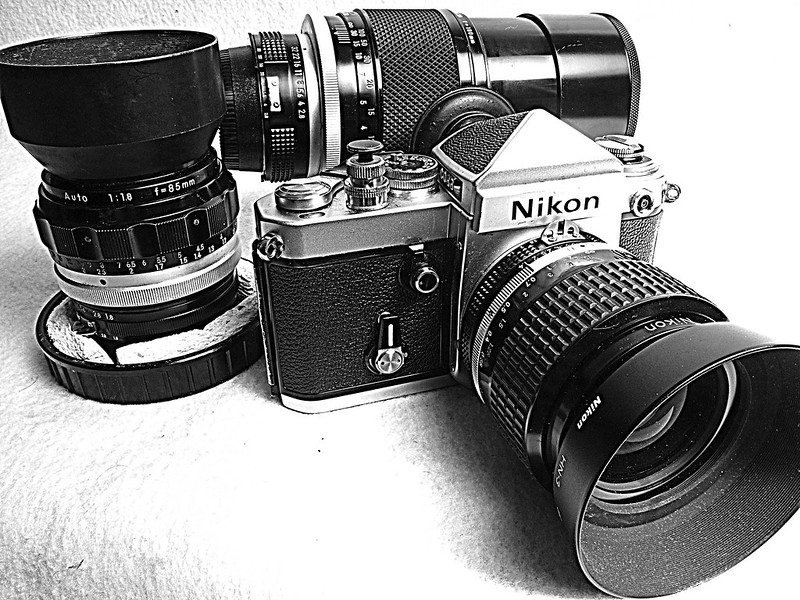
What I like most about it is the professionalism of lens shades... and metal ones at that! I did that a long while ago and thought I was only man on earth with that idea. To keep with thread, 85/2 for me. Great focal length. Almost too sharp for portraits sometimes. And as Ralph said, 52mm filters. I like having all of my Nikki’s with same filters.What a professional-looking picture of professional equipment!
85/2 is more compact, but I thinkt he 85/1.8 is better, although I've used the f/2version only sparingly (and have never owned it). If you are looking for perfection, the later 85 1.4 AIS is both notably faster and optically superior (at major weight and cost disadvantage). The Zeiss ZF and Milvus 85 1.4 are even better and surely more modern in design and coatings, but I doubt the difference is notable in use.
I don't find the 85 1.8 too large and I prefer the build of the pre-ai's, so I'd lean that route. I use the lower contrast (and lower transmission, and very flare prone) single coated version. And yeah, it is the lens David Hemming uses in BLOW-UP, so it gets some bonus fashion points if that matters to you.
I don't find the 85 1.8 too large and I prefer the build of the pre-ai's, so I'd lean that route. I use the lower contrast (and lower transmission, and very flare prone) single coated version. And yeah, it is the lens David Hemming uses in BLOW-UP, so it gets some bonus fashion points if that matters to you.

Perhaps people here whose profession involves optics can comment, but I've always thought that for any given era the slower lens is better overall than the faster one. The reason for this being that unfavorable compromises have to be made in the design in order to achieve that wider aperture.
So, using early 1960's lenses as an example, a 50/2.8 will be better at all apertures than a 50/1.8 (but diffraction probably renders them equal beyond f/11).
Perhaps that was more the case with lenses up to the 1980's and that modern computer-aided designs made the distinction less noticeable.
Just theories on my part.
So, using early 1960's lenses as an example, a 50/2.8 will be better at all apertures than a 50/1.8 (but diffraction probably renders them equal beyond f/11).
Perhaps that was more the case with lenses up to the 1980's and that modern computer-aided designs made the distinction less noticeable.
Just theories on my part.
For extreme fashion points, use a F body.
Don't worry... I do!
No- most lenses tend to be best two stops down from maximum aperture. Faster lenses tend to have more elements, required better corrections.Perhaps people here whose profession involves optics can comment, but I've always thought that for any given era the slower lens is better overall than the faster one. The reason for this being that unfavorable compromises have to be made in the design in order to achieve that wider aperture.
So, using early 1960's lenses as an example, a 50/2.8 will be better at all apertures than a 50/1.8 (but diffraction probably renders them equal beyond f/11).
Perhaps that was more the case with lenses up to the 1980's and that modern computer-aided designs made the distinction less noticeable.
Just theories on my part.
 leica by fiftyonepointsix, on Flickr
Look at the performance in this 1976 test of the 50/2 Summicron and 50/1.4 Summilux compared with the Aspheric 50/1.2 Noctilix and the 50/2.8 Elmar. The latter is a Tessar formula lens. The aspheric optics tend to have poor flatness of field across the frame. Older examples- my 1934 CZJ Sonnar 5cm F1.5 is better than the 5cm F2 Sonnar, even wide-open. Better corrections using more elements.
No- most lenses tend to be best two stops down from maximum aperture. Faster lenses tend to have more elements, required better corrections.
...
That Noctilux is a winner - explains the cost.
I've often seen similar charts where overall best is f/5.6 or f/8 regardless of maximum aperture, but for the Noctilux and Summilux, that's splitting some pretty thin hairs. Alas, I must eke by with mere Summicrons.
The 85/1.8 also uses 52mm filters.
In the olden days one of the things that made Nikon a true system was that all lenses 24mm to 200mm used the same filter size.
In the olden days one of the things that made Nikon a true system was that all lenses 24mm to 200mm used the same filter size.

Mick Fagan
Subscriber
I had the f/1.8 Ai-s for around 6 months and was quite happy with it, then I picked up the f/2 version and immediately noticed that it was soft by comparison. I ran with both lenses for close to a year trying to decide which I liked best. The f/2 version was pretty good for portraiture because one had soft focus built in, but this is an issue when you really wish for sharpness. By happen chance, I borrowed an f/1.4 unit for about half a roll from a photographer alongside me. From the moment I looked at the wet negatives, I hankered after the f/1.4 version.
I picked one up about 25-27 years ago, certainly one of my better decisions.
The f/1.4 version uses 72mm filters and has floating elements (CRC) with which the lens maintains unbelievable sharpness at virtually all apertures and focusing distances, including wide open; you just need to have your chosen critical area in focus.
The basics of the 85mm SLR Nikkor range is simple, the f/1.8 is sharp, but not overly sharp, the f/2 is definitely soft by comparison; these two lenses use 52mm filters. The f/1.4 is critically sharp almost through the entire range and is comparable to the Nikkor 105 f/2.5. When doing portraiture I often run two F3 bodies, one with the 85 f/1.4, the other with the 105 f/2.5. The 85 f/1.4 has a very slight difference, in that it has very slightly higher contrast by comparison.
In my pictures section, there are a few portrait type pictures. A mixture of lenses have been used, but the 105 f/2.5 and 85 f/1.4 are dominant.
Mick.
I picked one up about 25-27 years ago, certainly one of my better decisions.
The f/1.4 version uses 72mm filters and has floating elements (CRC) with which the lens maintains unbelievable sharpness at virtually all apertures and focusing distances, including wide open; you just need to have your chosen critical area in focus.
The basics of the 85mm SLR Nikkor range is simple, the f/1.8 is sharp, but not overly sharp, the f/2 is definitely soft by comparison; these two lenses use 52mm filters. The f/1.4 is critically sharp almost through the entire range and is comparable to the Nikkor 105 f/2.5. When doing portraiture I often run two F3 bodies, one with the 85 f/1.4, the other with the 105 f/2.5. The 85 f/1.4 has a very slight difference, in that it has very slightly higher contrast by comparison.
In my pictures section, there are a few portrait type pictures. A mixture of lenses have been used, but the 105 f/2.5 and 85 f/1.4 are dominant.
Mick.
Last edited:
- Joined
- Nov 1, 2007
- Messages
- 538
- Format
- Multi Format
I had the f/1.8 Ai-s for around 6 months and was quite happy with it, then I picked up the f/2 version and immediately noticed that it was soft by comparison.
As far as I know, the only 85mm f/1.8 AI-s lenses Nikon made were autofocus lenses. They switched from the non-AI f/1.8 to the AI f/2.0 and people have been debating "which is better" ever since. I haven't used either one since my wife bought me a Tokina 90mm f/2.5, so I'll go back to my corner and lurk now.
The performance of the Noctilux at 1/3 out and Far edge is the worst of the lenses tested. Probably flatness of field of the Aspheric optics. They often do not do well in lens tests of flat objects, much like a Sonnar.That Noctilux is a winner - explains the cost.
I've often seen similar charts where overall best is f/5.6 or f/8 regardless of maximum aperture, but for the Noctilux and Summilux, that's splitting some pretty thin hairs. Alas, I must eke by with mere Summicrons.
These are all with the Df.
Nikkor 85/2 Ais, wide-open on the Df:
 DSC_7401 by fiftyonepointsix, on Flickr
 DSC_7397 by fiftyonepointsix, on Flickr
 Fall 2015 by fiftyonepointsix, on Flickr
Nikkor 85/1.8, last version, factory Ai converted, wide-open on the Df:
 DSC_3994 by fiftyonepointsix, on Flickr
 Skate and Fun Zone by fiftyonepointsix, on Flickr
Having both lenses- both are great lenses, the 85/2 is under-rated. It is not as sharp as the Planar version of the 105/2.5. Sometimes you don't want razor sharp.
Nikkor 85/2 Ais, wide-open on the Df:
DSC_7401 by fiftyonepointsix, on FlickrDSC_7397 by fiftyonepointsix, on FlickrFall 2015 by fiftyonepointsix, on FlickrNikkor 85/1.8, last version, factory Ai converted, wide-open on the Df:
DSC_3994 by fiftyonepointsix, on FlickrSkate and Fun Zone by fiftyonepointsix, on FlickrHaving both lenses- both are great lenses, the 85/2 is under-rated. It is not as sharp as the Planar version of the 105/2.5. Sometimes you don't want razor sharp.
Mick Fagan
Subscriber
As far as I know, the only 85mm f/1.8 AI-s lenses Nikon made were autofocus lenses. They switched from the non-AI f/1.8 to the AI f/2.0 and people have been debating "which is better" ever since. I haven't used either one since my wife bought me a Tokina 90mm f/2.5, so I'll go back to my corner and lurk now.
You are correct, I am wrong. I distinctly remember my FE2 body that I bought in November/December 1983 and only having three very different lenses for it. A Vivitar Series 1 135mm f/2.3 that one turned and turned and turned to get focus. A Nikkor 85 f/1.8 lens with the newer rubberised body, which I thought was an Ai-S unit. This I now know was incorrect after checking my Nikon Compendium Handbook of The Nikon System and my 35 f/2 with the scalloped metal focusing that I had gotten modified to Ai for the FE2 body.
Mick.
| Photrio.com contains affiliate links to products. We may receive a commission for purchases made through these links. To read our full affiliate disclosure statement please click Here. |
PHOTRIO PARTNERS EQUALLY FUNDING OUR COMMUNITY:  |