• Welcome to Photrio!
    Registration is fast and free. Join today to unlock search, see fewer ads, and access all forum features.
    Click here to sign up

New to Rodinal - Reccomended Development times for TXP320 pushes

Forum statistics

Threads
203,275
Messages
2,852,204
Members
101,755
Latest member
andescapes
Recent bookmarks
0

EASmithV

Member
Joined
Aug 22, 2008
Messages
1,985
Location
Virginia
Format
Large Format
From what I've read about Rodinal, 1+25 should give me normal contrast negatives.

For the 1+25 dilution, all digital truth has listed is 7 minutes @ ASA 200, 20*C.

Alright, so I'm trying to put together a starting point time list for different speeds. I'm going to rate everything a third of a stop higher just to even out the numbers;

ASA 200 = 7 minutes at 1+25, 20*C
ASA 400 = ? minutes at 1+25, 20*C
ASA 800 = ? minutes at 1+25, 20*C
ASA 1600 = ? minutes at 1+25, 20*C

Who has numbers that can help me begin to start filling out this chart?
 
For MANY reasons, you might do better with D-76 or HC-110 than Rodinal with TXP.
See, TXP is the antithesis of a "push film", because it is intended to compress the shadows.
Rodinal sacrifices enough shadow speed that combining it with TXP can make a less than perfect combination unless
you are trying to make an image that is all midtones and highlights. Regular Tri-X, or FP4, or TMY... Rodinal works great.

If you WANT to use Rodinal and TXP, then you'll have to evaluate the midtones to determine the EI of the film,
the shadows will be 'normal'. Note, too, that the 1+25 / 7' time is for continuous agitation.

Have fun, but you really are in uncharted land here.
 
I've done a lot of TXP in Diafine @ EI 800. Pretty good results. That may be the way to go for you. You can also get EI 1000-1250 out of regular Tri-X & Diafine. Fun stuff.
 
I am using the following with Rodinal (1:100) and Tri-X (35mm), semi-stand development @20C or 68F:

@800 ~ t=120 minutes
@1600 ~ t=160 minutes

Prewash @ 20C
Five slow, initial agitations for the first minute.
A slight swirl at t/2 (halfway through).

I do not know if TXP is as flexible as Tri-X.

I would like to know the times for slower speeds for Tri-X. From what I have gathered it is something like this:
@400 ~ 50-60 minutes
@250 ~ 20 minutes

I am not sure if this makes sense, as I did not have the opportunity to test it, but I am working on it. (Looking forward to the brighter half of the year)

Probably you have to chart it yourself for TXP with a few test exposures. I am curious how it will turn out.
 
Last edited by a moderator:
I've done a lot of TXP in Diafine @ EI 800. Pretty good results. That may be the way to go for you. You can also get EI 1000-1250 out of regular Tri-X & Diafine. Fun stuff.

I have used Tri-X in Diafine @1250-1600. The results were quite acceptable. It is an easy combination for the beginner with an inclination towards low light photography. I also tried Tri-X in Diafine@200 (12 min A, 3 min B, if I recall correctly). Turned out surprisingly good.

Sorry that I don't know more about TXP.
 
Last edited by a moderator:
I have used Tri-X in Diafine @1250-1600. The results were quite acceptable. It is an easy combination for the beginner with an inclination towards low light photography. I also tried Tri-X in Diafine@200 (12 min A, 3 min B, if I recall correctly). Turned out surprisingly good.

Sorry that I don't know more about TXP.

TXP is the "Professional Studio" version of Tri-X. It has a different set of characteristics from regular Tri-X. I often wish it had its own name to aviod confusion between the two.
 
Right, Jim

Kodak, and others, have always made films intended to be 'Portrait Films',
or films which could be used in fairly low contrast situations and do two things for us:
1. Darken the Shadows
2. Brighten the Highlights.

I shoot lots of portraits by window light in a fairly light room. TXP does most of the hard work for me.

Folks who shoot out in "Big Sky Country" face a similar problem. While there can be a tremendous brightness range from the darkest shadows to the brightest highlights, it is like shooting in a planet sized softbox. THIS is why Ansel Adams turned to TXP, because it darkened the natural shadows (without eliminating them) and added sparkle to the natural highlights.

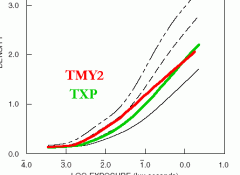
Here is an example, using Kodak's curve's. A normal TMY curve is laid over the normal TXP curve. The linear TMY curve renders each tonal step proportionate to its brightness. The TXP curves shows that shadows are sub-proportionately drawn.
(The effect is magnified by Rodinal, which tends to give up a little shadow detail while building strong midtones and the potential for brilliant highlights.)
 

Attachments

  • TXP-v-TMY2.gif
    TXP-v-TMY2.gif
    4.4 KB · Views: 135
Photrio.com contains affiliate links to products. We may receive a commission for purchases made through these links.
To read our full affiliate disclosure statement please click Here.

PHOTRIO PARTNERS EQUALLY FUNDING OUR COMMUNITY:


Ilford ADOX Freestyle Photographic Stearman Press Weldon Color Lab Blue Moon Camera & Machine
Top Bottom