• Welcome to Photrio!
    Registration is fast and free. Join today to unlock search, see fewer ads, and access all forum features.
    Click here to sign up

New to Gum Dichromate

Recent Classifieds

Forum statistics

Threads
202,891
Messages
2,847,108
Members
101,531
Latest member
F2_User
Recent bookmarks
0

5artist5

Member
Allowing Ads
Joined
Jan 18, 2023
Messages
38
Location
Ventura
Format
35mm
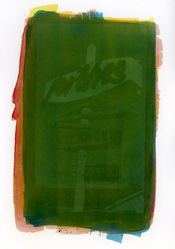
Hi all. I am new to Gum Dichromate printing. I just did my first pass of with one exposure of each of cyan, magenta, and yellow onto my first test sheets.


The paper is Canson Water Color Paper

The size I used is gelatin mixed at 250ml of warm distilled water to 6.5g gelatin powder. Note that no hardener was used in this first round. I have some Glyoxal on order to use with the next batch I try.

The pigment mixture I used is water color paint mixed at 5ml. Gum Arabic 10ml. Distilled water, 1" watercolor paint from tube

The dichromate mix I used was mixed at 21.5 gr ammonium dichromate to 100ml warm distilled water.

I used equal parts pigment mix to dichromate mix. 15 ml of each.

I did use a blow dryer to dry the emulsion before exposing.

I exposed each one a different amount of time between 4 min and 8 min. Didn't see much difference in that really.

Anyway. See aattachedpic of the best one from the batch. Does it seem like I'm on the right track, despite the lack of gelatin hardner and the hot air for drying the emulsion?
 

Attachments

  • 2023-03-09_Gum_Print_001-.jpg
    2023-03-09_Gum_Print_001-.jpg
    167.8 KB · Views: 152
Welcome to Photrio!

I am not a gummist (hopefully those who are will chime in) so I won't answer to your specific query - but curious how you got a single green color from doing 3 C,M, and Y layers which you can see on the outside. Did you use the same negative for all 3 layers?

:Niranjan.
 
No, I took the original color image and inverted it to negative, then separated into r,g, and b files.
Then printed them as grayscale.
Then used tho opposite color pigment for each one.

I will post the original for reference.
 
This is the original
 

Attachments

  • RNFetchBlobTmp_1401pg0p3o2kybgz5ejwyp.png
    RNFetchBlobTmp_1401pg0p3o2kybgz5ejwyp.png
    751.9 KB · Views: 103
This is the original
But then you should get some color variation on the print. Particularly since your original has many primary colors like the neon sign (perfect picture for learning this process.) How do the individual layers look, if you took pictures. I am just wondering why none of the colors came out.

:Niranjan.
 
It looks like to me that that paper needs to be sized. You'll have to wait for hardener to arrive... or you can put a wee bit of dichromate in the the gelatin, dry it, then expose to UV source. Then go ahead and coat with pigmented gum. I prefer to use a paper like Hahnemuhle platinum rag, as it doesn't require additional sizing.
 
The great news is that I just got notified that the Glyoxal hardener was delivered.
So I will size a new set of paper when I get home.
I might print a new set of color separations also. On this set, I adjusted the levels to darken each negative. The thinking was that it should help resist the uv in the hilight areas and create more contrast. But now I wonder if I was too unscientific about doing that? Mayne I should try to darken each one by the same amount? Or do it before doing the seperation?
 
I have done gum printing before and my recommendation is that you refine your technique with a single color. Learn the process thoroughly and when you can get repeatable results with different pigments and different images, then you can attempt to do a three color gum print.
Have you gone to Youtube? There are many good videos of the process that you can pickup some tips.
Do you have a good scale the can measure in at least tenths of a gram? You need to measure your pigment, how much is an inch of watercolor pigment?
Keep good notes and once you get the hang of the process you can then wing it if you want.
A great book on the process is "Gum Printing" by Christina Z Anderson.
 
Thank you for the suggestions. I do have a gram scale that will measure 10ths. That's a great idea to weigh the pigments rather than eyeball it!
 
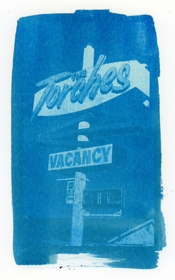
Here is a latest atempt in cyan. I did 5 of them. I'll keep one as a 1 color. Tomorrow I'll add a magenta layer to 4 of these and also do one as just magenta.

I am going with 1gram of pigment to 8ml of gum in this batch.

I'm pretty happy so far with the improvement.
 

Attachments

  • 2023-03-09_Gum_Print_001598.jpg
    2023-03-09_Gum_Print_001598.jpg
    651.9 KB · Views: 128
Here is a latest atempt in cyan. I did 5 of them. I'll keep one as a 1 color. Tomorrow I'll add a magenta layer to 4 of these and also do one as just magenta.

I am going with 1gram of pigment to 8ml of gum in this batch.

I'm pretty happy so far with the improvement.

Would be interesting how the next layers come out. From the colors of your original, I would have expected very clean, white in the background of the "VACANCY" sign as it is pure yellow and also the pole and the background of the "Torches" as they are all white in the picture. Either there is staining or the negative is not dense enough or the development is not long enough. or too much pigment., or....(ask Andrew.)

:Niranjan.
 
Hmm, development not long enough eh? I was thinking maybe the development was too long? The idea being that the uv was getting through the dark parts of the negative that should be being blocked?
 
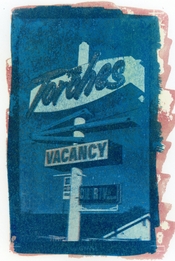
Here is with the magenta layer.
It acted a lot different than the blue layer during the rinsing. I'm doing the yellow layer now.
 

Attachments

  • 2023-03-09_Gum_Print_001599.jpg
    2023-03-09_Gum_Print_001599.jpg
    1.3 MB · Views: 103
I think I will try to do the magenta layer again once the yellow layer is dry.
 
This is just the magenta layer
 

Attachments

  • 20230312_185825.jpg
    20230312_185825.jpg
    406.4 KB · Views: 93
Hmm, development not long enough eh? I was thinking maybe the development was too long? The idea being that the uv was getting through the dark parts of the negative that should be being blocked?

My feeling is that you (@5artist5) and Niranjan (@nmp) are using the word "development" to refer to different processes. To me (and I think Niranjan) "development" in this context refers to the washing of the gum layer with water after exposure to UV light.
 
Ah, that makes sense. Longer wash is probably a good idea. What I'm seeing on the magenta and now on the yellow coats is that almost all of it is peeling off in rubbery flakes. And I wonder if I am being too aggressive with my washing.
 
Here is with the magenta layer.

Looks like the ratio between your cyan and your magenta is pretty far off. I.e. your cyan has too much pigment in it compared to your magenta. Consider adding another magenta layer on top, or adjusting the pigment ratios in the next print. Doing color without any decent means of calibration and linearization will be a haphazard endeavor. You'll get colors alright, but they'll be...very creative.

What I'm seeing on the magenta and now on the yellow coats is that almost all of it is peeling off in rubbery flakes.

That's a problem I ran into on the few times I tried gum as well. I think part of it is due to too high pigment loads, but it can also be due to too low a gum concentration, both making the emulsion kind of brittle. But see what Andrew has to say about it.

Have you considered getting Calvin Grier's book on Gum Printing? I have a feeling it'll save you a lot of trouble giving it a read. https://thewetprint.com/gum/
I'm more of a carbon printer myself, and generally not too quick to buy any books, but found this particular one to be very useful indeed. It specifically addresses issues like flaking.
 
Looks like the magenta behaves better on the bare paper - flaking wise. Cyan too. Have you used the hardener for this new prints or are they still on the plain gelatin. I wonder if an interlayer of hardened gelatin would help keeping the next layer anchored and not flake away.

:Niranjan.
 
these are with the hardener. I was wondering about an inter layer.
But the yellow peeled off also when it was by itself on the paper with just the hardened size.
I wonder if the mixture was bad for some reason? Like maybe the dichromate mix went stale? Is that a thing? I mixed the dichromate mix a few days ago.
 
Like maybe the dichromate mix went stale? Is that a thing?

Nope.

Your problem is either in the rheology of the emulsion itself, or the surface energy of the surface you're applying it to (i.e. adhesion). The amount and method of sizing strongly influences the latter, the ingredients and ratios in the emulsion influence the former.

How much gum is there actually in your gum solution? It should be around 30-35%. I've seen reports of unstable emulsions with gum solutions below 30% actual gum content.
 
I wonder if the mixture was bad for some reason? Like maybe the dichromate mix went stale?

Your problems (with flaking) do not appear proportional to exposure. I don't think your sizing gives the grip needed for the emulsion to stick.

A too thick gum layer would also flake, but mostly in the highligts. You have flaking all over.

Edit: It's interesting that your cyan layer doesn't flake. But the magenta layer flakes both on sized paper and on top of the cyan layer. Are you doing something differently with the C and M layers?
 
Last edited:
From the first post, looks like he is using water in the pigment mix (5ml. Gum Arabic 10ml. Distilled water, 1" watercolor paint from tube.) Most what I have seen use straight mixture of 5 ml pigment tube with 45 ml gum solution. Bob Carnie (check out his videos on youtube, by the way, if not done so), I think uses even more gum at the time of mixing dichromate. 30% by volume minimum requirement probably comes from the critical amount necessary to form a continuous matrix with embedded pigment particles, giving the film physical integrity.

:Niranjan.
 
That's right Niranjan, and good catch on spotting the water problem in the OP. I can confirm from my own experience that an emulsion with 20% gum content or thereabouts will not print well; it'll flake like mad. Given the recipe in the OP, the gum content is likely far below the critical limit where the process will work.
 
That's right Niranjan, and good catch on spotting the water problem in the OP. I can confirm from my own experience that an emulsion with 20% gum content or thereabouts will not print well; it'll flake like mad. Given the recipe in the OP, the gum content is likely far below the critical limit where the process will work.
Might be too soon to judge...looks like recipe got changed on the latest series...🙂
Now we wait for OP's clarification.

:Niranjan.
 
Photrio.com contains affiliate links to products. We may receive a commission for purchases made through these links.
To read our full affiliate disclosure statement please click Here.

PHOTRIO PARTNERS EQUALLY FUNDING OUR COMMUNITY:


Ilford ADOX Freestyle Photographic Stearman Press Weldon Color Lab Blue Moon Camera & Machine
Top Bottom