• Welcome to Photrio!
    Registration is fast and free. Join today to unlock search, see fewer ads, and access all forum features.
    Click here to sign up

neutral paper tone

Forum statistics

Threads
203,265
Messages
2,852,090
Members
101,752
Latest member
Frederic CHICHE
Recent bookmarks
0

lmmccubbin

Member
Allowing Ads
Joined
Jun 30, 2008
Messages
9
Location
Connecticut
Format
Medium Format
I've noticed that my prints seem very brown.

e.g.:

Anders.jpeg

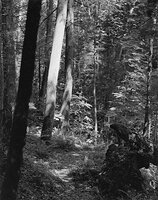
So I dug up an old lab print and tried to make a matching print myself.

home print

home.jpg

lab print

lab.jpeg

My scanning skills (and cleaning skills apparently as well) are nonexistent. So, while the lab print particularly seems to stray from the print on my monitor, it does underscore the difference.

Are these normal/neutral tones for Ilford Multigrade IV RC pearl in Ilford MG developer? What can I do to get some deep blacks, spanking whites and silvery grays in between?

Thanks for your help.
 
Last edited by a moderator:
well, basically you want to knock off the warm tone that you're getting. Try toning in rapid selenium, this should knock off the warm tone and give you richer blacks.

Anyway, that's the easiest way to fix it, you should also experiment with different papers and developers. How new is your paper? could also be old paper stock or a bad batch. I use the same paper and developer combination fairly regularly and don't remember it having a noticeable warm tone, the pic you posted looks more like MG IV warm tone than the standard MGIV.
 
Well, I've done my best to calibrate my monitor, but you can never be too sure about color rendition. Anyway, your lab print looks cold tone to me, in other words, it is bluish. As Tim said, selenium toning can remove the warmth from prints, depending on dilution, paper and the time in the toning bath. Another factor is the developer itself. Freshly mixed developer will give neutral results (at least Ilford's MG developer), while used developer (that has been kept bottled for another day) gives slightly warmer results. I don't know if any oxidation makes things different, but the bromide released during development (and it's concentration gets higher) can make a difference. Warmtone developers usually have higher levels of Potassium Bromide per litre. Developer's dilution can also be significant and combined with insufficient development it can give warmer results. Try developing more, like 90'' instead of 60'', it might give you cooler prints.
 
Have you tried Ilford Cooltone RC

It is slightly cool/cold in appearance, the base white colour is the same as MGIV but the greys and blacks are cooler

Its one of my favorite papers

Martin
 
I second Martin's recommendation. CT looks much cooler than MG whereas WT is only very marginally warmer than MG, IMHO. I think it has limited uses in terms of what kind of scenes it suits compared to MG but that's simply an opinion

pentaxuser
 
Thanks for the replies.

Let's see. The paper is fresh AFAIK (purchased recently from B&H) as is the Ilford MG developer. Ordinarily, I use replenished LPD happily, but for the brown color, so I thought I would try a fresh neutral developer in the form of Ilford MG, just to see what a neutral tone would look like. I was surprised to see the same brown, expecting something not as warm. I've been exact about development temperatures, and I've tried developing for 90" and 2'.

The lab print, particularly in natural light, does look at bit blue. I'm not aiming for its look specifically, but I would like to have more of a black, white and shades of gray feeling rather than brown.

While I'm happy to try toning, other papers or developers (is Dektol worth a shot?), I think what concerns me the most is whether this is simply what neutral tone looks like or my husband is sabotaging my prints, "inadvertently" spilling beer into the developer.

Thanks again.
 
Most papers are pretty neutral these days, but some of the eastern Europeans brands tend to be warm. The first step to correct your situartion would be to try a cold tone developer like D-72 (or Dektol, or even better Liquidol) with your current paper. If that doesn't work, try a cold tone paper Multigrade comes to mind, but there are plenty of others) with a neutral or cold tone developer. I've found that with most modern papers (some eastern European types excepted) the developer has only a modest effect on image tone, but it may have enough.
 
the lab print is cool tone and it looks like they've tried to emulate a slight selenium tone. So it might be the comparison that makes the neutral print look warm. I don't know if matters but I usually do 60 sec in developer with RC (not 1.5-2mins)

Anyway, personally I much prefer cool tone prints so I generally go to great lengths (ie. tone everything I print in selenium) to get rid of any tiny bit of warmth... I can't really say if this is what neutral prints look like, your example certainly looks like warmtone to me though it could be my computer screen. It is not uncommon however, for neutral tone papers to have a little bit of warmth in them... so like I said tone in selenium to remove the plague... and print on fibre... :wink:
 
Daft question.....

Is the lab print on mono paper...or a black and white print on colour paper ?

If so you get all kinds of 'casts' quite often cyan or 'blue'

Simon ILFORD Photo / HARMAN technology Limited :
 
Good point. The lab print is on "Fujicolor Crystal Archive Paper".

I think I have a few things to play around with (and, yes, fiber, when I'm a bit more in command). Thanks for the input.
 
I think this explains it, a 'monochrome' print on colour paper...or in other words not a black and white print.

Simon ILFORD Photo / HARMAN tcehnology LImited :
 
I think you are using warmtone paper. If you go with Ilford's regular MGIV RC, you should be fine. It is quite neutral to slightly cold.

I have not used the RC in sometime, but I do use MGIV fibre base. It has a very slight green cast which I never noticed until I had two prints from the same negative, side by side, one toned, the other untoned. You can get rid of this with modest selenium toning. MGIV does not respond all that well to selenium toning but the selenium does remove the green cast. I can't remember if MGIV RC has that green.

On the other hand, MGIV warmtone really responds nicely to selenium, although I never did it with RC.
 
Try Ilford MG fiber base developed in Zone VI (available at Calumet) or Dektol which is probably similar. Neutral with rich blacks and clean highlights. Selenium tone until you see a very slight shift in the midtones. My APUG portfolio is Jeffrey Glasser.
 
Simon is right. It is very hard to balance a color printer to give a good black and white print. Most turn out brownish, some purplish. To get a good black and white print you need to use black and white paper. Some custom labs still do that, but at a price. Doing it yourself is the usual solution. A less satisfactory solution is to scan the negative and print it with a really good inkjet printer - one set up to do black and white. That will give a cold tone print of adequate quality for most uses.
 
I highly recommend you pick up a bottle of KRST (Kodak Rapid Selenium Toner) and mix two seperate 1L containers of 1+10 and 1+20 dilution. Either will take off the olive warmth edge without an issue - with the additional bonus of deeper blacks and increased print "depth." The dilution allows you to work with different papers and toning times independently.

Very easy toner to work with - just make sure your prints are adequately fixed. You do NOT need a full wash - just a short rinse. Selenium will only stain prints that haven't been fixed completely.
 
full wash is necessary after selenium toning, all of the product literature I've read recommends this as does Tim Rudmans book on toning (the bible) especially for fibre based prints. It also recommends the use of hypo clear for FB paper to clear selenium toner and reduce washing time.
 
I would suggest two things in addition to the selenium toning mentioned above. First, extend your development time to 3:00 to allow the larger, colder tone grains to develop fully (I think I have the physics right here....shorter development time allows the silver grains to develop less, producing warmer tones) You will probably have to retest your exposure time to compensate for longer development. Second, add some benzotriazole to your developer to cool it down a bit.
 
full wash is necessary after selenium toning, all of the product literature I've read recommends this as does Tim Rudmans book on toning (the bible) especially for fibre based prints. It also recommends the use of hypo clear for FB paper to clear selenium toner and reduce washing time.

Definitely a full wash is required after Selenium toning - same wash time as without toning. However, my point was in reference to before toning. Sorry about the ambiguity.

Some people do a full on wash before Se toning and it's a complete waste of water. Se toner does not care about fixer in the print, it cares about silver complexes that haven't been completely fixed out.
 
Photrio.com contains affiliate links to products. We may receive a commission for purchases made through these links.
To read our full affiliate disclosure statement please click Here.

PHOTRIO PARTNERS EQUALLY FUNDING OUR COMMUNITY:


Ilford ADOX Freestyle Photographic Stearman Press Weldon Color Lab Blue Moon Camera & Machine
Top Bottom