• Welcome to Photrio!
    Registration is fast and free. Join today to unlock search, see fewer ads, and access all forum features.
    Click here to sign up

Neg / Pos digital neg real film

Local Artists Work

D
Local Artists Work

  • 0
  • 0
  • 2
Horicon Marsh-2

A
Horicon Marsh-2

  • 0
  • 0
  • 29

Recent Classifieds

Forum statistics

Threads
201,131
Messages
2,819,573
Members
100,549
Latest member
CarlZeissBiotar
Recent bookmarks
1

Bob Carnie

Subscriber
Allowing Ads
Joined
Apr 18, 2004
Messages
7,735
Location
toronto
Format
Med. Format RF
Hi Folks

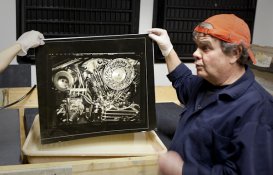
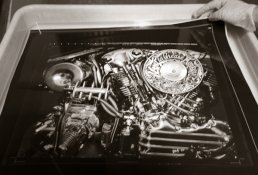
What you see here is Black and White film that has been exposed in my Lambda and processed in HC110. This film was imaged today .
As well you see the matted print Image and matted calibration. These are Lambda fibers done in 2003 on Agfa Classic , now I use the Harmon Paper.
The ugly guy you see beside me is Keith Corby who 8 years ago worked with me on the Lambda fibres, and today works with me at Elevator. I am the good looking guy with the Canada toque.
I believe the Negative and Positive will be useful for photographers doing alt process. I think the main advantage of this method of producing negs is that the film is real silver exposed by light using RGB laser technology.
Which has archival propertys, as well I thing making 40x50 film will be as easy as 30x40 as easy as 20x24 as easy as 16x20 which you see in the jpegs.

We are working on being able to do carbons, platinum, gumover platinum, and tri colour gum. I have to thank Kerik, Ike, and Sandy King who's workshops I attended and began to figure out how to make my own film using equipment I already have , bought and paid for.
I would be interested in talking to anyone doing photo gravure as to the possibility of this film working..
Protection masks for multiple hit can and will be done using Fuji Clear or inkjet *which is much cheaper than this silver film*

Bob
 

pellicle

Member
Allowing Ads
Joined
May 25, 2006
Messages
1,175
Location
Finland
Format
4x5 Format
Bob

congratulations on a great outcome. I wish I could go and see the results myself but the trip from Oz would be expensive. If I make it to Canada in the next year or so I'd love to lob in and look.

great stuff
 
OP
OP
Bob Carnie

Bob Carnie

Subscriber
Allowing Ads
Joined
Apr 18, 2004
Messages
7,735
Location
toronto
Format
Med. Format RF
You are most welcome anytime to drop in and hang out, thanks, lots of work still to do but I am really happy on quite a few levels.
Bob

congratulations on a great outcome. I wish I could go and see the results myself but the trip from Oz would be expensive. If I make it to Canada in the next year or so I'd love to lob in and look.

great stuff
 

Davec101

Member
Allowing Ads
Joined
Jul 29, 2005
Messages
1,216
Location
Cambridge, U
Format
Large Format
Hi Folks

What you see here is Black and White film that has been exposed in my Lambda and processed in HC110. This film was imaged today .
As well you see the matted print Image and matted calibration. These are Lambda fibers done in 2003 on Agfa Classic , now I use the Harmon Paper.
The ugly guy you see beside me is Keith Corby who 8 years ago worked with me on the Lambda fibres, and today works with me at Elevator. I am the good looking guy with the Canada toque.
I believe the Negative and Positive will be useful for photographers doing alt process. I think the main advantage of this method of producing negs is that the film is real silver exposed by light using RGB laser technology.
Which has archival propertys, as well I thing making 40x50 film will be as easy as 30x40 as easy as 20x24 as easy as 16x20 which you see in the jpegs.

We are working on being able to do carbons, platinum, gumover platinum, and tri colour gum. I have to thank Kerik, Ike, and Sandy King who's workshops I attended and began to figure out how to make my own film using equipment I already have , bought and paid for.
I would be interested in talking to anyone doing photo gravure as to the possibility of this film working..
Protection masks for multiple hit can and will be done using Fuji Clear or inkjet *which is much cheaper than this silver film*

Bob

Congrats Bob, look forward to seeing the print results.
 
OP
OP
Bob Carnie

Bob Carnie

Subscriber
Allowing Ads
Joined
Apr 18, 2004
Messages
7,735
Location
toronto
Format
Med. Format RF
Thanks, going to make a lith silver print shortly will post results,
Testing stage for carbon, platinum and gum, lots of work in this area.
Congrats Bob, look forward to seeing the print results.
 
OP
OP
Bob Carnie

Bob Carnie

Subscriber
Allowing Ads
Joined
Apr 18, 2004
Messages
7,735
Location
toronto
Format
Med. Format RF
As promised here is a Lith Print off a 16x20 negative. Simple glass over neg and paper with an enlarger exposure for main and a flash off a second enlarger.

works really well with Ilford Warmtone and Fomatone.

the person taking the picture's must have had a ugly filter on as I have been mistaken on many occasions for Brad Pitt.

I have seen some platinum prints off our negs, compared to inkjet negatives, basically our film was too contrasty , but this all looks very managable and promising for future adjustments.

I also have seen positives on this and they are nothing short of wicked, just wondering what to do with the Pos. Probably some applications for gravure printers or maybe silkscreen artists.

Now is time to print all the films with different artist that belong to The Toronto Farm Project.
after the first round of testing we will make film adjustments and start with the multiple printing stage... one little step at a time but we are moving forward


Thanks, going to make a lith silver print shortly will post results,
Testing stage for carbon, platinum and gum, lots of work in this area.
 

Attachments

  • firstlith.jpg
    firstlith.jpg
    121.6 KB · Views: 149
  • firstlith2.jpg
    firstlith2.jpg
    146.3 KB · Views: 172
OP
OP
Bob Carnie

Bob Carnie

Subscriber
Allowing Ads
Joined
Apr 18, 2004
Messages
7,735
Location
toronto
Format
Med. Format RF
I should add the above image is from digital capture Cannon Mark 3, Photshop curves, sharpening ,dodge and burn as normal for printing on fiber paper. Film is calibrated with 21 step wedge on Lambda, film is rollie iso 25 ortho, Hand developed in trays with HC110.
Lith Print is in Moresh lith chems, very strong dilution contact exposure and flash, 6 min development , then tone in selinum.

This is the test print for my client , who is going with a full on show in Toronto May Contact Photo Festival.
 

PVia

Member
Allowing Ads
Joined
Oct 3, 2006
Messages
1,057
Location
Pasadena, CA
Format
Multi Format
Looks great, Bob!

The positives could also be used for gumoils...!
 

Dinesh

Subscriber
Allowing Ads
Joined
Jun 3, 2005
Messages
1,714
Format
Multi Format
As promised here is a Lith Print off a 16x20 negative. Simple glass over neg and paper with an enlarger exposure for main and a flash off a second enlarger.

works really well with Ilford Warmtone and Fomatone.

the person taking the picture's must have had a ugly filter on as I have been mistaken on many occasions for Brad Pitt.

I have seen some platinum prints off our negs, compared to inkjet negatives, basically our film was too contrasty , but this all looks very managable and promising for future adjustments.

I also have seen positives on this and they are nothing short of wicked, just wondering what to do with the Pos. Probably some applications for gravure printers or maybe silkscreen artists.

Now is time to print all the films with different artist that belong to The Toronto Farm Project.
after the first round of testing we will make film adjustments and start with the multiple printing stage... one little step at a time but we are moving forward

You may want to back off the "ugly filter" a bit.
 

jd callow

Moderator
Subscriber
Allowing Ads
Joined
Jan 31, 2003
Messages
8,466
Location
Milan
Format
Multi Format
just like people think I'm Johnny Depp
 
OP
OP
Bob Carnie

Bob Carnie

Subscriber
Allowing Ads
Joined
Apr 18, 2004
Messages
7,735
Location
toronto
Format
Med. Format RF
bump

I have had some basic feedback from a few sources on this film, basically I am very happy considering the beta stage we are at. We have seen platinum, carbons, lith prints, silver prints and though nothing is perfect I am pretty happy with our progress.

The Lith Prints from digital capture were nothing short of mind blowing for me and it started me to consider some of the ramifications of printing silver from digital capture.

Here are some basic thoughts, there is a whole world of young artists who will probably never shoot film, for various reasons, but whose only recourse in printing is inkjet or RA 4... Now before people start jumping down my throat, remember I do print inkjet, I do print RA4, but I also print in other medias. The longevity scale of inkjet and RA4 is hopelessly muddled and very dicey IMHO. If you disagree then so be it but I believe that either materials only have a shelf life of around 15 to 30 years .. Time will tell but I am not willing to bank my career on what Epson or Cannon say about their product.
The only thing that will change this is us, the alternative historical printers producing shows and actually blowing peoples minds with the quality.

From my testing a file is converted from a Mark 3 to a black white negative, then laid in contact on silver rich paper which has a historical pedigree.
What was totally amazing to me was since good digital capture is very clean, or free of grain, the slight crunch of PS sharpening has given me a very lovely tonal range and contrast, as well as a classical look of a very good enlarger print from a low ISO film.

I do not print AZO or LODIMA , so I would like to jointly test with someone who 1. uses this contact paper 2. has an open mind with a willingness to test 3. Has the use of a high end digital capture device 4. Uses PS frequently and is comfortable learning channel blending,separating, and sharpening methods that I would help with 5. Would then like to multiple hit these prints 6. Also test a silver rich bromide paper at the same time for honest comparisons.

So if you are this person with Lodima background send me a email bob@elevatordigital.ca and we can discuss.

Since M&P have invested their whole life into this product , (which I respect beyond belief) wouldn't it be cool to find out that with a simple contact set up , young artists could produce archival, traditional contact prints and become a market for Lodima and of course the major manufactures of paper , without the pain of building a darkroom to enlarger specifications.

Once an artist has a setup for contact printing the possibility's are endless. Silver, Gum, Platinum, Carbon, Tri - Colour Carbon and Gum without the worry of the capture device.

I imagine within one year I will be set up to produce film at a reasonable rate, and I am sure vendors will follow suit once the market shows itself.
 

Loris Medici

Member
Allowing Ads
Joined
Sep 13, 2005
Messages
1,154
Location
Istanbul, Tu
Format
Multi Format
...The longevity scale of inkjet and RA4 is hopelessly muddled and very dicey IMHO. If you disagree then so be it but I believe that either materials only have a shelf life of around 15 to 30 years .. Time will tell but I am not willing to bank my career on what Epson or Cannon say about their product...

See Dead Link Removed, for instance. EDIT: Not to start a flame war BTW. I see silver prints (toned or untoned) no better than current generation of inkjet prints (made on pure cotton - fine art paper), in terms of longevity...

Kudos for the lambda negative stuff you're doing, BTW...
 
OP
OP
Bob Carnie

Bob Carnie

Subscriber
Allowing Ads
Joined
Apr 18, 2004
Messages
7,735
Location
toronto
Format
Med. Format RF
I have seen this as well over the last few years lots of opinion changing for my liking, I also have seen inkjets and ra4 fade very fast in display.
Silver prints *fiber* base I have not seen fade.
as I said its only my personal opinion for what that is worth.
But for my money I am moving to carbon and multiple gum for colour.
and keeping with silver, platinum and carbon for black white.

Somehow I feel more warm and fuzzy with the historical processes that have shown well over 100 year stability, rather than projections.


See Dead Link Removed, for instance. EDIT: Not to start a flame war BTW. I see silver prints (toned or untoned) no better than current generation of inkjet prints (made on pure cotton - fine art paper), in terms of longevity...

Kudos for the lambda negative stuff you're doing, BTW...
 

Loris Medici

Member
Allowing Ads
Joined
Sep 13, 2005
Messages
1,154
Location
Istanbul, Tu
Format
Multi Format
These inks/pigments are tested exactly the same way watercolor / acrylic / oil pigments are tested. Since we use the same paper (fine-art inkjet paper ~= watercolor paper), I don't see why they should prove to be weaker than, say, watercolor paintings. There are (maybe) thousands watercolor paintings in museums / private collections, kept well for hundreds of years, no?

I agree with the warm feeling the historical processes give to both the photographer and the collector.
 
OP
OP
Bob Carnie

Bob Carnie

Subscriber
Allowing Ads
Joined
Apr 18, 2004
Messages
7,735
Location
toronto
Format
Med. Format RF
Loris
The problem from my perspective and there are those who may want to correct me is the size of the pigments that are allowed to get through the nossels of the inkjet printer. Historically , last 10 years this has been the dye vs pigment printer argument/debate, pigment printers have improved and I do not argue that.
When you crush your pigments for alt process, lets say gum, you are using full on pure pigment, the pigment that is going through any Cannon, Epson, HP is crushed much smaller and mixed with dye to get through the nossels.
This in my opinion is the achilles heel of inkjet.
Years ago for example chromalins were the game in town for proofing out images before going to press.
this was a physical 3 colour layer with some type of exposure that layered one colour on top of each other to create the image.
If the five majors decided to go down this route and used R&D with this thinking I believe they would have figured out how to lay down pure pigment. I believe Charles Berrger had it right with the UltraStable process and if today he was current a lot more workers who now own hi end scanners and output devices would have jumped on board and helped him.
Unfortunately when I was introduced to Ultra Stable I did not own a scanner or output device of enough quality , and Photo Shop was only a pipe dream. Being a control freak that I am I did not value what he was offering and people like Todd Gangler did and now is considered a premium world colour printer.
In fact Loris , I believe this will be the future for permanent imaging from the major vendors who want to put it on a world platform. Maybe they will solve the nossel issue but I do not think so at our current state in history. but there is a whole world of believers who say its good enough and permanent. I just happen to be one that dosen't believe the hype.
We all know of photographers selling RA4 colour prints for monster prices, what is not being said that a lot of these are being returned to seller for fading issues.
This will become much more prevalent over the next few years, and is why my company always informs our photographers purchasing prints from us our views of permanence which does vary from other groups.

I started my career listening to Kodak telling us to Preserve the memories with good colour negative film and paper, and Ilford giving 200 year permmanence for Cibachrome.

I have seen the damage now to some pretty well known photographers reputation who bought the Manufacturers marketing propoganda and now are scrambling to figure out where all there images have gone.Some bought the koolaid and honestly were caught off gaurd, others just made tons of money and ran and are no longer in photography.
I really hope they (Manufactures) do figure it out, but for now at my advanced state of crazyness , I will continue on the hybrid to historical route I have taken.

I decided in 1973 that this was my life's work and now closing on to 2013 still am convinced the alt processes are the way to go.


These inks/pigments are tested exactly the same way watercolor / acrylic / oil pigments are tested. Since we use the same paper (fine-art inkjet paper ~= watercolor paper), I don't see why they should prove to be weaker than, say, watercolor paintings. There are (maybe) thousands watercolor paintings in museums / private collections, kept well for hundreds of years, no?

I agree with the warm feeling the historical processes give to both the photographer and the collector.
 

Tim Gray

Member
Allowing Ads
Joined
Sep 2, 2006
Messages
1,882
Location
OH
Format
35mm
I hope this is going to grow into an affordable service for us :smile:

What is the end goal here? To produce alt prints in house? I for one would be interested in sending digital files, having the right curve applied to them for alt print, and get a box full of film back that I could contact print at home.
 
OP
OP
Bob Carnie

Bob Carnie

Subscriber
Allowing Ads
Joined
Apr 18, 2004
Messages
7,735
Location
toronto
Format
Med. Format RF
Tim

If I can get a reliable source for the film, and balance it properly on a processor, I will be able to provide guidelines and film at a very reasonable price, much like our press and go service.
For the next 6 months I am tray processing and really beta testing and trying to figure it all out and not offering it as a service. I am in communication with various workers, in fact I started the Toronto Farm Project and its members are testing as well as some workers who I really trust their viewpoints. Sandy King would be one who has made a print for me but I will leave it up to him to comment.
I would imagine at some time I would invite photographers to Toronto to go through the workflow with us and get a really good handle on how to do it.
For now I have enough clients who will have me as a matter of course do all the work.
I have stated and will state again, the real advantage of this process is that it is a real film negative. As such I have seen silver print output from digital capture and it does offer a real opportunity for contact printers. I do not think it is any sharper or better than what is out in the marketplace right now, just different.
I will eventually provide profiles that work in my darkroom for the different processes I work on ,but to get it dead nuts easy and affordable will take me a bit more time to make it work in others darkroom with great accuracy.
This whole idea was started a couple of years back watching Kerik, Ike and Sandy easily make inkjet negs and prompted me to consider negs using gear I have.
I am a pretty slow worker and am in no hurry to turn this into a service for financial goals, but at some time if everything works out I will make sure it is affordable.

Bob
I hope this is going to grow into an affordable service for us :smile:

What is the end goal here? To produce alt prints in house? I for one would be interested in sending digital files, having the right curve applied to them for alt print, and get a box full of film back that I could contact print at home.
 

R Shaffer

Member
Allowing Ads
Joined
May 9, 2007
Messages
436
Location
Santa Cruz,
Format
Multi Format
I hope this is going to grow into an affordable service for us :smile:

What is the end goal here? To produce alt prints in house? I for one would be interested in sending digital files, having the right curve applied to them for alt print, and get a box full of film back that I could contact print at home.

I'm with Tim. I too would be interested if this were a service you offered.

My inkjet digi negs are working fine for my gums & kallitypes. But when I learned carbon last year, I found that my initial tries at diginegs were not quite up to the resolution of carbon. I still need to put more effort into carbon, if I only had more time.
 
OP
OP
Bob Carnie

Bob Carnie

Subscriber
Allowing Ads
Joined
Apr 18, 2004
Messages
7,735
Location
toronto
Format
Med. Format RF
I have seen Sandy Kings Carbons live and in person from digital inkjet negs and they are wonderful, so I do know you can get there with the inkjet negs.
I'm with Tim. I too would be interested if this were a service you offered.

My inkjet digi negs are working fine for my gums & kallitypes. But when I learned carbon last year, I found that my initial tries at diginegs were not quite up to the resolution of carbon. I still need to put more effort into carbon, if I only had more time.
 

donbga

Member
Allowing Ads
Joined
Nov 7, 2003
Messages
3,053
Format
Large Format Pan
Ok you got me gumoils?? thats a new one on me how are they Made?
Bob,

You really don't want to know. :smile:

They are a gum bichromate variant invented by Karl Koneig <sp?> who occasionally does workshops at the Formulary. A positive image is used instead of negative. Oil paint is used instead of watercolor.

It's sort of a resist on paper.

Don
 
Last edited by a moderator:

Loris Medici

Member
Allowing Ads
Joined
Sep 13, 2005
Messages
1,154
Location
Istanbul, Tu
Format
Multi Format
Loris
The problem from my perspective and there are those who may want to correct me is the size of the pigments that are allowed to get through the nossels of the inkjet printer. Historically , last 10 years this has been the dye vs pigment printer argument/debate, pigment printers have improved and I do not argue that.
When you crush your pigments for alt process, lets say gum, you are using full on pure pigment, the pigment that is going through any Cannon, Epson, HP is crushed much smaller and mixed with dye to get through the nossels.
This in my opinion is the achilles heel of inkjet.

Indeed, you're most probably right; the pigments are probably crushed to a smaller size. OTOH, this is a problem only for pigments that are vulnerable to atmospheric pollutants, because smaller particle sizes will increase the surface area of the pigment. If the pigments in question are resistant to atmospheric pollutants such as ozone, sulphur dioxide and others, this would be a moot point. I really don't think there's a correlation between particle size and fading due to the effect of (mostly UV) light...

...
I really hope they (Manufactures) do figure it out, but for now at my advanced state of crazyness , I will continue on the hybrid to historical route I have taken.

I decided in 1973 that this was my life's work and now closing on to 2013 still am convinced the alt processes are the way to go.

Good for you and your current/future clients. I'm in the same park; hybrid is the way to go. OTOH, I'm not that much reserved about the current generation of inkjet materials...

Regards,
Loris.
 

David Hatton

Member
Allowing Ads
Joined
Jun 21, 2006
Messages
78
Format
35mm
Hi Loris,
You do know don't you that these tests aren't independant but are paid for by the manufacturer..:smile:
David
 
Photrio.com contains affiliate links to products. We may receive a commission for purchases made through these links.
To read our full affiliate disclosure statement please click Here.

PHOTRIO PARTNERS EQUALLY FUNDING OUR COMMUNITY:


Ilford ADOX Freestyle Photographic Stearman Press Weldon Color Lab Blue Moon Camera & Machine
Top Bottom