
I have used for years T-Max 400 film from 35 mm to 8x10. I use T-Max RS Developer and pour the small bottle into the larger one. I also use the JOBO CPP2 processor. As for a general dilution I use 75ml of dev. to make 1000 ml of working solution and a 5 minute Dev. time. at 70 degrees. I also give all negative one minute Pre-Soak but I have been told it should be longer. Most of my smaller negatives come out perfect. But in a few large format negative I get this vertical mottling or streaking in the clear areas of the sky. Some areas where I took these photos from I can't go back there. I want to prevent this happening in the future. Would it be T-Max RS or is there a MUCH better developer for T-Max films? Any help would be very much appreciated.
-
Welcome to Photrio!Registration is fast and free. Join today to unlock search, see fewer ads, and access all forum features.Click here to sign up
You are using an out of date browser. It may not display this or other websites correctly.
You should upgrade or use an alternative browser.
You should upgrade or use an alternative browser.
Mottling and Streaking
-
A
- Thread starter Grillage
- Start date

Recent Classifieds
-
For Sale FS: Sliding Back for Wista N, VX & RF Cameras
- Started by B.S.Kumar
-
For Sale 6x17 Panoramic Film Camera: 304 Stainless Frame & 3D Printed PC,PETG Body
- Started by The Sasquatch Camera
-
For Sale FS: Mamiya K/L 250mm f/4.5 L-A Lens
- Started by B.S.Kumar
-
For Sale FS: Hansa 6x9 Wooden Field Camera
- Started by B.S.Kumar
Forum statistics

Eliminate the pre-soak, on many modern films it causes problems.

Do not eliminate the pre-soak!
Do you use a stop bath? This becomes critical as the format becomes larger!
PE
Do you use a stop bath? This becomes critical as the format becomes larger!
PE

I would find a way to extend the development time as 5 minutes is very short for even development.

I tray process LF film. Presoaks are always stipulated by the manufacturers, and have never caused me a problem with any of the tens of films and developers I've used. Mottling and streaking are common when insufficient developer is used and agitation is not begun immediately upon insertion. I'd look at what similar conditions may be present in your processor. XTOL works fine (and reliably) with TMAX. Most developers work best when given around 10 minutes (or longer) for normal development.

I have have that problem a lot with Ilford's 120, kodak seems to be bullet proof for me. I pay alot more to my agitation method when that happens.
- removed account8
- Deleted
Longer development time would help perhaps.
Also, Jobo recommends using their sheet film tanks to prevent back mottle. Are you using the Jobo prescribed method?
PE
Also, Jobo recommends using their sheet film tanks to prevent back mottle. Are you using the Jobo prescribed method?
PE
Thank you everyone for your comments. I do use an acid stop bath and I use the Kodak Rapid Fixer. I use the prescribed speeds for each style of film on the JOBO, sheet film has one and roll film has another speed. I use the JOBO drums that are designed for sheet film and of course the emulsion side is facing the inside for developer contact. Has anyone tried Illford DDX developer? Someone told me its better then T-Max. Otherwise I will "Re-do" my film, time combinations to get a longer development time.
I believe that Jobo later changed the speed recommendations to the fast speed for all.
Please check on that.
PE
Please check on that.
PE
- removed account8
- Deleted
If the mottle is on the base side, rewashing and then treatment in Photo Flo might fix the problem.
PE
PE
I am also using Beyond the Zone System method of exposure with the exposure calculator. It gives different times of speed for the drums for roll film and sheet film. But I will check with JOBO.
The mottling or streaking is on the emulsion side. It can be seen even on 8x10 contact prints.
Prewet and use a stop.
PE
PE
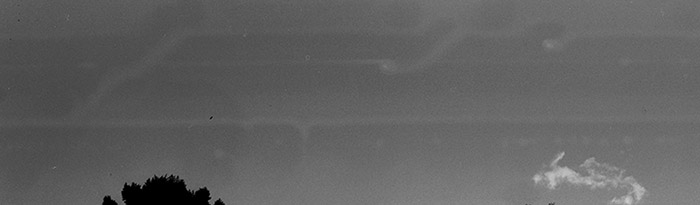
Is the example above the type of thing being discussed in this thread? This is a section from the top left of the sheet seen in full below - I upped the contrast to make the marks more obvious. This is a sheet of 8x10 HP5 that I exposed on Sunday and processed yesterday. It was processed in a Jobo 2830 print drum (with internal ribs), rolling by hand in a sink. There was no pre-soak; I used Rodinal 1:25 (16ml to 400ml) for eight minutes; water stop; fix for about 10 minutes; wash; hypo clear; then final wash for 15 minutes. When I saw the marks after the film was dry I washed it again and soaked in photoflo again but the marks were still there.
Very interesting to read Photo Engineer's remarks.
I've done a lot of HP5 8x10 in this tank and never had these marks before. I have always done a pre-soak, but this time I didn't bother, so that is the most likely cause in my mind.
I always use a water stop, but again it is interesting to read that Ron thinks stop becomes more critical as you go up in format. So perhaps the strange marks are from extra development happening due to uneven stopping of the dev. The marks are almost certainly occurring where the film base is in contact with the ribs.
Either way, both of these things are easy to do, so from now on I will be doing the pre-soak and using proper stop bath, at least for large format. Fortunately this was just a demo shot.
No prewet and no stop. Those are two critical factors especially with large format and hand agitated in a drum as well. It takes time for developer to spread evenly across a dry sheet of film or paper. It spreads more smoothly over a wet sheet. Same thing with stop. It takes time for water to neutralize developer evenly. Acid does it quickly.
These problems are worse at short development times. Kodak mentions that in their B&W darkroom dataguide.
PE
These problems are worse at short development times. Kodak mentions that in their B&W darkroom dataguide.
PE
- Joined
- May 21, 2010
- Messages
- 966
- Format
- Medium Format
the back isn't getting sufficient fluid circulation to remove the anti-halation dyes uniformly--that's why you need the special jobos for film--this problem gets very big very fast when sheet size inreases....4x5 hardly a mottle...use the same type of tank for 8x10, you'll always notice some fingers in a uniform area...11x14...forget it...any tube will give you uneven dye removal---this can't be fixed after the fact either--believe me, I've tried...uneven dissolution cannot be remedied...the leftover dyes take on a set or somehow react with the chemistry and produce a permanent stain.
the jobo film tanks do a better job because they have a barrel shape that gets fluid back there--but they batter the film too and cause scratching and are still uneven sometimes. jobo people hate the truth because they spent so much money--so there will be haters hating after they read this.
even if they made a special film jobo for 11x14 films with a barrel shape, it would not work due to the forces involved--I'm pretty sure the 8x10 one can't work 100% of the time either given how the film is "held in place" and the size of the forces involved.
deal with it or figure a workaround like some smart people have done...or do trays...but then you'll get tray scratches....maybe hangers you need....too many chemicals!!!!
everything has it's problems.
the jobo film tanks do a better job because they have a barrel shape that gets fluid back there--but they batter the film too and cause scratching and are still uneven sometimes. jobo people hate the truth because they spent so much money--so there will be haters hating after they read this.
even if they made a special film jobo for 11x14 films with a barrel shape, it would not work due to the forces involved--I'm pretty sure the 8x10 one can't work 100% of the time either given how the film is "held in place" and the size of the forces involved.
deal with it or figure a workaround like some smart people have done...or do trays...but then you'll get tray scratches....maybe hangers you need....too many chemicals!!!!
everything has it's problems.
Last edited by a moderator:
Well, these dyes should be removable somehow even if you need an acid or base solution to get them moving. They dissolve readily in water, acid or base.
OTOH, just like drying spots, if the film is not wetted evenly from the very start,there may be marks. You can get permanent marks just by placing a drop of water on dry processed film. The spot is not easily removed. Rewetting the entire negative, then drying after use of photo flo might help.
PE
OTOH, just like drying spots, if the film is not wetted evenly from the very start,there may be marks. You can get permanent marks just by placing a drop of water on dry processed film. The spot is not easily removed. Rewetting the entire negative, then drying after use of photo flo might help.
PE
The actual image I am having problems with is on my website. Go to www.davefrieder.com and go to Manhattan Bridge. Then scroll to image that says "Full View" It should be noticeable as vertical streaks. ANY help with this would be greatly appreciated.
- Joined
- May 21, 2010
- Messages
- 966
- Format
- Medium Format
hell...I can't see it ....
post it with arrows maybe...
but it you use tubes...sure as shitiuh...you got anti-halation dye problems on the back...it LOOKS like emulsion, but it ain't...done it...been there
post it with arrows maybe...
but it you use tubes...sure as shitiuh...you got anti-halation dye problems on the back...it LOOKS like emulsion, but it ain't...done it...been there
I use the JOBO CPP2 processor with the large film drum.
I agree to use a longer development time, with the appropriately more dilute developer. I experienced streaking when reducing my development times to control contrast, using BTZS tubes. I was developing between 4 and 5 minutes with D-76 1:1. I have changed to D-76 1:3 and processing around 11 minutes with Tri-X at 70 deg F. No streaks so far using the longer process time and more dilute developer.
- Joined
- May 21, 2010
- Messages
- 966
- Format
- Medium Format
increasing the time sometimes helps, but not always--it's a crapshoot depending on the fickle forces in the tube..if you go back and look on the film very closely, you'll see the streaking--but light streaking doesn't affect anything if you're printing--I do reversals--so you SEE this stuff on a light table if it's there--therefore it's completely unacceptable.
what will give MORE reliable success than increasing the time is MORE solution--it provides more presssure to get the liquid in back quickly and more evenly---however even this can't prevent it from happening in my experience--not if the back of the film is pressed against the tube--there will always be uneven wetting back there most of the time.
what will give MORE reliable success than increasing the time is MORE solution--it provides more presssure to get the liquid in back quickly and more evenly---however even this can't prevent it from happening in my experience--not if the back of the film is pressed against the tube--there will always be uneven wetting back there most of the time.
Thanks, everyone!!!
| Photrio.com contains affiliate links to products. We may receive a commission for purchases made through these links. To read our full affiliate disclosure statement please click Here. |
PHOTRIO PARTNERS EQUALLY FUNDING OUR COMMUNITY:  |