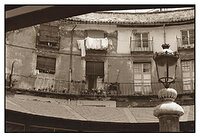
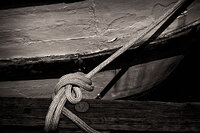
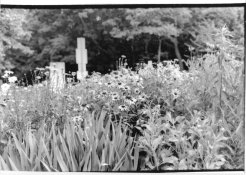
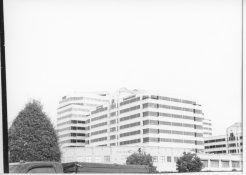
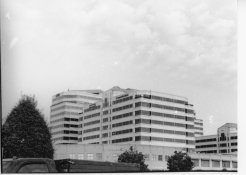
I had time to practice a little last night...was happy on the results on this one. The other two were a bit underexposed..not enough time. Question, do you folks make a test strip for every image before making a full print or do you adjust based on the image and your "typical" settings?
Test strips are a must. There's no such thing as typical settings, it can and will vary widely from negative to negative.
For most things I deem worthy of wet printing rather than just scanning I make test prints. They're made in the same way as a test strip, but using a whole sheet of paper. It helps me find dust spots I need to clean off the negative, plus I can instantly see places I'll probably need to dodge/burn and get a good feel for the overall exposure.
Test prints are a huge help to me. Give it a try, might help you too. Yes, the paper is expensive but it isn't getting any cheaper and I'd rather burn a few extra sheets in a box than produce less than excellent prints.
Well, actually I do multiple test strips not only one. I usually will guess an exposure, will make a testprint at half of what I thought might be right and in case this does not turn out disastrous I will make one at double the time i guessed. I will dry them both and see if further testing is needed. Once I think I have the exposure nailed, I will make a full size test print. The testprint will show me where burning/dodging is needed and then I will work with test strips of this particular region(s). I usually keep a print map and will piece all the pieces together once I am happy with the results. Might not be the fastest way of doing things and most likely not the most resource aware method, but this rather methodical approach seems to work for me. This being said, I definitely know a few printers who make one strip, one test and are ready for the final image, but I personally don't know anyone who does not do testing at all.
If I reprint a negative, I have my printmap to follow, but I still do testing, since chemicals will be different and maybe the paper I am using will be different.
So long answer short, yes, always make test strips and prints
Don't put them to trash - you can use for example high dilution of selenium toner to get print darker, or some other toners. When I get under or over exposed print - I use it for playing (learning) with toners.
ALWAYS make a test strip: I printed up to 1,500 prints a week commercially in my youth, hand processed....every time I thought 'don't need a test strip for this neg, just like the last neg' I usually had to tear the print up and start again...with a test strip.....false economy.
Please PM me your address and I will send you the ILFORD Multigrade printing manual, it will help.
For most things I deem worthy of wet printing rather than just scanning I make test prints. They're made in the same way as a test strip, but using a whole sheet of paper. It helps me find dust spots I need to clean off the negative, plus I can instantly see places I'll probably need to dodge/burn and get a good feel for the
When I'm aiming at making large exhibition prints, I can use anywhere from 3-10 test strips for all different areas of the photograph to see how dodging and burning and adjusting contrast effects those areas and either making mental notes or writing them down so that when I do the print, I know upon first exposure all the areas to dodge and for how long exactly, then add additional exposures for the required burning and adjusting the contrast to the burn in a sequential order. In essence, using test strips effectively will increase the quality of your prints, give you a better ability to get really technical with the print and in the end, it will save you a ton of paper. Even if you're using 1/3 page test strips, it will give you a lot of visual information that is necessary for good print-making and still save paper in the end.
If you are not using test strips, then you are basically making test prints. It is much cheaper to cut a sheet up and use the strips to set up. Once you are confident in your machine, paper, shooting and developing combination you will be able to dial in the settings much faster and save on paper. You will still need to make test exposures, just fewer of them.
Thank you for all the feedback! Test strips a must! Darko I really like the idea of playing with the selenium (sp?) toner on the ones that I wasn't happy with. I have to try the dodging and burning...one of the images that I was not thrilled with would be ideal for that.
I went back and tried one of the images that was too underexposed the other day and did a few test strips and got a much better exposure (initial attempt is the first image, last night's work is on the bottom
There are much spots on them. If that is not from the scanner you should clean the negatives more accurately. It makes no sense to enlarge photographs by your own and to reach only a mediocre quality.
If you look at the Characteristic Curve you will see that the relation between density and exposure is a logarithmic one. The problem with test strips is that people are using an arithmetic series of exposures to determine proper exposure. This means that if your initial choice for the first step is far off the mark you are propably not going to get any valuable information from the first strip. For example if you do a strip of 1, 2, 3, 4, 5 seconds and the correct exposure is 20 seconds you are going to get a blank sheet. There are better methods than the usual test strip.
OK...I see that...if you're way off in your initial guesstimate on what the proper time is the test strip will yield little useful information. So then what are the suggested methods other than test strips? I'm going through Ansel Adam's "The Negative" and he goes into the log relationship between density and exposure but I'll admit it's something I'll have to review to fully understand it.
Essentially, what I do is what Gerald suggested to you, because that progression is actually logarithmic in nature.
Here is another suggestion - do your test strips by progressively covering more of the print.
For example, you expose the whole print for 4 seconds, then cover over a portion for 2 seconds, then cover a bit more for 2 more seconds, than a bit more for 3 more seconds, etc.
Here is the table, which gives results out to a total of 64 seconds for the part of the test print with the most exposure:
I alway use 10-13-16-20-25-32 which gives 1/3 steps. I count with the motronome and use only whole seconds. (o.k I could count one-and-two or even one-and-the-two to divide seconds, bit I don't bother with that)
Photrio.com contains affiliate links to products. We may receive a commission for purchases made through these links. To read our full affiliate disclosure statement please click Here.