

• Welcome to Photrio!
    Registration is fast and free. Join today to unlock search, see fewer ads, and access all forum features.
    Click here to sign up

Mintol developer

Recent Classifieds

Forum statistics

Threads
203,176
Messages
2,850,964
Members
101,712
Latest member
Plastic
Recent bookmarks
0

Patent_freak

Member
Allowing Ads
Joined
Oct 29, 2005
Messages
6
Location
Tokyo, Japan
Format
35mm RF
Introduce a new Pyro-developer, which contains Menthol as Phenol.
Metol 0.1g
Ascorbic acid 0.3g
Sodium Carbonate (monohydrate) 3g
FRISK (trade name) 5tablets
to dissolve in 600ml water at 20degree(C).
This solution have no shelf life, so you should use immediately after dissolving.

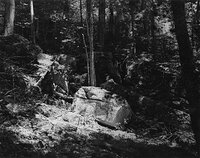
Example posted used Tri-X at EI(exposure index)=400.
Agitate condition; continuously initial 30s, and 5s in every minute.
Total developing time is 14minutes at 20C.

001.jpg
 
Two questions:

What compound in the Frisk tablets are you claiming to have developer activity?
Does your developer without the metol and ascorbic acid exhibit any developer activity?
 
OK - menthol is a recognised 1 hydroxyl developing agent but you cloud the issue with metol somewhat. I accept that ascorbate is a regenerator but at carbonate pH (~11.5) it is a developer in its own right.

What happens at lower pH levels?

An interesting source of Menthol, reminding me of Panadol/Rodinal formulae.
 
Can I assume by your name 'Patent Freak' and the nature of this post that you've developed this Frisk tablet? Is it proprietary or have you patented it?

I'm interesting in how to make dry powder developer formulas into tablets. I've started (there was a url link here which no longer exists) on the topic.
 
I looked this up earlier today as I had not heard of Frisk either. The Frisk mint ingredients are:

Sweeteners (sorbitol, aspartame, L-phenylalanine compound), fragrance, sucrose esters, silicon oxide fine.

I assume it's the L-phenylalanine which is the active ingredient in the developer.


Steve.
 
Ahh, thanks for the clarification guys. I don't think we have Frisk mints here in the US.
 
I would not expect menthol to be an active developing agent. Its chemical structure and properties are totally unlike phenol. Phenylalanine, similarly, has no structural features that would provide developer activity.

Jerry Koch's idea (to conduct control experiments) is correct -- are these mints actually doing anything?
 
At the proportions in the above recipe the Metol + Ascorbic Acid + Sodium Carbonate would make a decent developer on their own. I'm curious to see the difference without the Frisk tablets.
 
Hi guys, thanks for many comments.
Yes, the recipe is functional without frisk (Menthol).
Pyro developer uses a tint effect, which is happened to gives complexes of metal ion and (poly)phenol. For example, you may know deep color change when add honey to black tea.
Also blue-black ink for fountain pen uses similar effect.
The pyro-developing needs also conventional development for separation of silver metal.
The tint effect accompanies with image density, so it gives fine image because of small silver grain size.

I am a patent illustrator, but the recipe has not been applied for patent.
Use freely and have a fun.
 
Ahh, thanks for the clarification guys. I don't think we have Frisk mints here in the US.

We don't have them here in the UK. I assumed they were from the US!


Steve.
 
Yes, the recipe is functional without frisk (Menthol).

The question was whether thare is any developing activity without the metol and ascorbic acid. That is from just the Frisk tablets and carbonate. I seriously doubt that there is.
 
As I posted in another thread, neither menthol nor phenol are developing agents. Phenol is a weak coupler AAMOF. I think that the use of FRISK is a red herring unless there is some hidden ingredient in the tablets.

PE
 
Whether a chemical is a developing agent or not depends on a set of conditions. For example, the chemical must contain either two hydroxyl groups (hydroquinone), or two amno groups (paraphenylenediamine), or a hydroxyl and an amino group (paraminophenol). This is what is called a necessary but not sufficient condition. How the two groups must be positioned is summarized by the Kendall-Pelz Rule. Catechol and hydroquinone are developing agents but resorcinol is not.
 
Last edited by a moderator:
FRISK, Sharpens You Up!

Just running through here quickly - it looks like the OP is saying that the use of FRISK MINTS converts the soup into a non-pyro staining developer.

If so it might work just as well with other developer formulas....

?
 
Just running through here quickly - it looks like the OP is saying that the use of FRISK MINTS converts the soup into a non-pyro staining developer.

If so it might work just as well with other developer formulas....

?

Yes, exactly you are right.
Other developer formuras will work with Frisk I think.
But Sodium sulfite suffocate the staining effect.
Pyro staining effect swells the basic developer characterisic, it is interesting.

See my web site.
 
Last edited by a moderator:
When I tried Caffenol-C briefly I found the variation I used had very little stain - apparently the ascorbic acid also reduces stain (according to people who've tested it more than I have). Not sure if this is Caffenol-specific, or applicable to all staining developers - ex, is there an advantage to using Frisk tablets vs. just using more ascorbic acid if the reduced staining is the desired effect?

Incidentally, I haven't had time to compile/type up my results, but I did try using mint tea as a developer - it works as anticipated as a staining developer if very concentrated. Obviously, different compounds in mint tea vs. a Frisk tablet, though.
 
Neither metol nor ascorbic acid are considered to be staining developers. In fact ascorbic acid cannot produce any polymerized phenols because it does not contain a benzene ring.

I am still waiting for the OP to defend his formula. Does the formula produce any image without the metol and the ascorbic acid?
 
Last edited by a moderator:
After due consideration, I would have to say that if any of the ingredients in mintol are couplers, then a colored image could form imagewise by coupling with the oxidized Metol. This would enhance density and at the same time impart a "stain" of sorts.

PE
 
After due consideration, I would have to say that if any of the ingredients in mintol are couplers, then a colored image could form imagewise by coupling with the oxidized Metol. This would enhance density and at the same time impart a "stain" of sorts.

PE

An interesting idea. There is an easy way to determine whether this is true or not. That would be to bleach a negative and see if there is a stain image.

On the down side, I am beginning to dislike the idea of eating Frisk mints more and more as time goes by. :smile:
 
Last edited by a moderator:
The dye formed may be so unstable that it vanishes in a bleach. That may be a problem with any definitive proof.

PE
 
I still I think its worth a try. Anyone out there with access to Frisk mints who wants to experiment?
 
Last edited by a moderator:
Photrio.com contains affiliate links to products. We may receive a commission for purchases made through these links.
To read our full affiliate disclosure statement please click Here.

PHOTRIO PARTNERS EQUALLY FUNDING OUR COMMUNITY:


Ilford ADOX Freestyle Photographic Stearman Press Weldon Color Lab Blue Moon Camera & Machine
Top Bottom
