About 2/3 of the way down is the section titled "RGB chip characteristic parameters", which shows that blue has a little less than 1/2 the luminous intensity as green (on average).
This is somewhat misleading, as the luminous efficiency is expressed in candela, and candela is in turn compensated for the spectral sensitivity of the human eye. You could use the numbers in the table together with the luminosity function to work out the absolute luminous flux to get a better estimation. Doing this will show that for instance the absolute blue output is likely much higher than green output, while for red it depends of photopic or scotopic sensitivity is used as a starting point (likely photopic). But red is of course not very relevant if this is about VC B&W materials.
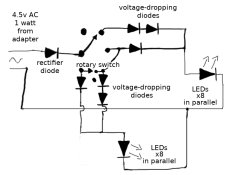
silicon rectifier diodes wired in series and switched to drop the current, which comes from an AC-to-AC mains adapter.
What do you mean by 'switched rectifier diodes'? Can you post a schematic of your solution?
On a sidenote, controlling leds by controlling voltage is generally not a good idea due to the steep I/V curve of leds. Small variations in voltage (due to variations in home AC voltage, aging of components, temperature of components etc.) will result in significant variations of led current and hence light output.
@albada, I still needed to get back to you on the question you asked about the minimum duty cycle of the leds in my current setup. Taking B&W as a starting point, I mix in a little bit of blue on the softest contrast grade in order to allow all papers to achieve full dmax. I found that only green light prohibits this (the result is an extremely long tonal scale and very low paper speed, but the tonal scale is so long that it doesn't have much practical value even for extremely contrasty negatives). To resolve this I add a little blue at the lowest contrast grade, which I do by switching the blue leds at a 6.25% duty cycle. Combined with a PWM frequency of 1.526kHz this gives a repeated 'on-state' of 41us.
This, however, doesn't help you much, because it says nothing about possible reciprocity failure at these short times. It only shows that the paper responds to these very brief (and repeated) pulses - but not of the response is linear if the duration is varied at the short end of the duty cycle range.
The most critical time variation is used for color work and that involves all 3 colors at a decent level. I.e. maximum duty cycles for color work in my setup are 100% for red, around 90% for green and 45% for blue, but this is at a Y/M filtration setting of 0, which of course isn't really used for color negative to RA4 paper - in practice, the green and blue duty cycles are probably closer to something like 60% and 20% or thereabouts, with variations (according to Y/M filtration setting) that are likely around +/- 20% for green and maybe +/-7% for blue for most negatives (I'd have to run the math on this as the variation is exponential and there's a bit of value mapping going on in the software). That means that for instance the blue channel tends to give pulses in the 100-150us range depending on filtration setting. Again, that doesn't give any insight into possible reciprocity failure. The only thing I can establish is that very small variations do indeed translate to color balance shifts and they do so predictably - which of course is the intended functioning of the setup in the first place.
So long story short: while the numbers above are nice for 'shits & giggles', they don't give any insight into reciprocity failure for repeated pulses in the tens-hundreds of microseconds range.