The following borders on being too digital for APUG, but since we've usually allowed discussions of scanning in the "Presentation and Marketing" forum for web presentation and marketing of analogue images through the internet, I've decided to post it here instead of on the hybrid forum, and if Sean and the other moderators think it should be over there, I'll happily move it. This isn't about making digital prints from film, but about selling film images and possibly even scans of prints through stock agencies for commercial and editorial use, and if people can make money shooting film, that can't be a bad thing.
I've recently started listing on Alamy (which is more of a traditional stock agency than microstock, though they do offer the options of selling images as Royalty Free and inexpensive low-res images for the web), in part because they seem open to film images. I tried iStock and the responses were amusing--a straight dupe of an 8x10" albumen print was too Photoshopped and they said I should resubmit without all those effects. A scan of an 8x10" Polaroid had too many colored pixels of irregular size when viewed at 100%. They had no problem with a straight digital shot. They mention that they are looking for "analog/grunge" images, so I think that means they are looking for a very specific aesthetic in analogue images, and it's not an aesthetic that I usually do. iStock pays so little, I decided it wasn't worth the trouble, and I just didn't care for the atmosphere in that environment. Alamy pays 60% of direct sales through Alamy, 40% of sales through distributors, 50% of sales for "Novel Use."
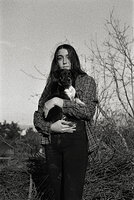
With Alamy, I submitted four digital images and they were accepted on the first try. I'm taking the strategy that I should try to establish enough of a collection of digital images that I can demonstrate that I can meet their standards, submitting film scans one or a few at a time (since they only check a few images per submission after the initial test, and they will reject everything in your queue, if the images they check fail) to see what it takes to get a film image in. I'm also submitting batches of safe (i.e., digital) images between rejections, so they know that I can continuously supply images that meet their standards. So far I've had 23 digital images accepted, up-resed from my Canon 40D (10Mpix) to their desired size of 48-50 Mb uncompressed JPEG (about 16Mpix), all without challenge with the exception of one that I didn't up-res to sufficient size, and today I had my first scan of a 35mm Kodachrome 25 slide accepted (APUG-sized version attached).
The way I'm digitizing is with the 40D and a Canon FD 35mm/f:2.8 Macrophoto lens on a copy stand with a lightbox. I shoot nine overlapping images of the slide, stitch them into one image of about 120 Mb 8-bit uncompressed using Photomerge in CS2, and save the merged file as a PSD file for any editing that needs to be done. This may sound dubious, but the FD 35mm Macrophoto is an incredibly sharp lens (sharper than my old 20mm Zeiss Luminar), and is very well suited to this, and the results are much better than with my old Minolta Scan Dual (I). My DSLR basically lives on the copy stand, functioning as a scanner for prints, slides, negs and documents, so it's not too much work to set it up.
Alamy prefers all images to be unsharpened and without noise reduction, so I tried that, submitting the whole stitched image with a little spotting, and it was rejected as "Soft or low definition." Second try I applied a little noise reduction, downsized to around 50 Mb uncompressed, and a very small amount of Smart Sharpen, and this one was rejected for "Dirt, dust, or other blemishes." I took a closer look and realized that there were some artifacts on the subject itself that may have been taken for dust or hair, so I spotted those out, and there was a little stitching artifact in one corner, so I fixed that. Third try, they accepted it.
It was a lot of work for one slide for a stock agency, and about a two-day wait per submission, but now I have a better idea of what they're looking at in film scans, so I think it was worth the effort. I do get the sense that they are scrutinizing film more closely than digital originals, and I suspect I'll have an easier time with medium and large format originals, as jbrunner has mentioned. I've decided to upgrade the 40D to a 5D MKII in the hope that I can eliminate the stitching part of the process, or at least reduce it to 2 or 3 panels instead of 9, and so that I don't have to up-res images shot originally as digital. iStock doesn't want up-resed images, but Alamy prefers all images to be about the same size (minimum 48 Mb uncompressed image, maximum 25 Mb compressed JPEG).
Here's a link to my Alamy portfolio, if you're curious--
Dead Link Removed
The peppercorns may not show up for a day or two.