

• Welcome to Photrio!
    Registration is fast and free. Join today to unlock search, see fewer ads, and access all forum features.
    Click here to sign up

Match Needle Technique with Nikon FE

IMG_3569 800x533.jpg

IMG_3569 800x533.jpg

  • 0
  • 0
  • 12
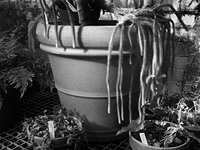
Ferns

H
Ferns

  • 0
  • 0
  • 31

Recent Classifieds

Forum statistics

Threads
202,870
Messages
2,846,784
Members
101,579
Latest member
And ee
Recent bookmarks
0
Another thing regarding exposure, even in P mode, and you may be aware of this, is that the exposure it's giving you is for a middle-gray result.

For example, if you have a white tablecloth in a dark room, a meter reading off the tablecloth (the exposure suggestion from the meter) is what you would use if you wanted the tablecloth to come out gray. If you actually want it to be white, you have to realize you need to add about a stop or two more exposure.

Conversely, if you have a large dark curtain in your scene and want it to actually appear dark, then a meter reading off the curtain will again give you the exposure that would make the curtain appear gray. So, what you need to do is give the scene less exposure than suggested by the meter.

The above is more what you'd be doing with a spotmeter. With the FE's center weighting, you mostly have to ask yourself whether the central area is representative of the tonal qualities for the image you want. If not, what many people do is move the camera and meter a region that *is* representative and then they can do either (1) manually choose the settings (like the face technique someone suggested earlier), or (2) use AE-lock before composing the final image.

From the images you posted, things look pretty good - so you probably have a good feel for exposure.
 
Last edited:
Thanks, Theo. Again I kind of knew all that, but need to be reminded every now and again, as I am forgetful - doubtless due to lazy habits in the past. Appreciated.
 
While we are on the subject of Ilford XP-2 Super film, an article reads,

"So here's how to shoot XP2 Super, according to me. It's simple. This yields the highest percentage of results of the best quality—I don't care a whit for "make do" solutions that yield only acceptable results. Using camera metering:
• For regular shooting in most normal lighting, use EI (ISO) 200.
• For shooting in extremely bright and/or contrasty lighting, like harsh full sun and shadows, use EI (ISO) 100. This insures adequate shadow detail, and the highlights won't block up.
• For shooting in low and low-contrast lighting—and this includes indoor shooting and "available darkness"—use EI (ISO) 400—or even a little higher, although I personally don't recommend ever going all the way to (gasp) 800."

My question is, can you do this moving around within a single roll of film? If so, would the exposures come out ok?
 
While we are on the subject of Ilford XP-2 Super fillm ...
My question is, can you do this moving around within a single roll of film? If so, would the exposures come out ok?


I rarely use ISO800 with the XP2; ISO100, 200 or 400 on one single roll is not a problem. Developing process is C-41 (though others have great results developing in b/w chemicals).
Yes, the negatives come out fine and usable (with individual exceptions).
Maybe you need to know that I scan my XP2 negatives and so there is room enough for adjusting the results. I know there are plenty of people who will refuse this.
Try out - maybe you'll like it (or not).
 
...
My question is, can you do this moving around within a single roll of film? If so, would the exposures come out ok?

I interpreted the text you quoted to mean one ISO is applied to a single roll of film under the assumption the entire roll will be exposed under the same or not too dissimilar conditions.

Whereas with a digital camera you can change the ISO from shot to shot in wildly varying conditions and still get a proper exposure, doing that with a film camera is simply lying to your meter: you can't change the sensitivity of individual frames.

I would pick the ISO most appropriate for your lighting conditions, 100, 200, 400, and use it for the entire roll.
 
...My question is, can you do this moving around within a single roll of film? If so, would the exposures come out ok?

However you deviate from the established ISO meter setting, your exposures will be under- or over-exposed. Developing film in C-41 is a single end-to-end process, with no adjustment, allowing no latitude for deviation of individual frames.
 
One simple way to find out the effect of changing the iso of a film camera is to put it on a tripod, and take four or five identical shots, changing only the iso each time.

Regarding LV, thanks Chan!
 
One simple way to find out the effect of changing the iso of a film camera is to put it on a tripod, and take four or five identical shots, changing only the iso each time.

Regarding LV, thanks Chan!

Once the film is loaded and the ISO has been set on the dial (e.g. 100), it doesn't make any difference how you change the ISO after an exposure @ ISO 100. Any exposure deviation will be the same as changing the aperture/shutter speed combinations. As I mentioned in a previous post, C41 is a closed-end system; x amount of developing, y amount of fixing, etc. There are changes which can be made in some of the steps, but very little deviation from standard.
 
Great camera.
 
If I understand your situation and concerns correctly...

Your film was too fast for the lighting conditions, limiting your exposure options. In that situation either user slower film or a filter, like a ND or polarizer or red contrast, that will allow you to use the aperture more to your liking.
exactly right.
 
The FE is a nice camera but it doesn't have a very high top shutter speed. If you like shooting wide open you might consider other models with a higher top speed. An FE2 will get you to 1/4000. An N90S will get you to 1/8000. A Minolta 9xi will get you to 1/12000.
 
Photrio.com contains affiliate links to products. We may receive a commission for purchases made through these links.
To read our full affiliate disclosure statement please click Here.

PHOTRIO PARTNERS EQUALLY FUNDING OUR COMMUNITY:


Ilford ADOX Freestyle Photographic Stearman Press Weldon Color Lab Blue Moon Camera & Machine
Top Bottom
