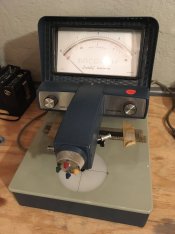
Sounds like Nicholas has been inside of those before. I don't know the electronics, but I've seen our in-house guys do repair work. As I recall the pots are along the back of the instrument when the case is off. So each pot adjusts a small part of the range, but they have overlapping effects; it's an iterative process with the calibrated wedge.
Personally I'd just turn it on and see if it works (the lamp should come on). Then when you depress the probe the needle should move. If the lamp comes on put a piece of thin paper (a Post It note works fine) over the aperture; you should see an image of the lamp filament there. If not, the bulb position needs to be adjusted. Originally, as I recall, they had a spare bulb inside somewhere. I'll have my fingers crossed for you.
If I had one that worked, but readings were off, I'd be inclined to just make a table of corrections based on your calibrated wedge. Then manually correct my readings. But an electronics guy might be more inclined to dig into the instrument. It just depends on where your interests lie, I guess.
Regarding calibration of the instrument, going from near-ancient memory, zero it with nothing under the probe, with the yellow knob down (this is the "visual" response). Set zero using the "zero" dial on the left. Then zero the individual colors by rotating the turret so the desired color us down, then rotate that color's knob. (Rotating the knob moves the filter deeper in and out of the light path.) The "calibration" was traditionally done with the yellow knob down, calibration patch in place, and rotate the "calibration" dial to get the required reading. For the other colors, well, whatever they read is what they read. It wasn't until later models, as I recall, that those became individually adjustable.
Fwiw the color filters are probably faded. If you wanted to look at them you should be able to pull the filter turret assembly out the front; be gentle so as not to scratch the outside of the PMT.
Hopefully it'll work.