
• Welcome to Photrio!
    Registration is fast and free. Join today to unlock search, see fewer ads, and access all forum features.
    Click here to sign up

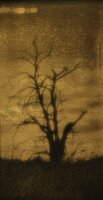
Lots of grain, lots of contrast

Recent Classifieds

Forum statistics

Threads
202,920
Messages
2,847,560
Members
101,535
Latest member
photomorg
Recent bookmarks
2

David Bigeleisen

Member
Allowing Ads
Joined
Oct 5, 2025
Messages
7
Location
San Francisco, California
Format
35mm
I've been thinking of this project for a long time:

I want to photograph a fish, one with very distinct scales, probably a carp. I want the final print to look something like a woodblock print or a linoleum print.
Please give me your suggestions for film, developer, paper and lighting.

Thanks in advance.

David
 
Definitely side-light, if you want to highlight the scales.

54206409678_952c14fc76_k.jpg


High grain and contrast? Maybe you should push a 400 speed B&W a couple stops. There's always Rodinal if you really want to invite the grain.

You could bracket a few exposures in order to get the right effect you're looking for with high contrast. Too much or too little light changes the image a lot when you're at a very limited exposure latitude.

If you have a specific texture in mind you might also consider a double exposure or overlaid frame of an evenly-lit material of that texture.

For really extreme contrast, you can use a copyfilm like Agfa Copex Rapid, but it won't give you much grain. You could add grain with the overlaid texture.

Just throwing some ideas.
 
I want the final print to look something like a woodblock print or a linoleum print.
Ok, so basically duotone or something very close to it.
You could use something fairly normal like Fomapan 100, underexpose by 1.5-2 stops, develop the heck out of it and then further boost contrast by printing on grade 5 or applying a dramatic curve in digital editing.
Alternatively, you could use an inherently contrasty film like ADOX HR50 and develop it in a paper developer or so.

Neither are going to be very grainy, but you will get lots of texture due to the high contrast.

The main challenge will be to illuminate the subject in such a way that the inherent contrast of the scene (SBR) is very low, so that all of the scene actually registers on the final image. If the SBR is even a little bit too high, too large parts will either blow out or sink into blackness due to the extreme contrast of your process.

You mention 'paper'; will you be printing optically?
 
I would use Delta 3200, shoot at 3200 or push to 6400 if you can meter that high, although rated at 3200 Delta 3200 seems to be a 1600 ISO film so at 3200 a one stop push, at 6400 a 2 stop push. Use a low solvant developer like Rodinal, DDX, or D76 1:1. Print with on VC paper with grade 4 to 5 filter depending on the amount of contrast you want. Lighting, direct flash.
 
Another option, in addition to those mentioned or separately, is to use a high contrast film (lots to choose from) and use a small format camera (half-frame or smaller) or CROP the image.
 
Ok, so basically duotone or something very close to it.
You could use something fairly normal like Fomapan 100, underexpose by 1.5-2 stops, develop the heck out of it and then further boost contrast by printing on grade 5 or applying a dramatic curve in digital editing.
Alternatively, you could use an inherently contrasty film like ADOX HR50 and develop it in a paper developer or so.

Neither are going to be very grainy, but you will get lots of texture due to the high contrast.

The main challenge will be to illuminate the subject in such a way that the inherent contrast of the scene (SBR) is very low, so that all of the scene actually registers on the final image. If the SBR is even a little bit too high, too large parts will either blow out or sink into blackness due to the extreme contrast of your process.

You mention 'paper'; will you be printing optically?
I only photograph with film. I create the images in the darkroom with an enlarger and various chemical baths. I'm not interested in the computer.
David
 
Last edited by a moderator:
You can also add grain by using texture screens -- store bought, or pretty easy to make at home to the size of the negative you are using.
 
Photrio.com contains affiliate links to products. We may receive a commission for purchases made through these links.
To read our full affiliate disclosure statement please click Here.

PHOTRIO PARTNERS EQUALLY FUNDING OUR COMMUNITY:


Ilford ADOX Freestyle Photographic Stearman Press Weldon Color Lab Blue Moon Camera & Machine
Top Bottom
