

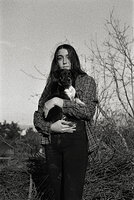
Greetings. I need a bit of advice with an emulsion project I've got in the works and want to know if it's salvageable or how badly it's hosed.
Liquid Light semi-Fail
This is one of four 4x6 samples I made from scrap glass after I cut down the larger pieces for the actual project. I figured I should probably prep them the same way and use them as test plates since I had never worked with Liquid Light before or done anything quite like this. The process I used is as follows.
1) chemically clean glass by scrubbing with sodium carbonate laundry powder until water sheets off of both sides
2) use home-made gelatin glue (3tbs near boiling vinegar:1tsp knox gelatin powder) to glue sheer white fabric to the plate and smooth out any bubbles, wrinkles, etc before it sets
3) once thoroughly dry, take into the makeshift darkroom (windowless bathroom with lights outside the room turned off at night), heat Liquid Light and decant into a clean beaker with a little Photo Flo added to aid in spreading
4) pour onto plate and spread with a sponge brush to get an even coating, inspected closely under safelight
5) dry for 12+ hours in a blacked out closet on a drying rack
6) expose, then develop in working solution strength Dektol and fix in full strength Kodak Fixer
From the looks of the plate, I suspect I needed 1-2 more layers of Liquid Light and all of the dark spots are bubbles in the emulsion from the brushing/pouring/slow stirring in of Photo Flo. Does someone more experienced agree with my assessment? Is there anything I can do about it at this point? Will subsequent layers of Liquid Light 'fix' it? Will the bubbles in the base layer show up after 1-2 more layers over top of the original coat, or will they just blend in with the additional layers? Is there a 'better' way to spread the emulsion besides a sponge brush that wont' leave streaks or waste emulsion? I was attempting to follow the initial suggestion of pouring in the center and tilting around to coat evenly, but my plates are too large and awkwardly sized to make that easy (three 12x18, one 14x24 that has a triptych of 2x 5x7.5 and one 8x12). I'm starting an advanced film photography class in a week and a half and the professor does these kinds of alt-process projects with the advanced class; will my unexposed plates keep for a couple weeks, or do I need to figure out something to attempt sooner than that to avoid fogging?
I'm hoping there's some way to get a bolder image and get rid of/cover up/mitigate the bubbles in the first layer. The shoot that was getting printed on these plates was a boudoir shoot, and I think printing them on the sheer fabric will really work well, I just don't want it to be quite -that- ghostly...lol.
Any help is greatly appreciated.
Liquid Light semi-Fail
This is one of four 4x6 samples I made from scrap glass after I cut down the larger pieces for the actual project. I figured I should probably prep them the same way and use them as test plates since I had never worked with Liquid Light before or done anything quite like this. The process I used is as follows.
1) chemically clean glass by scrubbing with sodium carbonate laundry powder until water sheets off of both sides
2) use home-made gelatin glue (3tbs near boiling vinegar:1tsp knox gelatin powder) to glue sheer white fabric to the plate and smooth out any bubbles, wrinkles, etc before it sets
3) once thoroughly dry, take into the makeshift darkroom (windowless bathroom with lights outside the room turned off at night), heat Liquid Light and decant into a clean beaker with a little Photo Flo added to aid in spreading
4) pour onto plate and spread with a sponge brush to get an even coating, inspected closely under safelight
5) dry for 12+ hours in a blacked out closet on a drying rack
6) expose, then develop in working solution strength Dektol and fix in full strength Kodak Fixer
From the looks of the plate, I suspect I needed 1-2 more layers of Liquid Light and all of the dark spots are bubbles in the emulsion from the brushing/pouring/slow stirring in of Photo Flo. Does someone more experienced agree with my assessment? Is there anything I can do about it at this point? Will subsequent layers of Liquid Light 'fix' it? Will the bubbles in the base layer show up after 1-2 more layers over top of the original coat, or will they just blend in with the additional layers? Is there a 'better' way to spread the emulsion besides a sponge brush that wont' leave streaks or waste emulsion? I was attempting to follow the initial suggestion of pouring in the center and tilting around to coat evenly, but my plates are too large and awkwardly sized to make that easy (three 12x18, one 14x24 that has a triptych of 2x 5x7.5 and one 8x12). I'm starting an advanced film photography class in a week and a half and the professor does these kinds of alt-process projects with the advanced class; will my unexposed plates keep for a couple weeks, or do I need to figure out something to attempt sooner than that to avoid fogging?
I'm hoping there's some way to get a bolder image and get rid of/cover up/mitigate the bubbles in the first layer. The shoot that was getting printed on these plates was a boudoir shoot, and I think printing them on the sheer fabric will really work well, I just don't want it to be quite -that- ghostly...lol.
Any help is greatly appreciated.
Last edited by a moderator:


