
• Welcome to Photrio!
    Registration is fast and free. Join today to unlock search, see fewer ads, and access all forum features.
    Click here to sign up

Lens damage questions

Fusion Energy

A
Fusion Energy

  • 2
  • 0
  • 49
The Outhouse

A
The Outhouse

  • 2
  • 3
  • 59

Recent Classifieds

Forum statistics

Threads
203,473
Messages
2,855,318
Members
101,858
Latest member
FreeRanger
Recent bookmarks
0

KN4SMF

Restricted Access
Allowing Ads
Joined
Mar 7, 2019
Messages
332
Location
US
Format
Traditional
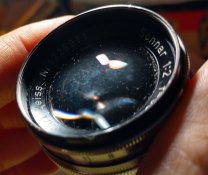
The attached photos are of the lens from a camera in another thread of mine, a Nikon S2 with Carl Zeiss Sonnar 50mm f/2. But since this question may have more wide-reaching readership, I decided to give it its own thread. Today I disassembled the lens for cleaning because it was obviously dirty down in there. When I got through, not only was there no change, but possibly even worse. I used my tried-and true method of cotton Q tips and alcohol, because it has worked so well for me in the past.
Looking down into my newly cleaned lens, it appears as crystal clear as can be. I can see the aperture blades and everything looks clear as a bell. But looking AT the glass from other angles and it looks like this. Examining the glass with a magnifier shows no build up, etching, or anything obvious. But here it is, and cannot be cleaned. Ideas? Remedies? Thank you.
 

Attachments

  • glass1.jpg
    glass1.jpg
    898.4 KB · Views: 270
  • glass2.jpg
    glass2.jpg
    734.9 KB · Views: 258
Fungus, coating damage, something like that. What do photos look like when shot with the lens?
 
Look like shadows from removed fungus, for the most part.
 
That's what I would call "biological damage" a fungus or fungi that are chewing between lens elements cemented together, or surface damage. The glass can be etched or eaten (insert expert opinion from mycologist, I'm not one) those trails look like fungal activity to me. Most common on enlarger lenses left in a humid basement etc.
 
Google mycelium,

the vegetative part of a fungus, consisting of a network of fine white filaments (hyphae).
 
This thread is only a few hours old, but all hands seem to be leaning toward fungus damage. I have cleaned the lens with alcohol and acetone, and even in the beginning I noticed no fungus; at least not living. Perhaps fungus damage may be the answer unless more readers chime in with other answers. So, for lack of any other answer at this time I have to run with fungus damage. In other words, etching, for which there is no remedy. The lens is therefore ruined. I might add that the camera spent much of its life since 1964 when he bought it, in the leather Nikon eveready case. From past reading it seems leather + lenses = fungus. So unless a poster adds some revelation I suppose I have to consider the lens to be ruined and need to be shopping for a replacement lens. What a pity. One less fine vintage Zeiss lens in the world. I'm not going to put up with this. Thank you all.
 
If the fungus cannot be just wiped off without marks in transmissive light, H2O2 will not do either. Then the glass already has been corroded.


(What I see in that photograph to me seems a mixture of surface artefacts.)
 
In your second post, you mention that you´ve used acetone to clean the lens. This is a surprising choice of cleaner for me, as I would expect it to damage the coating. Maybe other users have practical experience with acetone and coating, maybe this is a possible explanation, too.
 
If the fungus cannot be just wiped off without marks in transmissive light, H2O2 will not do either. Then the glass already has been corroded.
(What I see in that photograph to me seems a mixture of surface artefacts.)

Maybe, but the referenced link addresses using many types of solvents; what they can and cannot do with fungus. It is a good general guide...
 
In your second post, you mention that you´ve used acetone to clean the lens. This is a surprising choice of cleaner for me, as I would expect it to damage the coating. Maybe other users have practical experience with acetone and coating, maybe this is a possible explanation, too.

I have used a variety of solvents, including acetone without visible harm on the coating. (Coatings changed over time and I cannot speak for all coatings.)

Why would you "expect" it to harm the coating? I do not see an obvious technical cause.

And in some cases there is not even a alternative to strong organic solvents to rescue a lens.
 
Last edited:
In your second post, you mention that you´ve used acetone to clean the lens. This is a surprising choice of cleaner for me, as I would expect it to damage the coating. Maybe other users have practical experience with acetone and coating, maybe this is a possible explanation, too.

Professionally speaking, acetone is a primary solvent used in optical shops throughout the world. The materials used for coatings are not soluble in acetone, and therefore acetone does not damage coatings.

Damage to coatings during cleaning is by physical process: wrong type of cloth, particulates between cloth and surface causing scratches, or applying too much pressure when wiping the lens down.

Regards,
Jason
 
If the fungus cannot be just wiped off without marks in transmissive light, H2O2 will not do either. Then the glass already has been corroded.


(What I see in that photograph to me seems a mixture of surface artefacts.)
+1
 
This thread is only a few hours old, but all hands seem to be leaning toward fungus damage. I have cleaned the lens with alcohol and acetone, and even in the beginning I noticed no fungus; at least not living. Perhaps fungus damage may be the answer unless more readers chime in with other answers. So, for lack of any other answer at this time I have to run with fungus damage. In other words, etching, for which there is no remedy. The lens is therefore ruined. I might add that the camera spent much of its life since 1964 when he bought it, in the leather Nikon eveready case. From past reading it seems leather + lenses = fungus. So unless a poster adds some revelation I suppose I have to consider the lens to be ruined and need to be shopping for a replacement lens. What a pity. One less fine vintage Zeiss lens in the world. I'm not going to put up with this. Thank you all.
Don't throw the lens away. Try it with a roll of B&W film, you may be pleasantly surprised with the effect you get. Not every subject/picture should be required to be "needle-sharp", if fact many mediocre shots are! Use that lens for "artistic-effect", if any. Good luck.......REgards!
 
I've removed coating with toothpaste and cotton swabs with NO APPARENT damage.

Tale this with the "try it, if it screws the lens up; YOU DID IT bear no responsibility.
 
But why would one want to remove a lens coating (other then provoking more flare)?
Coatings that seem harmed in reflected light may have no effect in transmitted light. Otherwise the glass is already affected too, and toothpaste would not help either...
 
I've had similar patterns left on materials due to contaminates forming an uneven film while drying.

- If the patterns can change after a second cleaning, then we can safely assume it is surface film and not etched damage - that or you're doing something really weird with physics...
- If stuff stays exactly the same after applying various washing solutions, then you're possibly out of luck.

Worth a re-clean with a wet-swab dry-swab methodology. - If you're just wetting the surface, smearing stuff around, letting it dry, then you'll have a hard time getting a clear surface. So wet the surface out, use light pressure to try and loosen the material, and them 'mop it up' with dry swabs to carry it off the lens.
 
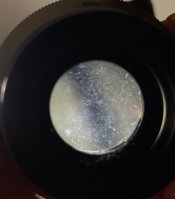
The attached photos are of the lens from a camera in another thread of mine, a Nikon S2 with Carl Zeiss Sonnar 50mm f/2. But since this question may have more wide-reaching readership, I decided to give it its own thread. Today I disassembled the lens for cleaning because it was obviously dirty down in there. When I got through, not only was there no change, but possibly even worse. I used my tried-and true method of cotton Q tips and alcohol, because it has worked so well for me in the past.
Looking down into my newly cleaned lens, it appears as crystal clear as can be. I can see the aperture blades and everything looks clear as a bell. But looking AT the glass from other angles and it looks like this. Examining the glass with a magnifier shows no build up, etching, or anything obvious. But here it is, and cannot be cleaned. Ideas? Remedies? Thank you.
Yes, looks like a case f fungus.Try cleaning with a 5% solution of hydrogen peroxide prior to cleaning with alcohol.
 
I've got an old Canon FL 100mm lens I paid ten bucks for on line, and it showed up with heavy fungus damage.

But F me, that lens is like god's own diffusion filter. Just gorgeous, not too over the top, just-right, with sort of a muted Rembrandt-ey color rendering. Love that thing.
 
That is ugly- but as others stated, you might try using the lens with a Hood.
Acetone will damage plastic parts, and will make paint run. Be careful of using it around the black paint used on the glass to reduce reflections.
 
If Ultra-Brite toothpaste didn't take it off, which it didn't, this lens is done. Life is too short for playing around, experimenting, or special use adaptation. It's nothing but a parts lens as far as I'm concerned. And since it will cost $150+ for a replacement Nikon Lens, on top of the 320 I already have in it, then the body goes on ebay. I'm not going to have some rangefinder camera laying around the house with $500 in it. There's far too many other pressing needs for that money. You win some and you lose some.
 
Photrio.com contains affiliate links to products. We may receive a commission for purchases made through these links.
To read our full affiliate disclosure statement please click Here.

PHOTRIO PARTNERS EQUALLY FUNDING OUR COMMUNITY:


Ilford ADOX Freestyle Photographic Stearman Press Weldon Color Lab Blue Moon Camera & Machine
Top Bottom
