• Welcome to Photrio!
    Registration is fast and free. Join today to unlock search, see fewer ads, and access all forum features.
    Click here to sign up

Leaving Paper developer in trays overnight?

Temporary Jewels

H
Temporary Jewels

  • 1
  • 0
  • 30
Horicon Marsh-5

A
Horicon Marsh-5

  • 2
  • 0
  • 85

Recent Classifieds

Forum statistics

Threads
201,255
Messages
2,821,261
Members
100,622
Latest member
zerzig
Recent bookmarks
0

hoffy

Member
Allowing Ads
Joined
Jan 21, 2009
Messages
3,073
Location
Adelaide, Au
Format
Multi Format
Howdy,

For the last 3 weekends, its happened each time. The kids and the wife head to bed and I head to the darkroom. Tonight I managed to spend 5 hours (of which half of that was used to clean the head of my enlarger, but thats a post for another thread at another time :mad:).

Anyhow, I know that tomorrow morning when I struggle out of bed, I will probably spend quite a few hours more in there.

Being the ever diligent person I am, I have read the data sheets for the paper developer (Ilford Multi purpose) and have kept it for a "working day" (which in my language equates to 8 hours), which means a new batch at night and a new batch in the morning.

Am I being over the top? Should I keep the previous nights batch of developer and re-use the next day? Would it need to be bottled, or could I leave it in the tray?

Any advice would be welcome!

Cheers
 

Anon Ymous

Member
Allowing Ads
Joined
Feb 7, 2008
Messages
3,675
Location
Greece
Format
35mm
I haven't done any serious testing to see the actual life of the working solution, but I find it very pessimistic. Whatever you chose to do, don't leave it in the tray. Put it in a bottle. It will oxidise at a much slower rate, because of the much smaller surface that is exposed to the air. Washing the trays doesn't take that much, does it?
 

Karl_CTPhoto

Member
Allowing Ads
Joined
May 14, 2009
Messages
39
Format
Medium Format
I've seen the adjustable-volume (accordion thingie) bottles used at college darkrooms with excellent success.

Do NOT leave the developer out when it is not in use. It will start to noticeably oxidize in as llittle as two hours out with a U.S. Qt. size that I usually use (~950mL).

So the smaller solutions can even be poured in a bottle when you go on a break or are counting paper or processing film or something.

The more surface area (8x10" trays oxidize much more slowly than say a 16x20" tray with similar amounts of solution) and the higher the dilution, the quicker the oxidation.

Also, though, sloshing them around in bottles causes oxidation too, so don't make too many dumps back into a bottle either.

I always use a graduated cylinder for RA-4 tray processing, and dump the developer back in before it reaches capacity and replenish. Then I'll just use the bottom of a 10-L RA-4 Kodak kit, I think the part A bottle as a make shift floating lid.

A similar approach would probably produce just-as-consistant results with Dektol or the like, although it is time consuming if you are running a lot of prints through to have to constantly replenish.

I think I was using a 4-L Paterson cylinder, or maybe it was a 2- or 2.5L variety, I forget.
 

Photo Engineer

Subscriber
Allowing Ads
Joined
Apr 19, 2005
Messages
29,018
Location
Rochester, NY
Format
Multi Format
I have run tests to stress paper developers and find that many of them keep well for up to 24 hours with little use or an in-between time with some use due to the seasoning factor. Some developers will keep in covered trays for days at a time.

I have not tested your particular developer, but I have tried to design developers aimed at high capacity and long tray life and find that this is possible to do. The only way to find out if your developer will last is to do the open tray or covered tray test for a day or two.

PE
 

Karl_CTPhoto

Member
Allowing Ads
Joined
May 14, 2009
Messages
39
Format
Medium Format
While I agree with PE that developers can last overnight, or even longer than that, I find it better to store them stoppered. While some will keep working with just a tray covering, there definitely is a level of exhaustion that is noticeable, and caused frustrating print exposure inconsistancies that ultimately just waste your time and paper.

If you have an adjustable volume bottle, why not use a method that will work consistantly every time (unless the damned bottle starts leaking which, of course, has never happened to me ;-) )?
 

Monophoto

Member
Allowing Ads
Joined
Aug 27, 2004
Messages
1,689
Location
Saratoga Spr
Format
Multi Format
How much developer are you mixing for a processing cycle?

I use a liquid concentrate (Sprint - mixes 1:9). 3 ounces of the concentrate gives me about 30 ounces of working solution - more than enough to cover a print in my processing tray, and coincidentally, enough to exhaust at about the same rate that I do. So when I get tired after 3-4 hours of printing, the developer is also starting to approach exhaustion and I don't feel at all guilty about dumping it.
 

Rick A

Subscriber
Allowing Ads
Joined
Mar 31, 2009
Messages
10,007
Location
Laurel Highlands
Format
8x10 Format
I've had good luck floating plastic cling wrap, also , years ago I used to place sheet glass on my trays. Depending on how full your trays are, you can stretch the cling wrap over the trays. This works best with FRESH chems, I wouldnt do it if you plan on several days of printing. Now days I have bottles marked just for mixed (working sol)developer and return to the bottle when finished. I also keep track of how many prints I process and mark it on the label.
Rick
 

archphoto

Member
Allowing Ads
Joined
Dec 14, 2008
Messages
960
Location
Holland and
Format
4x5 Format
I would put the chemicals into bottles any time you don't use them !

Leaving it in the tray's causes a damp atmosphere in you darkroom: rust in/on your enlarger and fungus in your lenses !!!!

You can make use of "floating lids" on your tray's, this will prevent evaporation and detoriation of your chemicals.

Peter
 

OMU

Member
Allowing Ads
Joined
Oct 23, 2007
Messages
743
Location
Norway
Format
Multi Format
I have used Ilford Mulitgrade developer for years and have left it over night in the trays several times without notisting any differens the day after. But I suppose it will be exausted sooner when I use it that way.

Now I have bought more trays at the same size that I have from before and uses them as floting lid. And thet works fine. I have used the same developer for up to tre days. (Sorry for my english)

OM
 

Sirius Glass

Subscriber
Joined
Jan 18, 2007
Messages
50,728
Location
Southern California
Format
Multi Format
My trays are too large to pour the chemicals back into the bottles or to cover with plastic wrap. I leave them exposed overnight and start up early the next morning. Sometimes the developer goes bad overnight; other times there appears to be not change. Since my dry darkroom is a bedroom and the wet darkroom is a bathroom, I am not concerned about the effects of the chemicals on the enlarger or the dryer.

Steve
 

ricksplace

Member
Allowing Ads
Joined
Jan 22, 2006
Messages
1,561
Location
Thunder Bay,
Format
Multi Format
I often leave the chems in the trays at night if I am going to continue to work in the morning. I've never had a problem. I have left chems in the trays for at least 24 hours and the developer still worked fine. I use Dektol 1:2.
My darkroom is in the basement and rarely gets over 20C even in the middle of summer.
 
Last edited by a moderator:

CBG

Member
Allowing Ads
Joined
Nov 21, 2004
Messages
889
Format
Multi Format
To make a floating lid; plexi or similar would work; PVC too. Stainless if you want bragging rights - but then you may need stainless trays to go along with it. Maybe you should say with plastic.
 

Blackknight603

Inactive
Allowing Ads
Joined
Jun 20, 2009
Messages
9
Format
4x5 Format
I've seen the adjustable-volume (accordion thingie) bottles used at college darkrooms with excellent success.

Do NOT leave the developer out when it is not in use. It will start to noticeably oxidize in as llittle as two hours out with a U.S. Qt. size that I usually use (~950mL).

So the smaller solutions can even be poured in a bottle when you go on a break or are counting paper or processing film or something.

The more surface area (8x10" trays oxidize much more slowly than say a 16x20" tray with similar amounts of solution) and the higher the dilution, the quicker the oxidation.

Also, though, sloshing them around in bottles causes oxidation too, so don't make too many dumps back into a bottle either.

I always use a graduated cylinder for RA-4 tray processing, and dump the developer back in before it reaches capacity and replenish. Then I'll just use the bottom of a 10-L RA-4 Kodak kit, I think the part A bottle as a make shift floating lid.

A similar approach would probably produce just-as-consistant results with Dektol or the like, although it is time consuming if you are running a lot of prints through to have to constantly replenish.

I think I was using a 4-L Paterson cylinder, or maybe it was a 2- or 2.5L variety, I forget.

While I agree with PE that developers can last overnight, or even longer than that, I find it better to store them stoppered. While some will keep working with just a tray covering, there definitely is a level of exhaustion that is noticeable, and caused frustrating print exposure inconsistancies that ultimately just waste your time and paper.

If you have an adjustable volume bottle, why not use a method that will work consistantly every time (unless the damned bottle starts leaking which, of course, has never happened to me ;-) )?
 

RalphLambrecht

Subscriber
Allowing Ads
Joined
Sep 19, 2003
Messages
14,862
Location
K,Germany
Format
Medium Format
Howdy,

For the last 3 weekends, its happened each time. The kids and the wife head to bed and I head to the darkroom. Tonight I managed to spend 5 hours (of which half of that was used to clean the head of my enlarger, but thats a post for another thread at another time :mad:).

Anyhow, I know that tomorrow morning when I struggle out of bed, I will probably spend quite a few hours more in there.

Being the ever diligent person I am, I have read the data sheets for the paper developer (Ilford Multi purpose) and have kept it for a "working day" (which in my language equates to 8 hours), which means a new batch at night and a new batch in the morning.

Am I being over the top? Should I keep the previous nights batch of developer and re-use the next day? Would it need to be bottled, or could I leave it in the tray?

Any advice would be welcome!

Cheers


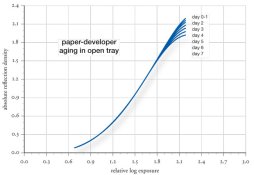
I have tested this with Dektol 1+2 and got the same results Dr. Henry published in his book. The developer shows no significant sign of aging for a couple of days, after which, the achievable Dmax starts to suffer. See the attached file with my test results. However, I agree with others who have recommended to pour the developer back into the bottle after printing. For one, it can't hurt and the darkroom will smell better the next morning.
 

Attachments

  • AgingDektol.jpg
    AgingDektol.jpg
    34 KB · Views: 133

Blackknight603

Inactive
Allowing Ads
Joined
Jun 20, 2009
Messages
9
Format
4x5 Format
Ralph, are you sure there is *no* deterioration at all?

When the developer oxidizes (turns brown) there has to be some loss of action, as the brown is the benzene compounds going bad.

With Dektol 1:2 in a U.S. Qt (950 mL) quantity, I think 1:2 is the dilution I usually use, it'll definitely be brown at the end of an 8-hour workday.

So, unless you are replenishing chemistry, I would think that for optimal consistancy, you would *have* to bottle it to avoid this, even over the course of a single day.

Air flow will have an effect on this though, of course, but as long as there is oxygen in the air, the process will be ongoing.
 

Photo Engineer

Subscriber
Allowing Ads
Joined
Apr 19, 2005
Messages
29,018
Location
Rochester, NY
Format
Multi Format
My data agrees with Ralph's post, and I can better it with a simple cover on the tray. Then again, I have been able to better that by mixing my own developers which have up to 4x the capacity or tray life of the example that Ralph's data shows!

PE
 

RalphLambrecht

Subscriber
Allowing Ads
Joined
Sep 19, 2003
Messages
14,862
Location
K,Germany
Format
Medium Format
Ralph, are you sure there is *no* deterioration at all?

When the developer oxidizes (turns brown) there has to be some loss of action, as the brown is the benzene compounds going bad.

With Dektol 1:2 in a U.S. Qt (950 mL) quantity, I think 1:2 is the dilution I usually use, it'll definitely be brown at the end of an 8-hour workday.

So, unless you are replenishing chemistry, I would think that for optimal consistancy, you would *have* to bottle it to avoid this, even over the course of a single day.

Air flow will have an effect on this though, of course, but as long as there is oxygen in the air, the process will be ongoing.

I'm not a chemist, so, I don't know what it really means for the developer to turn brown, but I do know that the color of the developer is little indication of its capability. Maybe oxidation doesn't affect developing power as much as it changes color. Dektol, for an example, changes its color very quickly after it has been prepared. However, even after it has turned into a brown 'soup', it still develops the print perfectly.

In theory, there is a small change in Dmax after the first day. In practice, this isn't an issue for several days. Dmax deterioration is hard to detect without a densitometer, and my tests show that highlight and midtone contrast is not affected for days. I never replenish developers. I discard it after my emergence time has gotten too long for 6x factorial development or the smell got to me. Through my development technique, Dmax loss is almost non-existing.

I still pour my developer back after use, but I don't think it's a big issue if one doesn't.
 

Blackknight603

Inactive
Allowing Ads
Joined
Jun 20, 2009
Messages
9
Format
4x5 Format
Thanks for your expansion.

I've never carried it past one day, but wouldn't you then have to deal with evaporation too?

I remember trying browned developer once I'd left out overnight, and I seem to remember that it had deteriorated though.

Probably depends on quantity, air quality, humidity, and temperature.
 

Anscojohn

Subscriber
Allowing Ads
Joined
Dec 31, 2006
Messages
2,704
Format
Medium Format
Howdy,

For the last 3 weekends, its happened each time. The kids and the wife head to bed and I head to the darkroom. Tonight I managed to spend 5 hours (of which half of that was used to clean the head of my enlarger, but thats a post for another thread at another time :mad:).

Anyhow, I know that tomorrow morning when I struggle out of bed, I will probably spend quite a few hours more in there.

Being the ever diligent person I am, I have read the data sheets for the paper developer (Ilford Multi purpose) and have kept it for a "working day" (which in my language equates to 8 hours), which means a new batch at night and a new batch in the morning.

Am I being over the top? Should I keep the previous nights batch of developer and re-use the next day? Would it need to be bottled, or could I leave it in the tray?

Any advice would be welcome!

Cheers
********
You can float Saran Wrap over the developer, smoothing it to get the air bubbles out and you'll be o.k.
 

RalphLambrecht

Subscriber
Allowing Ads
Joined
Sep 19, 2003
Messages
14,862
Location
K,Germany
Format
Medium Format
Thanks for your expansion.

I've never carried it past one day, but wouldn't you then have to deal with evaporation too?

I remember trying browned developer once I'd left out overnight, and I seem to remember that it had deteriorated though.

Probably depends on quantity, air quality, humidity, and temperature.

That's an interesting side point. After I pour the developer back into the bottle, I always fill it back up to the rim with fresh water to make up for the loss in volume due to evaporation. I don't know if this helps or hurts with anything, but it's a habit of mine.

From other tests I have seen that small changes in dilution do not affect print densities, and large changes in dilution are compensated by factorial development again. I strongly suggest factorial development for many reasons of change in developer activity. It does wonders for print consistency.
 

Blackknight603

Inactive
Allowing Ads
Joined
Jun 20, 2009
Messages
9
Format
4x5 Format
That's an interesting side point. After I pour the developer back into the bottle, I always fill it back up to the rim with fresh water to make up for the loss in volume due to evaporation. I don't know if this helps or hurts with anything, but it's a habit of mine.

From other tests I have seen that small changes in dilution do not affect print densities, and large changes in dilution are compensated by factorial development again. I strongly suggest factorial development for many reasons of change in developer activity. It does wonders for print consistency.

Sorry, I have never heard of factorial development; what is it?

As for filling back up to top, that'll make up for evaporation, but it might *overdo* it when you consider that there is liquid carried out by the prints. Over two or three days it'd definitely be noticeable.

From my RA-4 tray days, I noticed that about half a fluidounce (~15mL) got carried out with each 8x10 in an, I think, 11x14" tray.

And, I think that level of dilution, assuming you do it a quart at a time too, would matter because the difference in dilution between a 32 fl. oz. of Dektol 2:1 and 3:1 is only 1-1/3 fluid ounces (although there is, of course 4 fl. oz. more Dektol)
 

Sirius Glass

Subscriber
Joined
Jan 18, 2007
Messages
50,728
Location
Southern California
Format
Multi Format
********
You can float Saran Wrap over the developer, smoothing it to get the air bubbles out and you'll be o.k.

Thanks, I will try that.

Steve
 
Photrio.com contains affiliate links to products. We may receive a commission for purchases made through these links.
To read our full affiliate disclosure statement please click Here.

PHOTRIO PARTNERS EQUALLY FUNDING OUR COMMUNITY:


Ilford ADOX Freestyle Photographic Stearman Press Weldon Color Lab Blue Moon Camera & Machine
Top Bottom